



TOP STORY
Asunción’s Amazing Architecture
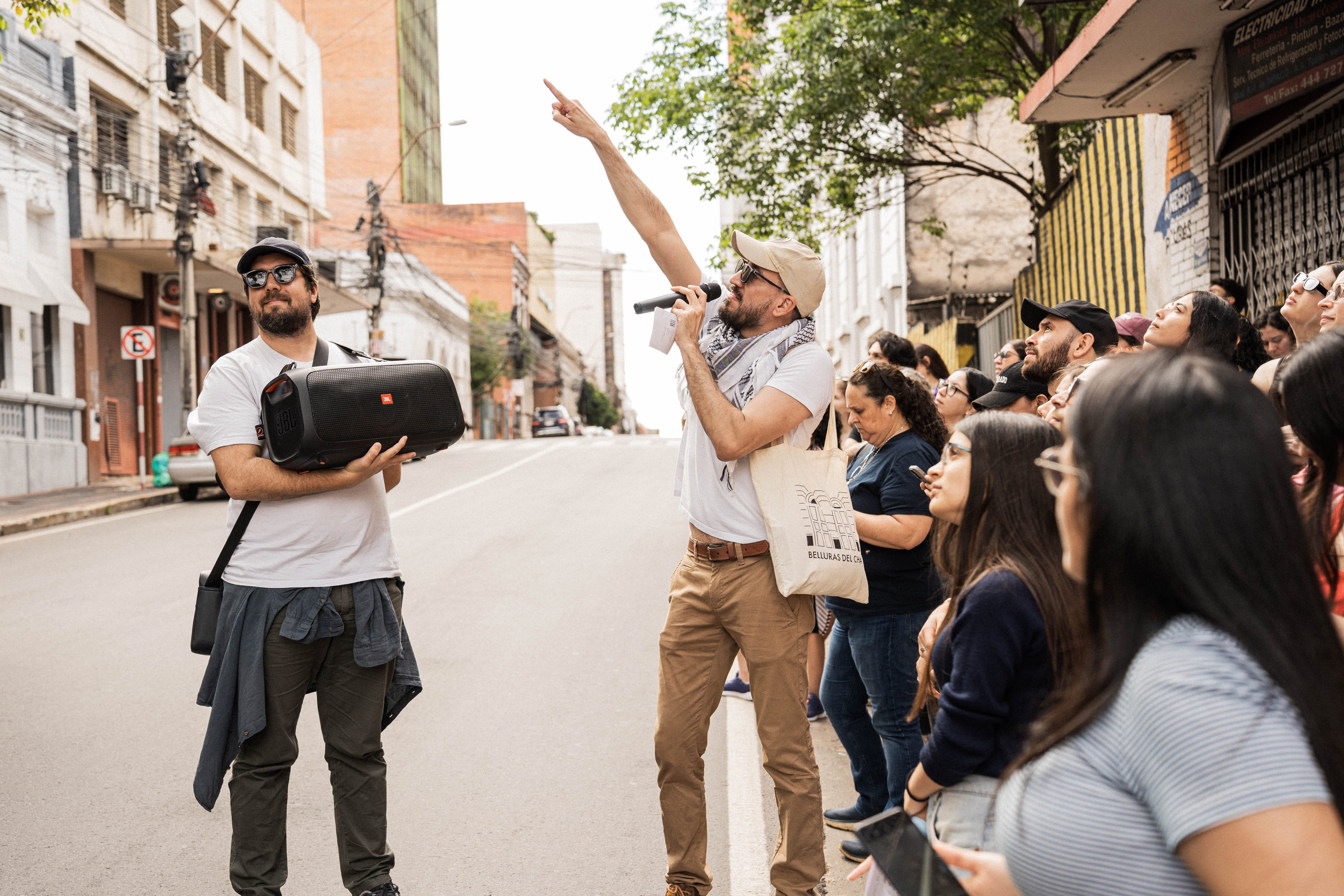
Juan Manuel Talavera and Agustín Albornoz lead a hundred people through the shabby streets of downtown Asunción, navigating potholes, honking buses, fetid corners used as public lavatories and kerbs that crumble underfoot.
They pause outside the Diplomatic Academy, a honeycomb-yellow palazzo whose balustraded balcony is flanked by two ugly modern edifices. The door is open, so Talavera, an art historian, ushers the crowd inside: “Easier to ask forgiveness than permission.”
We cross a floral-tiled floor into a courtyard with Tuscan columns supporting a rippling Catalan Vault. “Fancy as fuck,” Talavera clucks in appreciation, pointing out the marble slabs topping the window-ledges and lining the stairs at the entrance. “It’s giving coquette.”
The tour on a recent Saturday was the latest outing by Belluras del CHA. Created in 2023 by Talavera and Albornoz, an architect from Uruguay, the initiative encourages locals to rediscover the eclectic architecture of the Paraguayan capital’s neglected historic centre.
The millennial duo behind Belluras — whose name is a nod to a 2016 viral video — are appreciative but irreverent, unafraid to point out the eccentric and sometimes-sombre backstory of local landmarks.
First up is the Hotel Guaraní, a triangular edifice overlooking the capital’s main square. Inaugurated by dictator Alfredo Stroessner in 1961 after an international design competition won by a Brazilian architectural studio, it belongs to the rationalist school, an evolution of Bauhaus.
“They declared war on decoration,” says Talavera, his voice echoing around the cavernous lobby. “A wall is a wall, a door is a door.” But the monumental marble slabs also had propaganda value, buttressing the regime’s claim to be bringing peace and progress. “It was a postcard of Paraguay to show that we weren’t such a jungle,” the historian explains.
As the middle classes posed for photographs outside, visiting luminaries like Ayrton Senna, Isabel Sarli, Charles de Gaulle and Prince Philip quaffed cocktails by the pool. “It’s a pleasant change” — the British royal reputedly remarked — “to be in a country that isn’t ruled by its people.”
Across the road lies the Banco Nacional de Fomento, loosely inspired by Buckingham Palace, with four Ionic columns supporting a Palladian façade. The headquarters of Paraguay’s national development bank, it was built in 1942, complete with inlaid bronze spittoons for tobacco. Talavera recommends we return during the week to peek inside: “Don’t take photos, because they might get suspicious.”
Around the corner, we come to the Hotel Hispania: a storied jewel of Catalan architecture shuttered since 2001 and left to decay. “This is one of my favourite buildings in the centre, but it’s one of those that is suffering the most,” Talavera explains.
Girders have been stapled to the elaborate columns, reminiscent of la Sagrada Familia. A For Sale sign hangs beneath barbed wire. Saplings sprout behind the rusting railings. A corrugated iron roof has been erected over the wreck: not the beginning of a rescue, but rather as if entombing a corpse. “It’s a tragedy,” Talavera sighs.
A 2016 law requires owners to look after historical buildings. But Asunción’s elites now live in penthouses in the business district out east, or mansions in gated communities. Many landlords, Talavera explains, are waiting for their properties to collapse so they can sell the plots to developers: “Whoops! Oh well,” he mimics. “Let’s put in a gas station or a Biggie.”
The popular chain of 24-hour convenience stores and Shell, Petrobras, and Enex forecourts seem to have sprung up on every other block. The city has gained petrol stations — with 188 in 2026, up from 171 in 2023 — while steadily losing residents to the suburbs. The population fell to 462,000 people in 2022: down 10 percent from the turn of the millennium.
We stop to take in the Escuela Básica Celsa Speratti, its lions and Corinthian columns almost obscured by power lines and foliage. (The Post lived next door for years but barely noticed it). Today’s roster also includes the Casa Argaña, the Colegio Dante Alighieri, and the Paraguayan Episcopal Conference, some of them more faithfully maintained than others.
“As a kid, I used to explore abandoned houses,” says Sofi Moscarda, a graphic designer who helps organise Belluras del CHA. Getting insider access to palaces previously kept behind lock and key, she says, “is a dream come true.”


The afternoon’s final beauty is the Iglesia de la Encarnación: a soaring, semi-classical church dating to 1893, topped with a monumental cupola and made almost entirely from Paraguay’s characteristic red bricks.
This is the sixth iteration of a church founded by the conquistadors and destroyed in a 1543 fire, the guides explain: making it the oldest parish in the Río de la Plata region. Legend tells the latest location, on one of the capital’s highest points, was decided after surveyors smelt incense.
Inside are carved wooden confessionals and a baby-blue vaulted ceiling, hung with a dozen chandeliers and painted with the Virgin Mary at the moment of the Incarnation. Arching around stained-glass windows is a made-to-measure organ, used to play guaranías for the wounded when the nave served as a hospital during the Chaco War (1932-35).
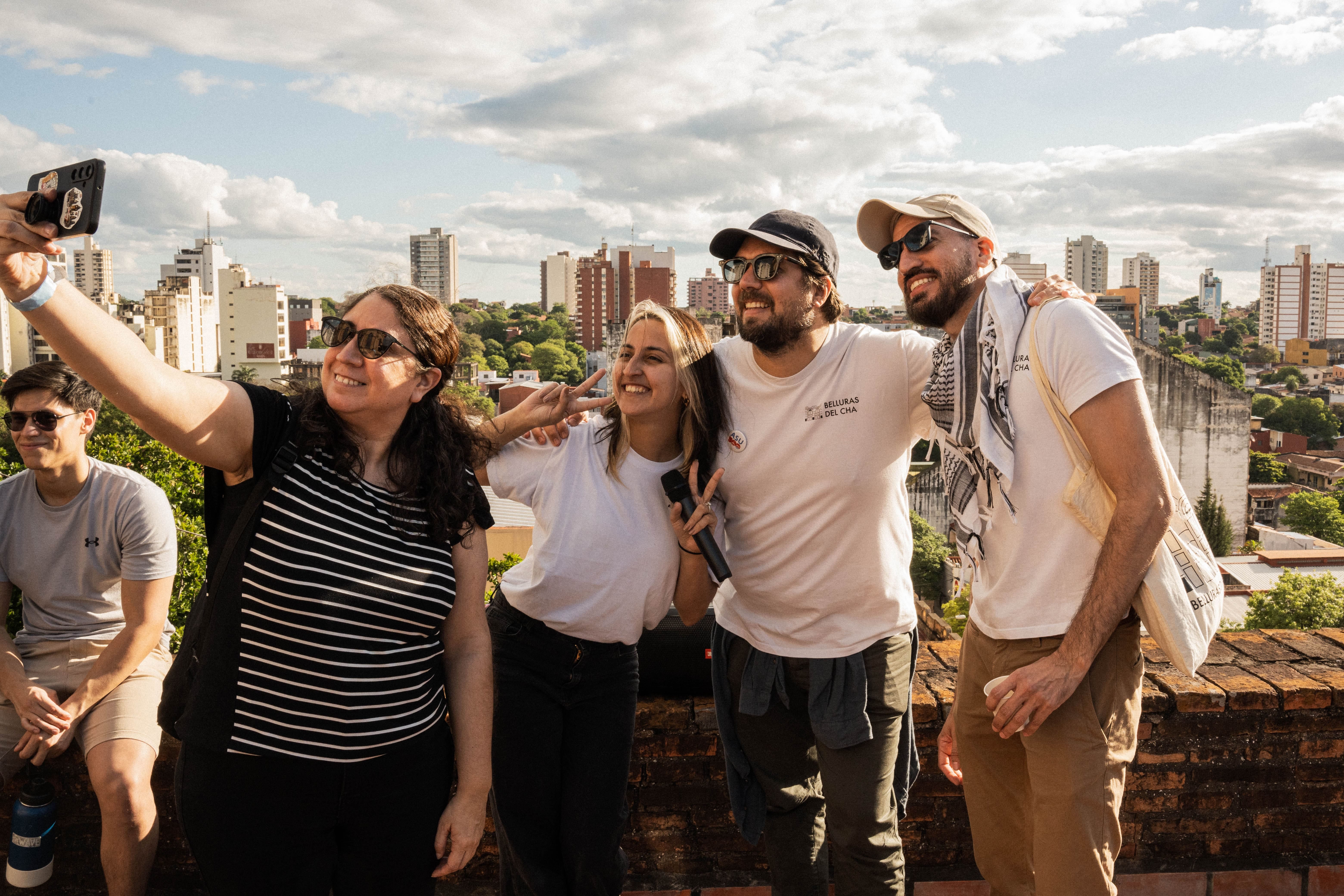
Our party slips behind the altar and up a winding staircase, surfacing on a flat, cruciform roof that offers an up-close peek at the carved floral motifs on the dome. Over coffee, cookies and chipa — served by friends of the Post Café Contacto — the group poses for photos and takes in the sweeping views.
Nearby, roof tiles, turn-of-the-century ruins turned into car parks, and overgrown patios slope down to the Paraguay River. In the distance, a thicket of cranes and new cement skyscrapers with names like Soho, Petra and Park Lofts Tower: part of a building frenzy largely catering to Argentine and Brazilian investors.
Funded by Paraguay’s cultural secretariat, Belluras has shown roughly 1500 people around Asunción’s palaces, ministries and mansions in the past three years, Talavera estimates. They’ve also organised outings to Concepción and Pilar: towns on the Paraguay River known as la Perla del Norte and la Perla del Sur respectively for their well-preserved Belle Époque architecture.
In a car-centric conurbation, the walking tour itself is political, says Albornoz, generating awareness about the state of the sidewalks and furthering the “fight for a more dignified city.” Attendees skew under 35, and roughly 90 percent come from the capital, but many have never lived downtown. The initiative seems to have tapped into a desire to look past the grime and decline to imagine what el centro could look like with a bit of TLC.
Several other initiatives are enticing people to return to the historic centre. Most Saturdays since 2024, Calle Palma hosts a bustling street fair overseen by First Lady Leticia Ocampos. The World Bank is financing efforts to revitalise a string of green spaces, including Parque Caballero: a once-fashionable promenade now known for its empty swimming pool and smashed-up statues.
Soledad Núñez, who takes office as Asunción’s new mayor next week, has promised to create a cultural district in the centre, give tax breaks to businesses that set up in the area, hand over abandoned buildings to artistic collectives, and convert others into affordable housing.
Locals “have huge affection” for Asunción, Moscarda reflects, and are yearning for an outlet to express it. More Belluras outings, as well as a series of photobooks, are on the way, she adds. “We want everyone to know how beautiful our city is.”
Also in this issue:
What Lula’s win means for Paraguay · Peña at the CIA, signs mineral deals · Strong guaraní squeezes exporters · Pressure on Central Bank boss to resign · Students asked to empathise with Hitler · Jail for promoting “gender ideology?”
Want to keep reading? Claim your trial to unlock everything, and access exclusive subscriber benefits.