



TOP STORY
Paraguay’s political pyromania
By Laurence Blair
As the autumn nights grow longer, Paraguayans look forward to San Juan Ára or St. John’s Day. Though officially celebrated on June 24, this carnivalesque festival typically reaches its peak the night before — and extends throughout the whole month.
Community celebrations often involve polka music, sack races, demonstrations of skill on horseback, mock weddings known as casamiento koygua — and deliciously greasy soul food like payagua mascada (ground-beef and spring onion fritters) and chicharõ trenzado (braided, barbecued strips of beef and pork).
But perhaps the main ingredient of San Juan Ára is fire — and lots of it.
Partygoers boot around a flaming football in a hair-raising (and hair-singing) pastime known as pelota tata. Some are known to walk over glowing coals: a test of composure and machismo as much of as of faith. Meanwhile, a two-person team inhabit the role of the toro candil — a bull’s hide and skull, complete with flaming horns — and charge the shrieking public.
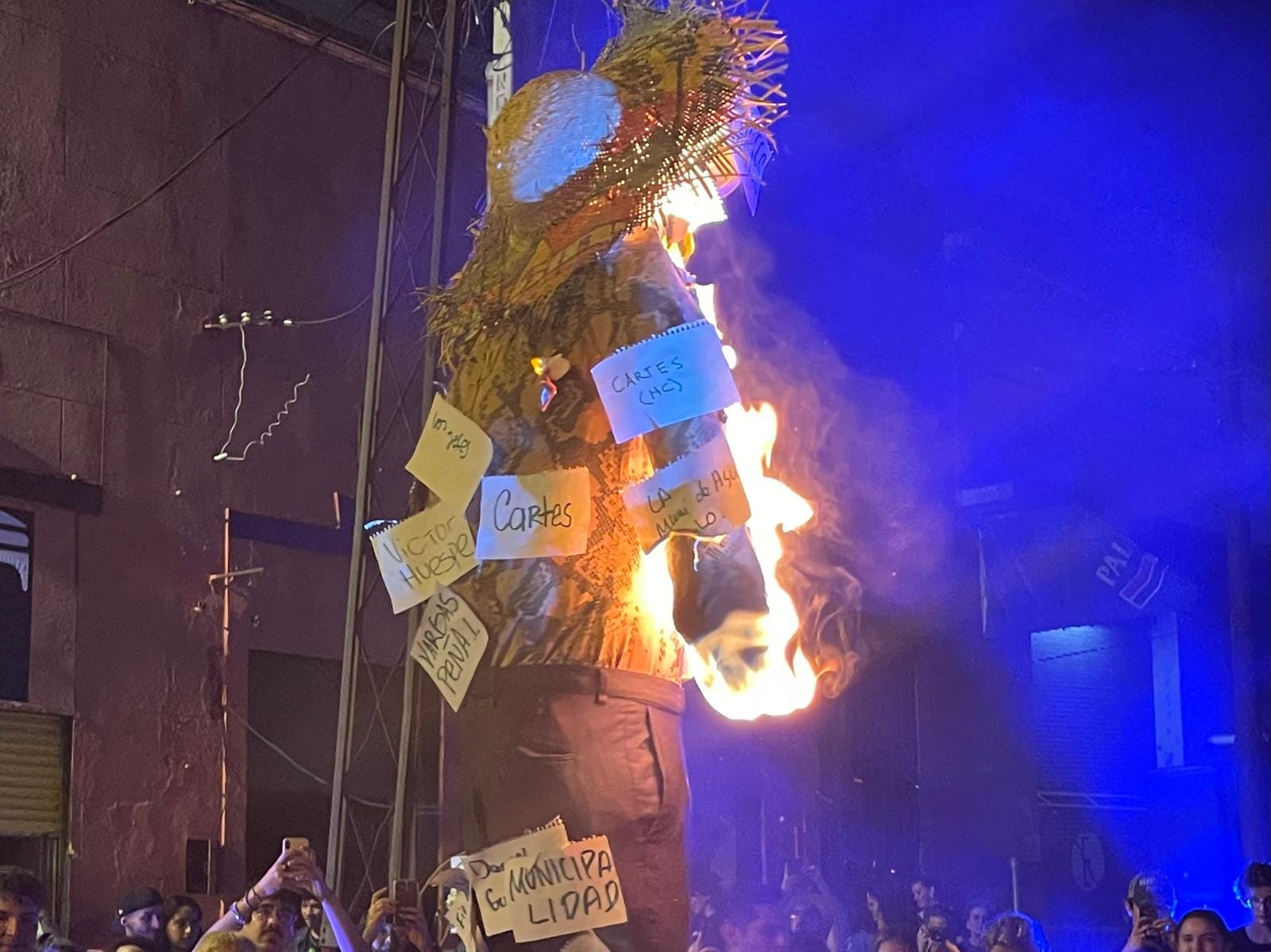
The grand finale is often the judas kái (burning Judas): a mannequin dressed to represent an unpopular figure, before being doused in petrol — and sometimes stuffed with fireworks — dangled from a tree or lamp-post, and set aflame.
The tradition has provided a welcome side-hustle for Alberto, a 58-year-old seller of medicinal herbs in Asunción’s sprawling mercado cuatro.
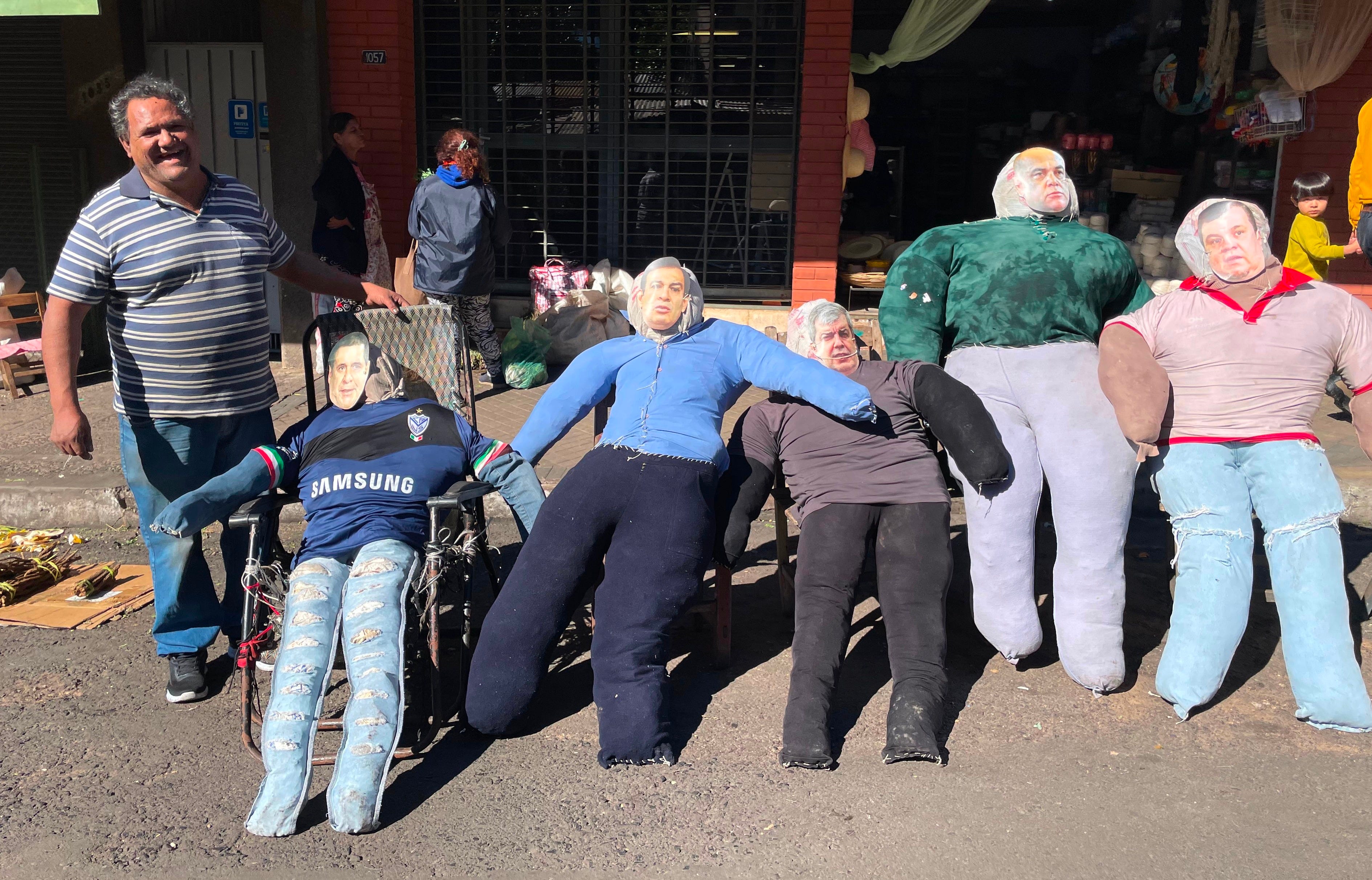
One recent lunchtime, the portly vendor parked a series of home-made dummies in deck chairs across from his market stall, fixing printed masks of politicians — mainly from the ruling Colorado Party — to their faces.
“This is trato apu’a”, he says with a grin, meaning Dirty Dealer — the nickname given to Silvio “Beto” Ovelar, an influential Colorado senator famously caught on camera buying votes at election time in 2013.
To Ovelar’s left is Interior Minister Enrique Riera: the mayor of Asunción in 2004 when a tragic blaze at a supermarket with no working fire exits killed 400 people. Riera has more recently been accused by a dissident Colorado senator of “filling his pockets” as head of the notoriously corrupt National Police.
To the right is Horacio Cartes, the powerful tobacco magnate, former president (2013-18) and current boss of the Colorado Party — a position the Biden administration claimed Cartes secured through a mass bribery scheme, imposing financial sanctions which the Trump White House later dropped.
A cable leaked from the US embassy in 2010 indicated Cartes was under DEA investigation for alleged involvement in a money-laundering and drug-smuggling scheme. “He’s a narcotrafficker,” Alberto alleges.
“We’re also going to make the referee,” he adds, meaning Salvadorean FIFA official Iván Barton, widely panned for perceived bias against Paraguay in their 1-0 nailbiter victory over Turkey last week.
At the end of the line-up is Dionisio Amarilla. A senator formerly with the Liberal Party who has consistently voted with Cartes’s Colorado faction, he has been investigated for malfeasance during his time as an administrator at the Universidad Nacional de Asunción. In 2019, he forfeited his seat over a corruption scandal involving a $23m dollar contract with the IPS public health system and an alleged attempt to bribe a journalist.
But the effigy that sells the most, Alberto says, is Basilio “Bachi” Núñez.
Núñez was accused of illicit enrichment once his wealth skyrocketed after becoming mayor of Villa Hayes, a working-class town across the river from Asunción, in 2006. As president of the senate since 2024, he has presided over the hiring of some 800 poorly qualified staffers — most of them Colorados — dubbed the bachibabies.
“He’s the most corrupt,” argues Alberto, who also hails from Villa Hayes. “He’s a thief. He’s got everything stitched up there in congress. He’s basically the president.”
Alberto’s mannequins go for 80,000 guaranies ($13) each, with a few firecrackers thrown in. He started this unusually lucrative sideline eight years ago with a simple motivation: “I don’t like thieving politicians.”
He makes one exception, however.

Asked what he thinks about Miguel Prieto — the youthful former mayor of Ciudad del Este, who threw an allegedly corrupt Colorado clan out of office, was himself unseated last year in a dubious corruption probe, and now polls as Paraguay’s leading opposition figure — Alberto sounds positively enthusiastic.
Ese co anda, he replies: “That one’s OK.”
THE POST TAKE
On the surface, that Paraguayans feel free to set fire to representations of their political overlords could serve as a feel-good fable.
“That’s democracy,” Alberto told me with a shrug, when I asked whether felt afraid about selling his flammable dummies or speaking to the press.
His wife is Cuban, he added, and has warned him that such activities on the Communist-ruled island are likely to land you in jail. Under Paraguay’s right-wing dictator Alfredo Stroessner (1954-89) — whose regional record in power was only outstripped by Fidel Castro — the retribution would have been worse.
But look a little deeper, and something stands out. Few of the judas kái on display in the Mercado 4 have faced any lasting consequences for scandals that would have been career-ending in most democracies worth the name. The few formal cases that resulted have mouldered in prosecutors’ in-trays for years. None have been formally charged, still less convicted. All deny serious wrongdoing.
Ovelar has admitted to buying votes but denied using public funds. Riera has said he holds “institutional, not penal” liability for failing to inspect and enforce safety regulations at the Ycuá Bolaños supermarket: a cop-out slammed by victims’ groups to this day. Amarilla was voted back into office in 2023 and has since headed a commission targeting the press and NGOs.
Cartes alone did two months in jail in 1989 in connection with a currency-fraud case that was later thrown out. He still controls the Colorado Party. Paraguay’s president, Santiago Peña, is often dismissed as Cartes’s puppet — and was notably absent from the selection of mannequins on offer in the market this week.
In this light, the annual burning of politically-inspired judas kái seems less like the anarchic expression of a free, egalitarian society.
Rather, it looks like an escape valve: an explosion of pent-up rage at a system where the court of public opinion is the only one that seems to function.
You’re reading The Weekly Post, your essential briefing on Paraguay.
Also in this issue:
Paraguay’s constitution, reviewed · Kattya at the OAS · Peña hikes minimum wage · Businesses warn of inflation risk · FIFA bans Paraguayan commentator · Science festival returns · Foreign firms pile in · Prisoners rebuild Tacumbú
Want to keep reading? Claim your free trial: