


TOP STORY
Beautiful game, dirty money
Believe it or not, one of the most powerful men in world football is Paraguayan.
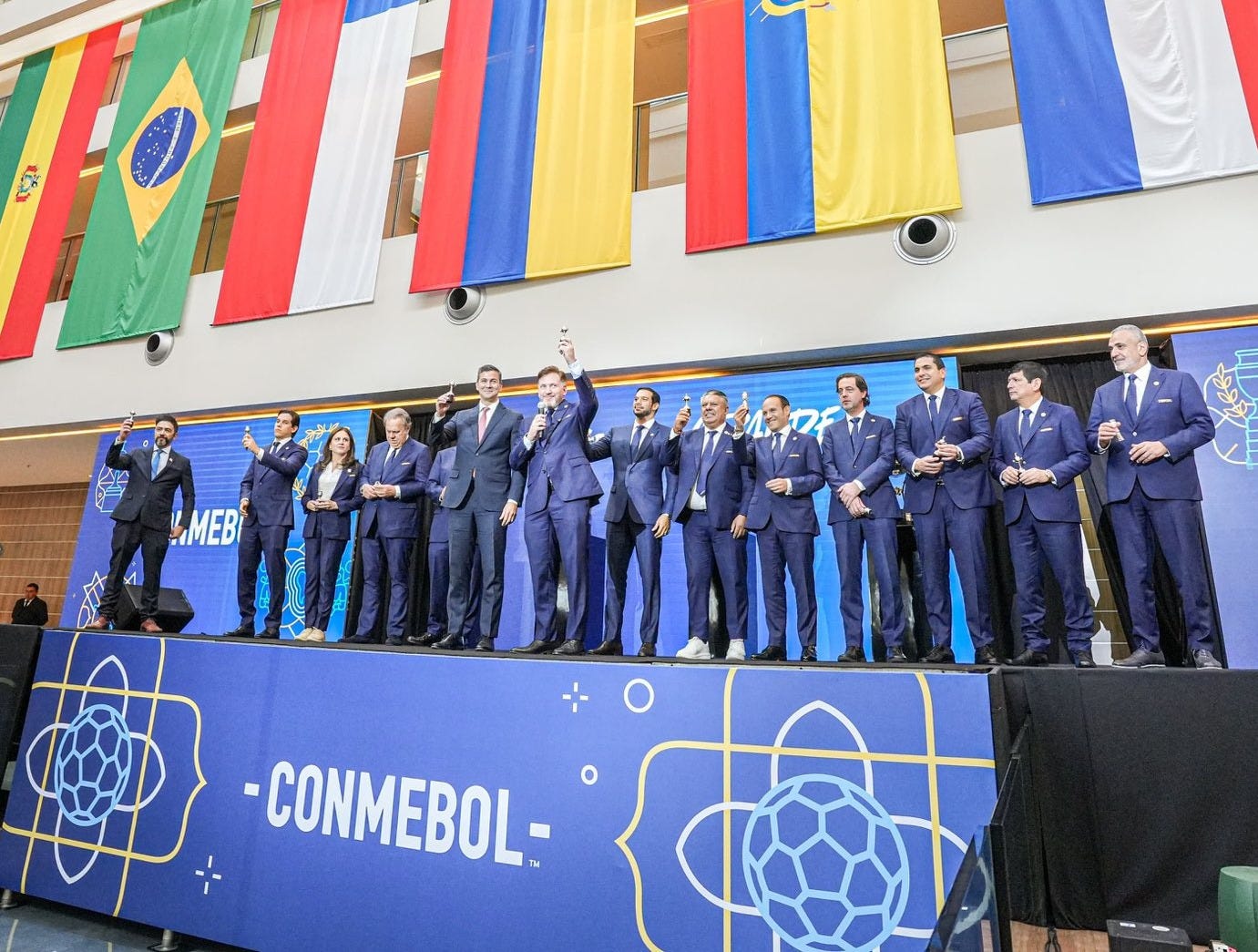
Alejandro Domínguez is not just president of CONMEBOL — the South American football confederation headquartered in Luque, just outside the Paraguayan capital, Asunción. He is also a vice-president of international soccer body FIFA and a central figure in the global game as the 2026 World Cup approaches.
That makes the latest allegations against him more than just a sports story. According to The New York Times, a FIFA whistleblower has accused Domínguez and another senior CONMEBOL official of pocketing more than $5m from money recovered after FIFAgate, a 2015 corruption scandal.
Domínguez has not been found guilty of wrongdoing; the procedural status of the complaint is unclear. But the allegation is not exactly surprising in a country where football, money, and power are even more tightly entwined than most.
In Paraguay, football clubs are prestige machines, political springboards, cosy business associations — and, at times, vehicles for laundering money and influence.
Start with Domínguez’s family. His father, Julio Osvaldo Domínguez Dibb — better known as ODD — was the legendary boss of Club Olimpia, Paraguay’s most decorated club. Under his long tenure, the magpie-striped Asunción side won three Copa Libertadores titles and the 1979 Intercontinental Cup.
Prior to their victory in the 2002 Libertadores final, according to Olimpia captain Julio Enciso, Domínguez Dibb flashed him a briefcase containing an estimated $300,000 in cash as an incentive to bring home the trophy. “With him, there were no signatures — you shook his hand,” Enciso later told local TV.
ODD was also a wealthy tobacco magnate — a counterfeiter, according to Brazilian police — and Colorado Party strongman who ran in the party’s 2002 presidential primaries and briefly presided over the ANR in 2008.
Alejandro Domínguez seamlessly followed in his father’s footsteps.
Before taking over CONMEBOL in 2016, he went from Olimpia board member to vice-president and then president of the Paraguayan Football Association. He also ran Grupo Nación de Comunicaciones, a media group founded by his father that included La Nación, Crónica, and Radio 970 AM. In 2015, Sarah Cartes, sister of then-president Horacio Cartes, acquired the group.
If the Domínguez Dibb story shows how football, media, and party politics often overlap, Horacio Cartes shows how far that combination can go. Before becoming president of Paraguay (2013-18), and later president of the Colorado Party (2023–), Cartes ran Club Libertad, one of Asunción’s major teams.
Like ODD, he made his fortune by churning out cheap cigarettes that have a strange habit of turning up all over Latin America without paying taxes. (Cartes’s representatives deny any wrongdoing, and say it’s not his responsibility what happens to his smokes once they leave the factory).
Cerro Porteño, Olimpia’s great rival, has also provided a springboard into politics. Abraham Zapag, a longtime financier of the opposition PLRA party and a presidential candidate in 1993, took over the club in the 1970s; his sons later filled his shoes. The wider Zapag Group is a major family conglomerate active in fuel distribution, river logistics, real estate — and now cellulose pulp, as the local partner of the Paracel project.
Cerro is now headed by Blas Reguera, grandson of the late Colorado caudillo Blas Riquelme, who was once also at the club’s helm. Another former Cerro president is sitting Colorado senator Luis Pettengill. President Mario Abdo Benítez (2018-23), Peña’s predecessor, even considered a run for Cerro’s leadership after leaving office.
That local pattern — football as a nexus to prestige, influence, and serious piles of cash — has a continental and global version.
In 2015, US prosecutors accused FIFA officials and marketing executives of netting more than $150m in bribes and kickbacks tied to broadcasting and marketing rights. The scandal helped bring down FIFA president Sepp Blatter and exposed CONMEBOL as one of the rotten cores of world football.
Paraguay was central to that story as home to two of the most prominent executives convicted in FIFAgate.
Juan Ángel Napout — a former Cerro Porteño, Paraguayan Football Association, and CONMEBOL president — was convicted and sentenced in 2018 to nine years in prison in the United States.
Nicolás Leoz, Napout’s predecessor and the long-serving Paraguayan boss of CONMEBOL, was also indicted by US authorities, but died in 2019 before his case went to trial.
After the scandal came the cleanup — and with it, a new fight over the money. CONMEBOL sought to recover the cash siphoned off by former bosses, including Leoz. But the new FIFA ethics complaint reported by the Times alleges that Domínguez and another official received undue bonuses from those funds.
And in Paraguay, the Leoz money trail is currently pitting two powerful economic groups against each other. On the one side, Domínguez and media aligned with Horacio Cartes. On the other, Banco Atlas, newspaper ABC Color, and their owners, the Zuccolillo business group.
THE POST TAKE
In Paraguay, football is rarely just football.
That may sound like a cliché in South America, where the sport is treated more like a religion. But in Paraguay, soccer clubs represent an unusual combination of social venues, business networks, campaign stages, prestige brands, and mass-contact platforms. Where political parties are distrusted, club loyalties can last generations.
For elite families, a football club offers something money alone cannot buy: popular legitimacy. A club president handing out trophies, signing strikers, and promising fans glory looks like a patron. That matters in a political culture where patronage is a key feature. Meanwhile, gangs of football ultras known as barras bravas often work as hired muscle during protests and organisers at election time.
The same logic helps explain why sports administrators keep turning up in politics. President Santiago Peña recently considered offering Domínguez a presidential bid in 2028. Another name in the hat to succeed Peña was Robert Harrison, from Club Nacional and the current Paraguayan Football Association boss. Camilo Pérez, the head of the Paraguayan Olympic Committee, has been tapped by Cartes’s Honor Colorado faction for the Asunción mayoral race.
Organized crime also has its uses for Paraguayan football. Sebastián Marset, the Uruguayan cocaine trafficker now in U.S. custody, famously bought — and played for — Deportivo Capiatá. Erico Galeano, the Colorado ex-senator tied to the same club, was convicted this year of collaborating with Marset’s criminal organization. Judges considered it proven that Galeano invested more than $1.6m of dirty money in Deportivo Capiatá.
The larger warning behind the Domínguez story is that FIFAgate was supposed to be a cleansing fire. CONMEBOL presented itself after 2015 as a reformed institution recovering stolen money and restoring credibility with new figures like Domínguez. Now, a whistleblower complaint reportedly alleges that recovered funds may have themselves been creamed off by current officials.
There’s a Paraguayan twist to the tale. Banco Atlas is currently being prosecuted in Paraguay for handling funds linked to Nicolás Leoz through trusts and certificates of deposit (CDA) after the FIFA scandal broke.
ABC Color claims that Domínguez and CONMEBOL are using the late Leoz and corrupt prosecutors to target Atlas — part of the Zuccolillo business group that also owns ABC — to punish the paper for investigating Domínguez.
The Cartes media ecosystem has backed CONMEBOL’s attack against Atlas, covering the case almost daily. CONMEBOL says the case is about alleged money laundering, not press freedom; Domínguez has emphasised that the accused are bankers, not journalists.
In a healthier institutional setting, those questions might be separated by independent courts, regulators and referees. In Paraguay, they collapse into the same scrum: a mix of corruption case, media war, and punch-up between rival power blocs.
For a country that sells itself as stable and business-friendly, the CONMEBOL saga is a reminder that in Paraguay, power rarely pools in Congress, the Central Bank — or even Mburuvicha Róga, the presidential residence.
To see where real influence lies, watch the football clubs: who funds them, who runs them, and who sits in the presidential box. The pitch is often where Paraguay reveals its true colours.
You’re reading The Weekly Post, your essential briefing on Paraguay.
Also in this issue: Prieto panic sets in · Paracel breaks ground · Argentine factories look north · Meat-packer feels financial squeeze · Paraguay’s new migration trends · Ysanne Gayet: 50 years in the arts · Trump’s anti-terror units · Indigenous candidate murdered
Want to keep reading? Claim your free trial here: