



TOP STORY
Paraguay’s population is aging, fast
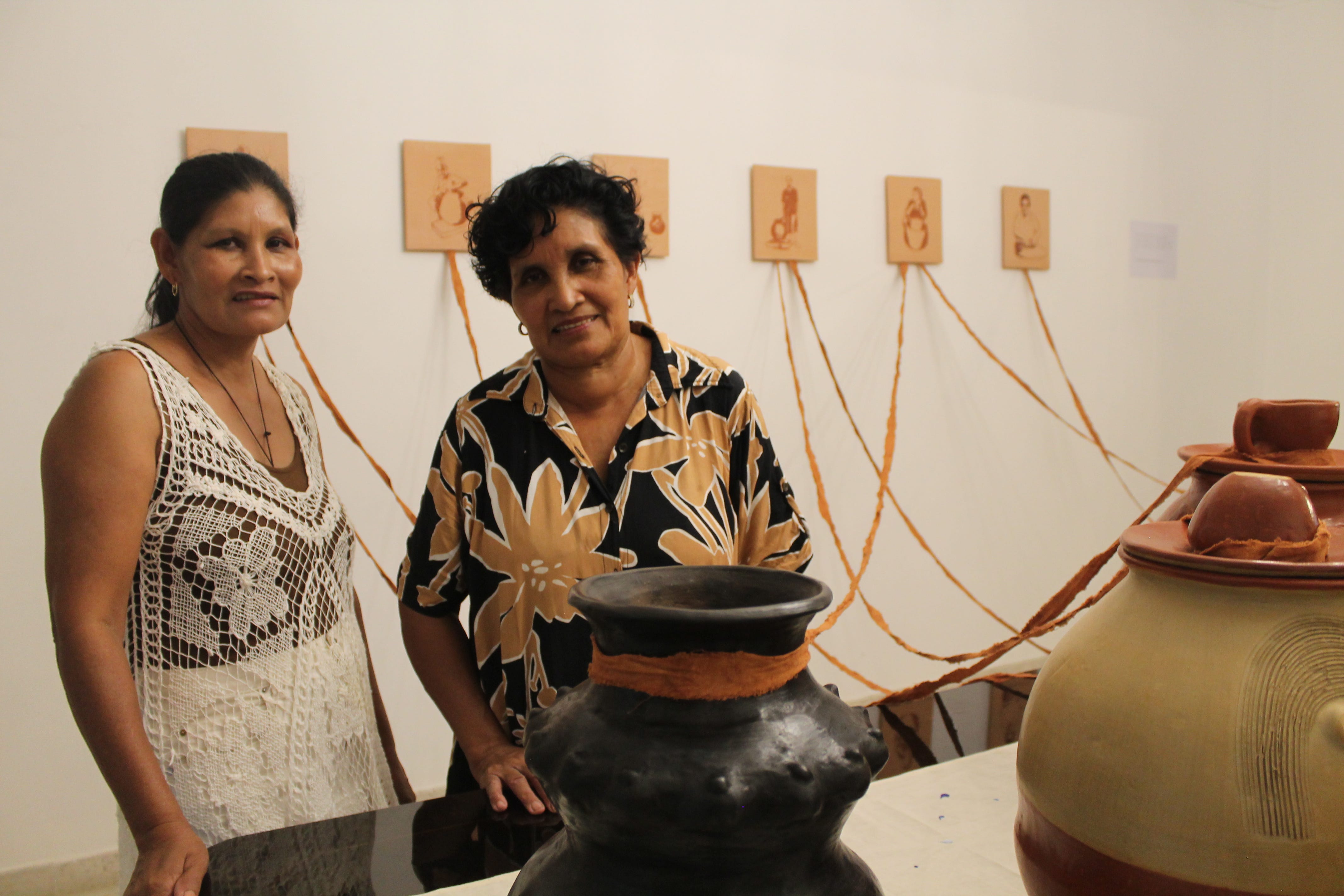
Ediltrudis and Carolina Noguera often say they were raised by clay.
Growing up in the small Paraguayan town of Tobatí — nestled in green hills around 40 miles east of the capital, Asunción — their father was typically absent with work.
Their mother, Mercedes, just about managed to put food on the table by making hand-built, wood-fired pots from ñai’ũ, the prized black earth harvested from local hillsides.
Mercedes had her work cut out: she had no fewer than 15 children.
Today, the sisters have inherited the family craft and taken it in new directions. Ediltrudis in particular has won admirers for her bulbous ceramic sculptures that have something of Colombian artist Fernando Botero to them.
But the tradition of huge, struggling families, they recently told me, was something they resolved not to continue.
Ediltrudis, 60, had eight kids. Carolina, 43, has two. And between them, they only have three grandchildren, whom they have encouraged to stay in education as long as possible before picking a trade and starting a family.
“It was my decision,” said Ediltrudis, describing how she delayed parenthood until her twenties and carefully controlled her pregnancies. “My husband had to accept it.”
The story of the shrinking Noguera family across three generations encapsulates a historical shift unfolding across Paraguay — and Latin America as a whole.
As I write for the cover story of the latest issue of Americas Quarterly, Latin America’s average birth rate has plunged — from roughly six children per women in 1950 to just 1.8 today — reflecting greater access to contraception, education and employment. Better medicine, sanitation and nutrition mean the region’s average life expectancy has increased by nearly 30 years over the same period, to 76.
The result: Latin America is aging faster than any other continent. The ranks of the elderly are expanding exponentially: where one in ten Latin Americans are over 65 today, somewhere between a fifth to a quarter will be pensioners by 2050.
This rapid demographic transition will have far-reaching consequences for economies, pensions systems, and politics, as lawmakers grapple with how to pay for the elderly when so many other pressing needs are at hand.
“The main challenge for Latin America,” Citigroup economist Ernesto Revilla told me, “is that the region will get old before it gets rich.”
The story is often framed as an issue mainly for the wealthier Latin American nations like Chile, Uruguay, Argentina or Costa Rica. It’s true that those countries have precipitously low fertility rates: that of Chile, at 1.14 births per woman, is now lower than Japan.
Paraguay (2.42 in 2024) is notionally at the other end of the table, belonging to a group of developing countries like Haiti (2.63), Bolivia (2.52), Honduras (2.48) and Guatemala (2.29) where a range of factors – including Indigenous and Afrodescendant traditions of young motherhood and large, rural households – mean that birth rates remain relatively high.
But it would be a mistake to assume that Paraguay is insulated from the regional baby bust. The country’s birth rate has nearly halved since 1990. The 2022 census found that just 6.1 million people live in Paraguay: well below estimates of 7.5m.
And Paraguay’s fertility rate is still dropping fast: the country’s national statistics institute (INE) projects a birthrate of 1.92 in 2025, below the replacement rate of 2.1. If this trend continues, Paraguay’s population will peak around 7.1m in 2050, before inexorably falling.
THE POST TAKE:
The 2022 census figure came as a shock – the economy minister said he would “basically have to plan for a new Paraguay” – but the underlying trend has been clear for decades.
Moderate improvements in education, greater access to contraception, and rural-urban migration – 68% of Paraguayans now live in cities – have all reduced the number of babies being born.
So too, say experts, has the outflow of young, working-class women to work as nannies, cleaners and carers in places like Spain, Argentina and the United States. Put another way, catering to the elderly in rich countries is accelerating Paraguay’s own demographic transition.
And especially among Paraguay’s educated middle classes, many are postponing paternity indefinitely, citing corruption, climate change and the cost of living. The Post knows one thirty-something couple who have a dozen mouths to feed: but they belong to cats, not babies.
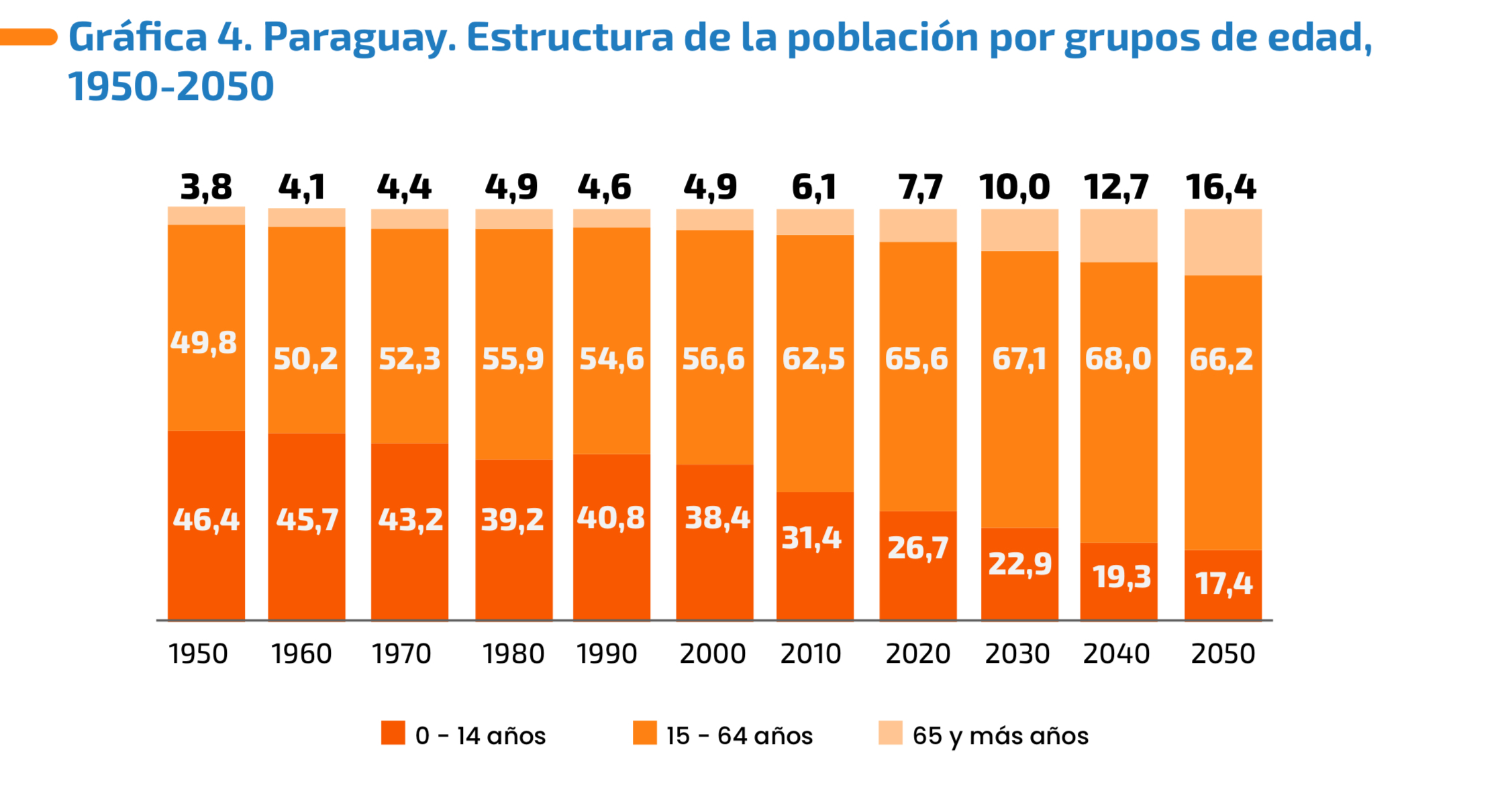
The consequence is that Paraguay’s median age has risen sharply in the past twenty years, barely increasing from 19 in 1982 to 20 in 2002, before leaping to 29 in 2022. The proportion of the population aged 65+ has also grown exponentially since the turn of the millennium, and is projected to double from roughly 8% today to 16.4% of the total by 2050.
Paraguay’s aging process is already producing political frictions. In recent months, protests and opposition in congress have forced the Peña administration to water down a controversial public-sector pension reform, one intended to plug a fiscal black hole forecast to reach $10bn by 2030.
A new paper by CADEP notes that even with the reform, a serious pensions crisis has been delayed until 2032 at most. IPS, the social welfare and public health system, is also projected to go bust later in the same decade.
And many people qualify neither for the IPS or other contributory pension funds (because they don’t earn minimum wage) nor the Adultos Mayores welfare pension (because they’re not below the poverty line).
In a country where pre-teen mothers remain shockingly common, it can only be a positive thing that more young women and girls are enjoying greater control over their bodies and lives.
But as the population turns grey, the urgent priority should be helping Paraguayans gain skills, get formal jobs, and save for their retirement. In December, UN population expert Sabrina Juran warned that Paraguay’s “window of opportunity” to make the most of its relatively youthful population is rapidly closing.
Paraguay, most serious economists agree, will also need to rethink its flat 10% tax rates – along with generous exemptions for soybean farmers, real estate developers and factory-owners – to help fund the pensions and care systems of tomorrow.
The country currently spends barely 4% of GDP on social protection for the elderly, compared with 8% in Brazil and 11% in Uruguay: partly reflecting a feeble tax take of just 11.4% of GDP.
Yet strong vested interests, and a chronically short-term political cycle – the 2028 election is already dominating headlines – are likely to get in the way of a serious discussion about how Paraguay can age with dignity.
Welcome back to The Weekly Post, your essential briefing on all things Paraguay.
Also in this issue:
Colombian attack ads · Journalists targeted · Debt interest payments soar · Chaco pipeline stalls · Albirroja flick · Roa Bastos in Europe · Paraguay’s poorest district · Louis Vuitton versus Paraguay’s forests · Deadly neglect in prisons
Want to keep reading? Claim your free trial — and unlock exclusive Insider Insight.