


TOP STORY
Defending the Médanos del Chaco
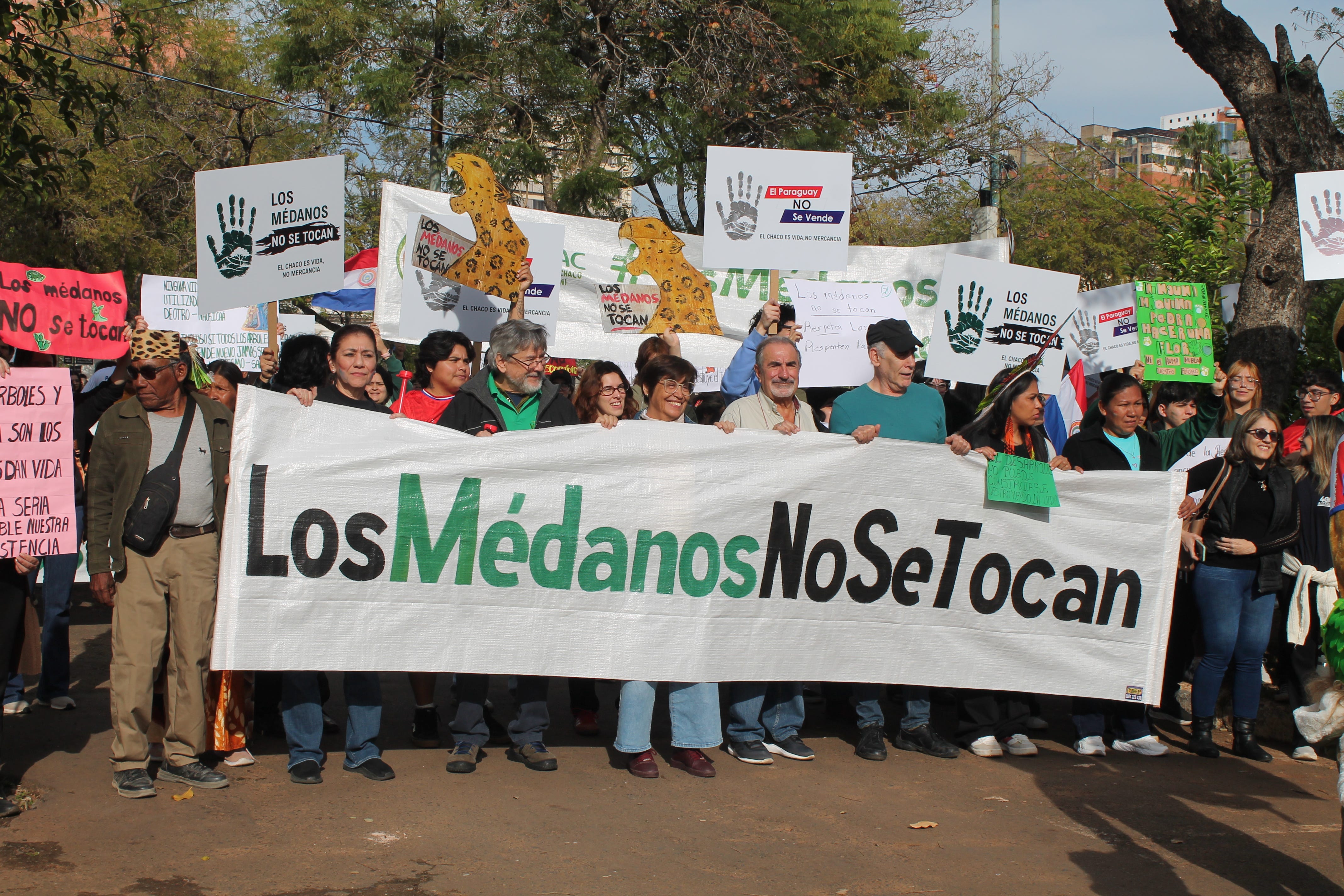
Hundreds of demonstrators marched through Paraguay’s capital, Asunción, on Tuesday to protest new plans to open the Médanos del Chaco National Park to drilling for oil and gas.
A young crowd convened by the #PorLosBosques coalition of eighty non-profits gathered downtown and posed for photos before continuing on to congress. Protesters carried signs reading “Paraguay is not for sale” and “Hands off the Médanos.”
“The Paraguayan state needs to protect our national park,” said Isabelino Bogado of the Guaraní Ñandéva people. He said his community, Pykasu — which lies inside the reserve — had not been consulted about the plans.
At stake is the Médanos del Chaco National Park, a remote reserve 400 miles from Asunción encompassing six thousand square kilometres of dry scrub and rare wildlife — including the tiríka, an endangered wildcat, and the guanaco, a camelid common to Andean regions but found nowhere else in Paraguay.
One of the last surviving extensions of native vegetation of any real size in Paraguay, the Médanos del Chaco features unique formations of sweeping sand dunes that give the park its name.
It sits atop the Yrenda Aquifer — the main freshwater reserve in Paraguay’s arid Chaco region — and contains historical sites from the Chaco War, a brutal conflict fought between Paraguay and Bolivia between 1932 and 1936.
Today, it’s home to Guaraní Ñandeva Indigenous communities, who have strongly opposed the search for hydrocarbons on their doorstep.
Organisations representing the native Ayoreo people say their uncontacted relatives also use the Médanos park, an ancestral territory, for shelter and sustenance — and warn of the “risk of genocide” if prospection goes ahead.
Diri Etacore, the president of the Asociación Garaigosode del Pueblo Ayoreo, said Médanos del Chaco — together with the adjacent Defensores del Chaco National Park — represents Paraguay’s “last forest.”
“Our brothers and sisters in voluntary isolation take refuge there with their families,” he told The Paraguay Post. “In the forest, in the native trees, they can find lots of medicines.”
“People with money are destroying what we, the poor, want to protect forever,” he added.
The protests follow a bill by congressman José Rodríguez — a member of a wing of the ruling Colorado Party loyal to former president Horacio Cartes — that would modify the 2016 law that declared Médanos del Chaco a protected wild area and authorise the extraction of oil, gas, and minerals.
Rodriguez notes that Paraguay’s hydropower surplus from the Itaipú dam is due to run out as soon as 2027. He argues that extracting gas from the Médanos would unlock critical resources for the country — and develop the isolated and poor Chaco region — “without depending on any foreign body.”
Supporters of the scheme have insisted the park won’t be touched unless comercially viable deposits can be found — and that it can even be explored by satellite.
But the Asunción lawmaker’s proposals explicitly authorise “exploitation” of the park’s resources, not just exploration. And they go beyond a previous failed attempt in 2023 to unlock the northwestern national park for drilling.
As well as hydrocarbons, Rodríguez’s bill would authorise the extraction of lithium and uranium: minerals crucial to the country’s nascent energy transition, and claimed by industry insiders to exist in large quantities in the arid Chaco subsoil.
The congressman also says that the 2016 creation of the park unfairly affected land — including gas exploitation rights — belonging to the Cano Martínez family firm, which briefly extracted small amounts of natural gas from the Chaco to supply generators in the town of Bahía Negra before its concession was cancelled.
The bill envisions freeing up some 40,000 hectares, or six percent of the park, to extraction. But opponents say permitting drilling in even part of the territory would put the whole ecosystem at risk.
Paraguay’s Environment Ministry, MADES, has said the proposals would set a dangerous precedent for other natural reserves — and violate international treaties that prohibit Paraguay from rolling back environmental protections.
Paraguay’s president, Santiago Peña, has not publicly commented on the bill itself. But asked about the topic in July, he spoke of the need to explore Paraguay’s mineral wealth in order to diversify the economy beyond cattle and soybean.
Ana Romero, an environmental defender and member of the Guaraní Occidental people, said Médanos del Chaco represents a “unique habitat” and feared fossil fuel prospection would have “devastating” consequences for local communities.
“We’re being sold a policy of economic development that’s based on destruction,” Romero told the Post. She said the loss of the Médanos would worsen extreme weather in the area, including heavy winds and hurricanes, and affect local water sources, flora and fauna.
“The impact will be catastrophic,” she added.
THE POST TAKE
Paraguay has been chasing the mirage of commercially viable fossil fuels in the Chaco for over a century.
Dozens of wells have been drilled in Paraguay’s sparsely-populated western outback. Many have showed traces of oil and gas. But none have led to lasting extraction.
British firm President Energy spent a decade searching. It trumpeted an “immense”, world-class prospect in 2014 — supposedly representing a billion barrels of oil — only for it to later admit that no commercial deposits had been found.
The chances that the Médanos just happens to be the only spot where Paraguay can feasibly access huge underground fossil fuel reserves — of the kind enjoyed by neighbouring parts of Argentina and Bolivia — seem remote as the park itself.
The Peña administration risks tearing up a rare untouched ecosystem and damaging its carefully constructed “green” credentials abroad for nothing. In that eventuality, of course, it’s not hard to imagine miners, cattle ranchers, and even farmers of GM soybean filling the gap and pouring into the park.
But the new urgency to search for fossil fuels, uranium, and lithium in the area reflects the undeniable — and self-inflicted — energy crunch facing Paraguay.
”The government of Santiago Peña is desperate to find alternative sources of energy because they’re giving away our hydropower at miserable prices to electro-intensive industries,” Mercedes Canese, a former energy minister, tells the Post.
The country’s electricity consumption jumped by a combined 31% over 2024 and 2025, in large part reflecting cryptocurrency mining operations and foreign-owned data centres.
Paraguay’s energy minister Mauricio Bejarano has even suggested that natural gas could be used to power these industries, according to reporting by Consenso.
“According to our laws, hydrocarbons are property of the state,” Canese added. “It’s always interesting to know what’s underground.”
But she noted that Paraguay’s constitution and international treaties oblige it to get the free, prior and informed consent of Indigenous peoples before carrying out projects on their land — something that’s impossible in the case of the isolated Ayoreo thought to live in the Médanos del Chaco.
“There’s no way of doing it,” Canese said. “It’s their land since before the Paraguayan state existed.”
Rodríguez’s proposal to tear up the park’s protections face stiff hurdles — including a 2019 Supreme Court ruling and opposition from a dissident wing of the Colorado Party led by congressman Mauricio Espínola and former president Mario Abdo Benítez.
And though few foreigners ever visit the Chaco, the fracturing of one of its last carbon-dense native ecosystems could have “planetary consequences”, warned Romero, the Guaraní Occidental activist.
Like much of the world, parts of the Chaco broke extreme heat records earlier this year, with temperatures in some parts measuring above 42 Celsius (107.6F).
“My grandparents always said difficult times were ahead,” she added. “I think we’re living them now.”
You’re reading The Weekly Post, your essential briefing on Paraguay.
Also in this issue:
Peña’s bulletproof cabinet · Japanese royalty in Paraguay · Yguazú: Paraguay’s Silicon Valley? · Chinese steel · Paraguay’s unaffordable beef · New café, restaurant and bar openings · A geological wonder · Aura farming in San Lorenzo
Want to keep reading? Claim your trial to unlock everything we publish, and access exclusive subscriber benefits.
SPRING SPECIAL OFFER: Two months for free!