


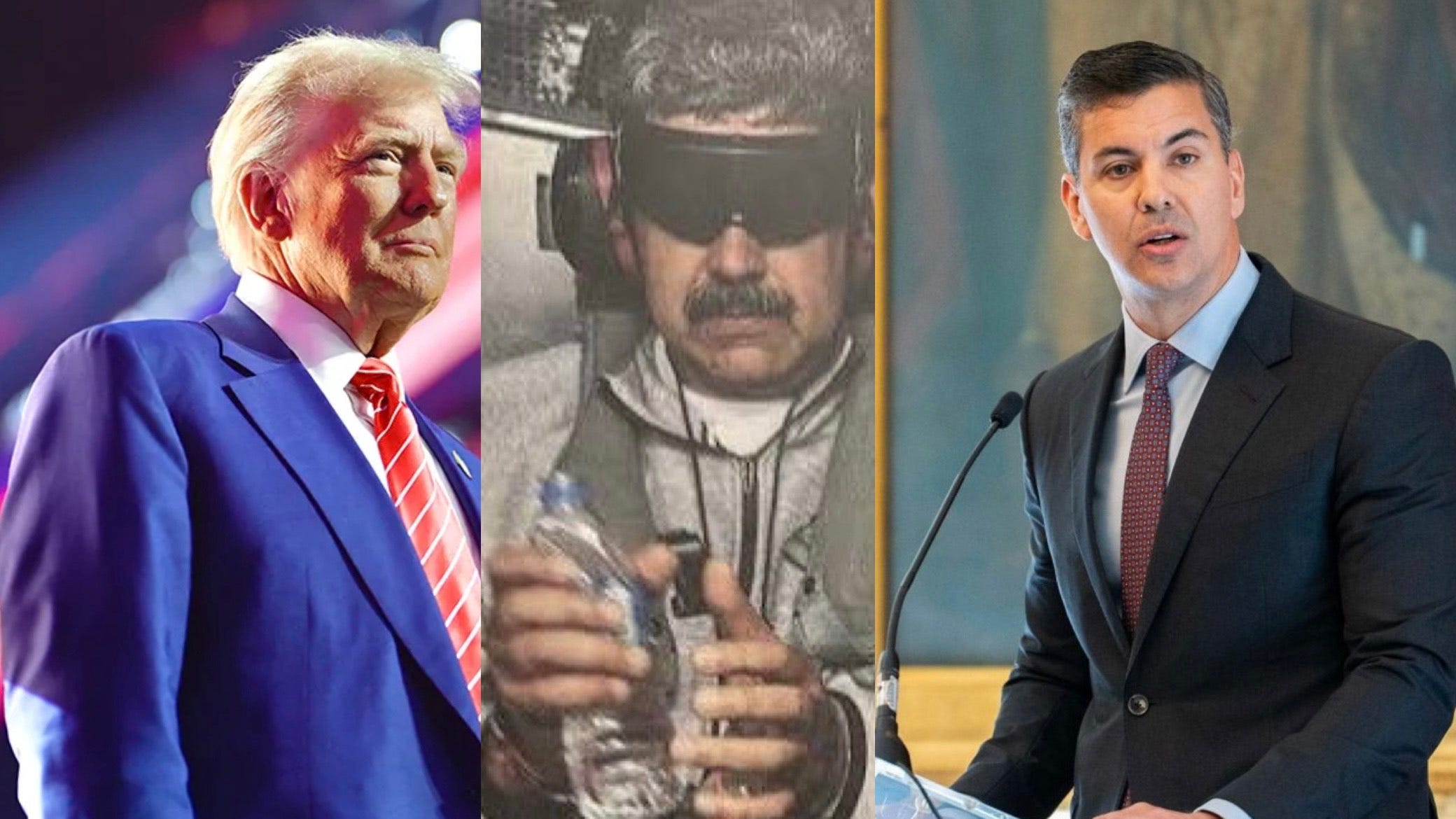
Millions worldwide were glued to their screens as news broke this morning that U.S. special forces, in cooperation with the CIA, had seized Venezuela’s autocratic leader Nicolás Maduro and his wife in an early-hours raid – and flown them to a warship bound for the United States.
Videos on social media showed fiery explosions from U.S. strikes on military bases across Caracas, the mountain-ringed capital. A few hours later, President Donald Trump posted a picture of Maduro blindfolded and in U.S. custody aboard the USS Iwo Jima.
Speaking to reporters, Trump claimed that Maduro and his wife, Cilia Flores, had built an international cocaine-trafficking ring that had led to the deaths of hundreds of thousands of U.S. citizens, and said they would face justice in a New York court.
U.S. officials will “run the country” and secure U.S. interests in Venezuela – which has the largest proven oil reserves on earth – until a democratic transition can take place, he added, promising “to do what is necessary to make Venezuela great again.”
The dramatic military intervention by the U.S is the only clear-cut case of its kind in South American history – and the first in Latin America since the 1989 toppling of Panamanian dictator Gen. Manuel Noriega. Trump said it represented a revival of the 1823 Monroe Doctrine, arguing that Maduro’s removal was necessary to prevent hostile foreign countries from taking over Venezuela.
The U.S. military, Trump added, was poised to carry out a “second wave” of attacks to return democracy to the Andean-Caribbean nation – but that renewed strikes would probably not be necessary. He said that U.S. Secretary of State Marco Rubio had spoken via telephone with Venezuelan vice-president Delcy Rodríguez, and that she had agreed to cooperate.
Venezuelan opposition leader María Corina Machado – whose party is widely accepted by observers to have won an election in July, in which Maduro claimed victory without proof – said “the hour of freedom” had come, and called on her supporters “to be ready” for her instructions.
The images of U.S. helicopters hovering over a South American capital, and foreign troops standing guard over a captured head of state, provoked alarm across much of Latin America.
For roughly a century, the region has been the world’s strongest defender of international norms that explicitly prohibit military incursions into another country’s territory.
Condemnation came from the Lula administration in Brazil, President Claudia Sheinbaum of Mexico, and Gustavo Petro of Colombia – whom Trump accused in his press conference of overseeing “factories where he makes cocaine”, saying he should “watch his ass.”
A statement posted by Sheinbaum said Mexico “energetically condemns and rejects” the U.S. intervention, and described Latin America and the Caribbean as a “zone of peace.” Any military action, it added, “puts regional stability at grave risk.”
Yet a small group of U.S. allies defended the armed nocturnal incursion on Venezuelan soil, which Rubio painted as a “law enforcement operation”.
Among those celebrating Maduro’s ouster were Ecuadorian president Daniel Noboa, Nayib Bukele of El Salvador, Argentine president Javier Milei – and Paraguay’s conservative leader, Santiago Peña.
In comments posted to social media site X, Peña said Maduro’s fall “could only be a good thing.”
“Paraguay’s government has always had an unnegotiable commitment to democracy” in Venezuela, Peña wrote. “That’s why it has warned for a long time about … the illegitimate, rapacious, and dictatorial regime of Nicolás Maduro, who has caused so much harm to that noble people.”
Peña – who lead the ruling Colorado Party to victory in elections in 2023 – called for “democratic means” and the “wellbeing of Venezuelans” to be prioritised in the “decisive hours” to come.
He also made an unlikely pitch for Paraguay to play a role in Venezuela’s rocky road ahead.
“As a country that has successfully transitioned from an authoritarian regime to a full and vigorous democracy,” he added, “Paraguay offers the international community its cooperation and experience so the change of regime leads to the full enjoyment of rights and freedoms.”
“We stand with the Venezuelan people, who deserve to live better days in democracy, freedom and peace.”
THE POST TAKE:
The full-throated support by Peña for the “snatch-and-grab” seizure of Maduro is the latest confirmation of Paraguay’s lockstep alignment as Trump deploys gunboat diplomacy and naked force across the hemisphere.
Last month, the government of Peña – who has a warm personal relationship with Rubio – signed a Status of Forces Agreement (SOFA) which paves the way for greater U.S. military deployments to the landlocked South American nation. U.S. officials denied that a permanent base is planned.

In August, Paraguay designated the so-called Cartel de los Soles – a loose drug-trafficking scheme with ties to Venezuelan military officials – as a “terrorist organisation,” three months before the Trump administration. A statement today by Paraguay’s foreign ministry described Maduro as “the ringleader” of the group.
Peña’s Paraguay has meanwhile been one of the loudest defenders of U.S. allies Taiwan and Israel, and ruled out establishing formal diplomatic relations with China – making it one of barely a dozen countries to maintain this stance worldwide.
Yet this double-or-nothing bet on Trump’s fickle friendship – and Peña’s offer to support the transition in Venezuela – raises several questions.
One is whether Paraguay really is a paragon of democracy that can lecture anyone about the rule of law.
The military dictatorship of General Alfredo Stroessner ruled Paraguay with U.S. financial and military support for nearly 35 years before being toppled by a palace coup in 1989. But Stroessner’s Colorado Party has continued to hold power ever since, with one brief exception between 2008 and 2013.
Peña, who joined the Colorado Party not long before his election in 2023, has vacillated on Stroessner’s record. At times he has condemned the general’s abuses – he had over 400 people murdered and “disappeared,” and tortured thousands more – while also praising him for bringing “stability” to a crisis-torn nation.
Analysts have in recent years described Paraguay as a “hybrid regime.” It has a more-or-less independent press and largely free elections – but the odds are firmly stacked in the Colorado Party’s favour through corruption, clientelism, and legal chicanery.
And ex-president Horacio Cartes (2013-18) – the leader of the Colorado Party, Peña’s patron, and the financial and political power behind his presidential sash – was only recently exonerated from U.S. sanctions.
The Biden administration accused him of leading a mass bribery campaign to shore up his anti-democratic control of Paraguayan politics. Cartes has denied any wrongdoing.

More far-reaching is the question of whether supporting a return to the era of powerful countries throwing their weight around in the Americas is really in Paraguay’s long-term interests.
It’s only a few generations ago that Paraguay was nearly wiped off the map by invaders. The 1864-70 War of the Triple Alliance saw Argentina, Uruguay and Brazil wipe out 90 percent of Paraguay’s male population, annex nearly half of its territory, and seize swathes of its natural resources: claiming all the while to be freeing the country from the “tyranny” of Francisco Solano López.
Constructing a web of institutions, norms and treaties to restrain the behemoths next door – and prevent such a cataclysmic conflict from ever happening again – has been the cornerstone of Paraguayan foreign policy ever since. If this culture of peaceful resolution of disputes breaks down, Paraguay could be left extremely vulnerable.
Argentina could throw up restrictions along the Paraguay-Paraná waterway, choking Paraguay’s access to two thirds of its foreign trade. China could ramp up its alleged cyberattacks on Paraguayan state institutions.

Brazil – which already wields nuclear-powered submarines, and has hundreds of thousands of dual nationals and descendants living in Paraguay’s eastern border regions – may conclude it now needs atomic weapons to defend its sovereignty: upending entirely the regional balance of power.
There are signs that Peña is trying to pull off this difficult balancing act – staying on Trump’s good side without abandoning international law and angering neighbours like Brazil, on whose cooperation for investment, trade, and energy Paraguay depends.
“I’m very worried about a military incursion on [Latin] American soil, and I’ve transmitted that concern to the U.S. government,” he told a press conference earlier this week. “I would rather it didn’t happen.”
“We would love for a peaceful solution to the conflict to be found,” he added, but that failing that “without doubt” a military incursion would take place.
As that prediction comes to pass, some in Paraguay are recalling the words of statesman Manuel Gondra (1871-1921), who helped rebuild the country from the ashes of invasion: “The just are not always strong, so we have strived to make it so the strong are always just.”