


TOP STORY
Bolivia-Paraguay ties reactivated
Paraguay and Bolivia, who share nearly 500 miles of border, have spent most of their history looking past each other, in a relationship defined less by cooperation than by absence.
For centuries, they were separated by the Chaco, a tough, arid outback. Then, they fought over it. The Chaco War (1932–1935) left hundreds of thousands dead and lingering border questions in its wake. In recent decades, divided by ideology, the two countries have traded little and discussed important issues even less.
In 2024, Paraguay exported $92.2m to Bolivia and imported $75.9m, for total trade of just $168.1m: barely 0.6% of Paraguay’s total commerce. Compare that with bilateral trade with Paraguay’s other neighbors, Brazil ($7bn) and Argentina ($4bn).
Paraguay mainly ships agro and industrial inputs to Bolivia’s agribusiness heartland around Santa Cruz: herbicides, oilseeds, packaging components, metal containers, and medicines. Bolivia sends Paraguay a narrow basket dominated by urea, hydrocarbons, lead accumulators, potash, and some fish products.
Migration is thinner still. Out of Paraguay’s 156,000 foreign-born residents, 65,000 were born in Argentina and 52,000 in Brazil. The number born in Bolivia was just 1,619. One likely reason: Bolivia and Paraguay are both developing countries with similar levels of wages and public services, meaning the working-classes in each nation have little incentive to migrate to the other.
So while Brazil and Argentina are embedded in everyday Paraguayan life through families, labour, and frontier economies, Bolivia remains much less socially present. One sign of just how distant and “exotic” the Andean-Amazonian nation to the north is perceived as being is an occasional, tropical-coded Asunción club night called Bolivia.
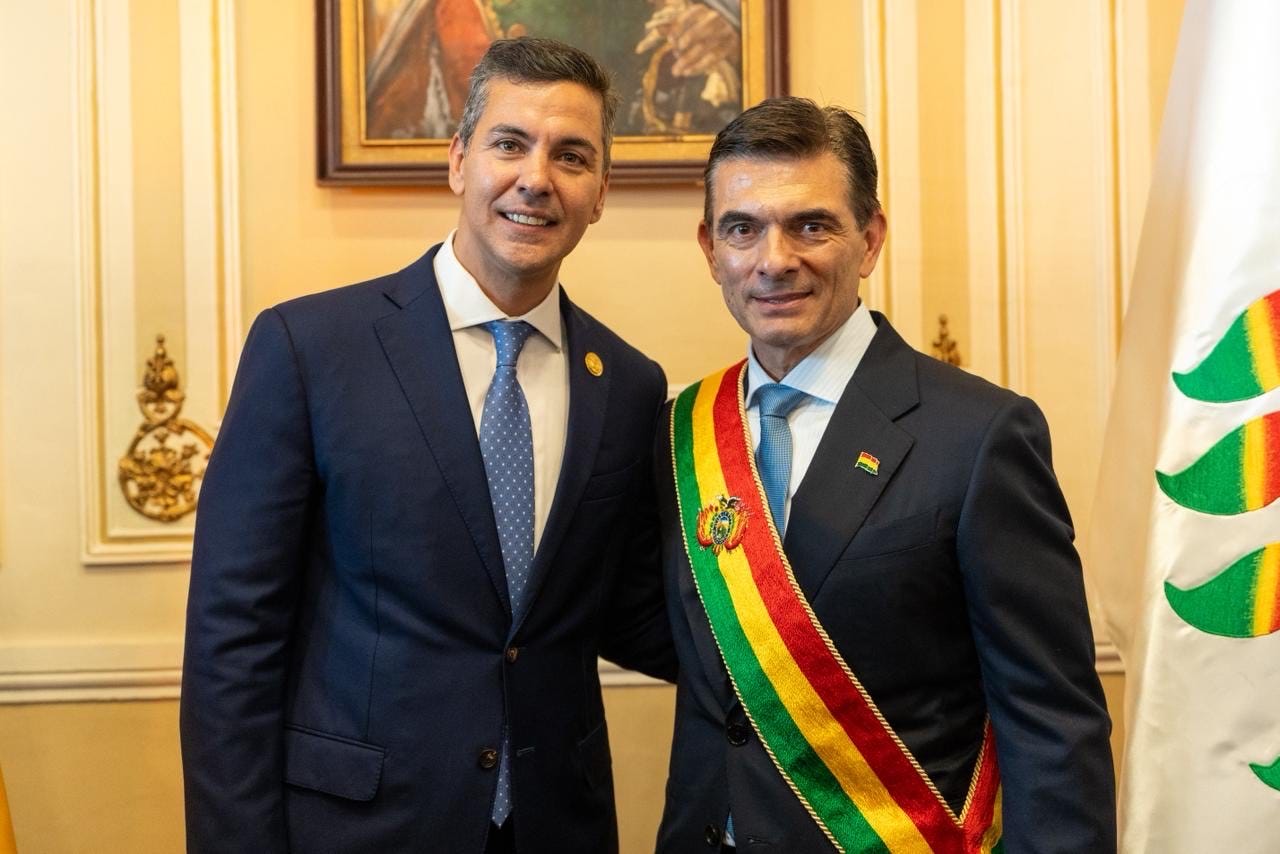
There are now signs that could be changing. Bolivia’s new conservative president, Rodrigo Paz and Paraguayan president Santiago Peña held a summit in November, with Peña hailing an “excellent moment” to boost bilateral ties.
In March, both leaders agreed to reactivate URUPABOL — a dormant economic bloc created in 1963 by Uruguay, Paraguay, and Bolivia — as part of a broader new agenda around trade, energy, and infrastructure.
For two landlocked countries, integration should matter. Paraguay offers river access to the Atlantic and a growing logistics network in the Chaco; Bolivia wants cheaper, faster ways to move goods to market.
The border itself — 704km of dry frontier and 38km of shared river — is now entering the final phase of technical demarcation, a process begun shortly after the Chaco War. Paraguayan officials have been working using drones and satellite measurements in the remote Bahía Negra–Río Negro segment; the long afterlife of the 1938 armistice is finally being translated into precise cartography.
This could unlock greater progress on binational infrastructure. A 120km road linking Roboré–Hito VII–Agua Dulce to Paraguayan river ports has become the flagship idea behind this new moment. Regional authorities in Santa Cruz and Alto Paraguay have already signed cooperation agreements around connectivity and development. One projected benefit cited in the report is a saving of up to 17 hours for hauliers heading toward Paraguayan river ports.
There is also a broader economic logic emerging in the background. The Santa Cruz–Chaco axis is becoming more important as an agribusiness frontier, with subnational governments, logistics operators, and local businesses playing a larger role.
THE POST TAKE:
For decades, Paraguay-Bolivia relations have been characterized by what they were not: not strategic, not culturally or socially vital, nor commercially important. Unlike Paraguay’s dense entanglement with Brazil and Argentina, Bolivia has remained peripheral. That is precisely why this moment is interesting.
The potential reset is not being driven by sentiment or even by diplomacy, but rather logistics and business. If Bolivia needs better access to global markets and Paraguay wants to bring its version of development to the northern Chaco, the two countries have reasons to start taking each other more seriously.
Welcome back to The Weekly Post, your essential briefing on all things Paraguay.
Want to keep reading? Claim your free trial — and unlock exclusive Insider Insight.