


TOP STORY
Sermon slams Santi
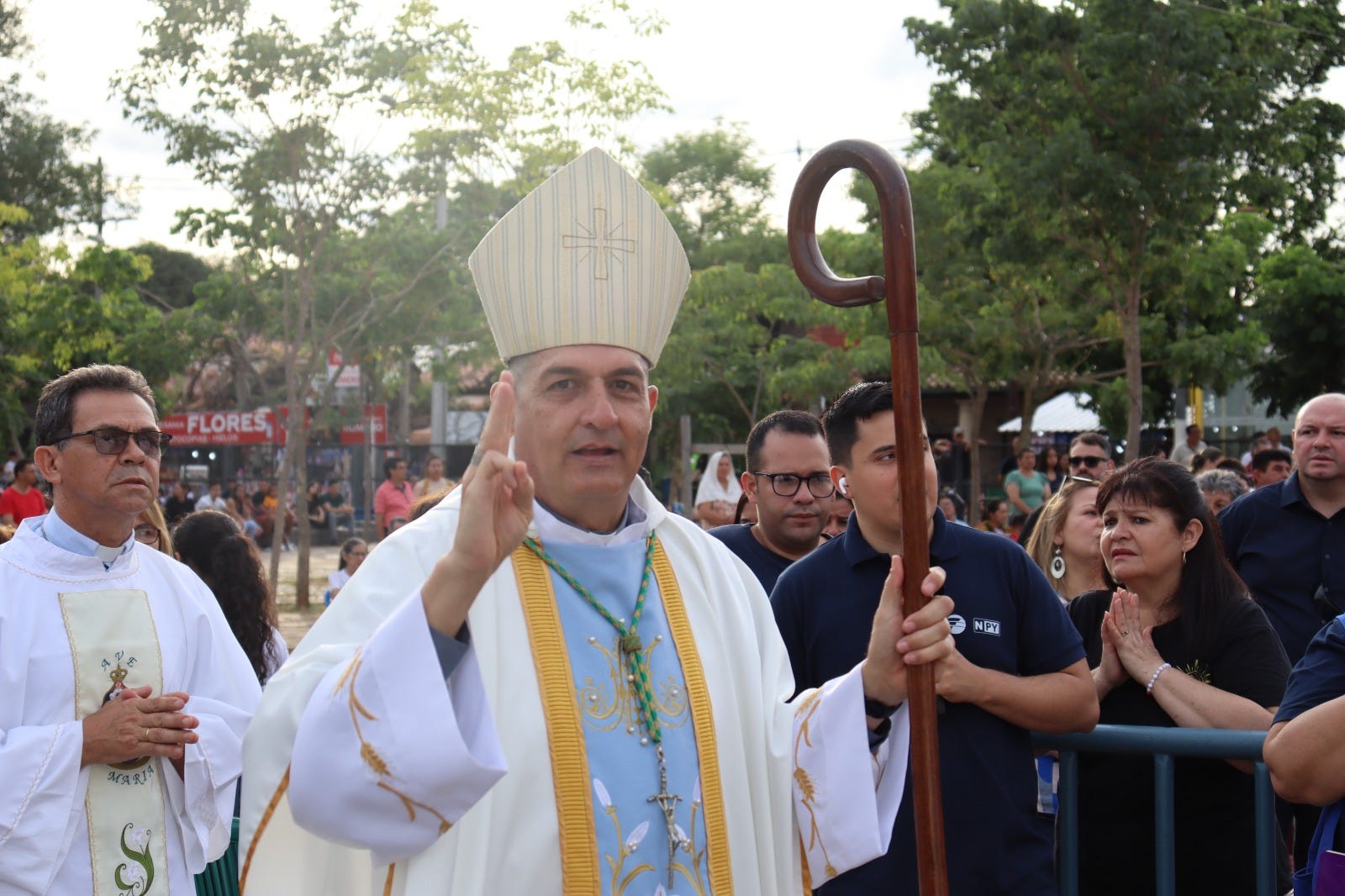
The festival of the Virgin of Caacupé – the holiest event in Paraguay’s religious calendar, which sees hundreds of thousands of pilgrims flock to a shrine in the hills 30 miles east of Asunción – kicked off on Friday with a bang. In an opening sermon, Monseñor Gabriel Escobar delivered an excoriating indictment of president Santiago Peña and his handling of the economy.
“We turn to the Virgin because we often feel defrauded, tricked by those who promised to serve the people,” Escobar told the assembled faithful. “We recognise that there are advances and achievements in Paraguay’s macroeconomy, we realise that there is growth at the financial level,” he continued, “but it is hard to see and feel how the poorest, most humble and defenceless of our people, those out in the country, pray each day to God and the Virgin that they have enough money to make it to the end of the week.”
Escobar, the bishop responsible for the remote Chaco region, described how Paraguay’s schools and hospitals are “falling apart at the seams”, and condemned its politicians for awarding themselves pay rises and top-tier health insurance. Meanwhile, Juan Pueblo – the Paraguayan equivalent of Joe Plumber – watches as his spending power shrinks, and is forced to host cookouts and raffles to pay for basic medical attention, Escobar lamented: “We have to analyse why there are rumblings of discontent among the population.”
The cleric’s comments were echoed in an unlikely quarter. At a November 21 meeting of the Unión Industrial Paraguaya, top business leaders warned that mismanagement by the Peña administration is straining Paraguay’s economy to “breaking point.” Runaway spending on public pensions, failure to pay suppliers of medicines, school meals, and road projects, rumoured price hikes for Paraguay’s dwindling energy supply, and weak rule of law are “stoking uncertainty, discouraging investment, reducing competitiveness and eroding trust in institutions,” they cautioned.
Vox-pops by the viral activist-journalist Fiorella Rivarola in the Mercado 4 suggest working-class asuncenos are also feeling the pinch. “Our country is miserable. Santiago Peña is trash,” said one. “He’s not interested if the poor eat or not,” chimed in another.
Market-stall owners practically begged Peña not to declare a public holiday on December 26, saying the reduced footfall would hammer their livelihoods. “People are going hungry,” argued one exasperated vendor. “It’s impossible to get survive: look how expensive the fruit is, meat is impossible to buy.” Peña, he argued, is Paraguay’s “worst president ever.”
THE PARAGUAY POST ANALYSIS:
Paraguay’s opposition is in the wilderness, local NGOs are facing political and financial persecution, and Donald Trump’s White House – having dropped sanctions on former president Horacio Cartes – has fallen squarely behind the ruling Colorado Party. In this context, the Catholic Church, independent media and captains of industry have emerged as some of the only counterpoints to the official narrative that everything is rosy in Santiago Peña’s Paraguay.
Many of the advances alluded to by Bishop Escobar are hard to dismiss. Amid a construction and real-estate boom, foreign direct investment grew by 15% in 2024 to $3.3bn, according to preliminary figures. Poverty fell 2.2 percentage points to 20.1%, down from over half of the population in 2003. The economy added 146,000 jobs in the year to September: many of them salaried, formal and non-agricultural jobs. The Central Bank reported annual inflation of 4.1% in October: a headline rate that would be the envy of consumers in next-door Bolivia (22%) and Argentina (31%). GDP expanded by 5.9% in the first half of the year, leading Latin America for growth.
Yet several warning lights are blinking on Paraguay’s economic dashboard. Two thirds of people remain trapped in the informal economy, with zero social safety net. Prices for key staples, especially meat, remain painfully high. Consumer credit expanded by 22% in the year to September, especially on small-balance cards, suggesting working-class Paraguayans are going into the red to pay for groceries. With public debt at 40% of GDP, the Peña administration is also maxing out its credit card, reportedly withholding payments to state contractors in order to artificially suppress the annual fiscal deficit from 3.9% to 1.9% of GDP.
Are the critics hysterical prophets of doom – or using their pulpits to righteously recommend a sorely-needed course correction? Give us your take on how Paraguay’s economy is doing by dropping a comment below:
You’re reading The Weekly Post, an essential Monday briefing on Paraguay.
Also in this week’s issue:
Cracks in the Colorado Party · Narco districts · Canadian crypto colonialism? · Guarani + AI · Can the Virgin of Caacupé still grant miracles? · In Other News
Want to see the rest? Get your free trial here:
POLITICS
Colorado Party fractures
Senator Carlos Núñez Agüero announced on Wednesday that he is leaving the Honor Colorado bloc – the dominant faction of Paraguay’s ruling party, founded by former president Horacio Cartes. Núñez says his decision is motivated by threats received by him and his family after he denounced corruption in Paraguay’s national police force, including paid-for promotions. He also claims that president Santiago Peña offered him fifty government jobs for his friends and relatives if he remained loyal. Núñez is said to be joined by colleagues Erico Galeano and Alfonso Noria. (Última Hora has a helpful graphic of the different intra-party divisions).