



TOP STORY
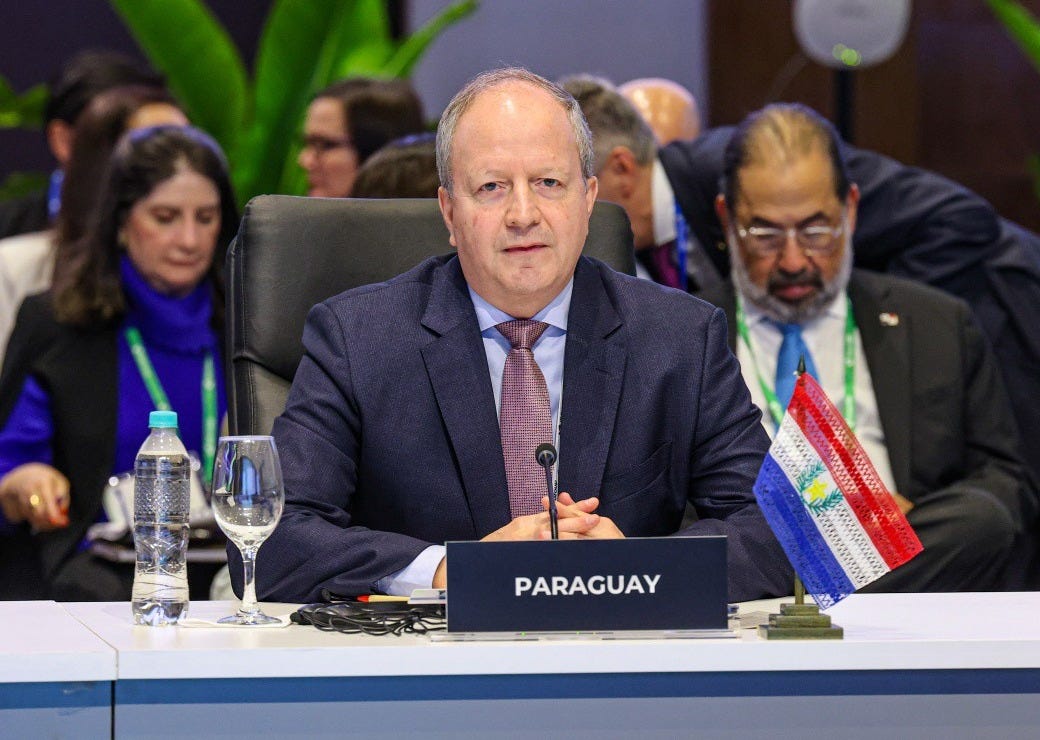
Finance minister falls
Carlos Fernández Valdovinos has had quite the month.
It was only on Friday that Paraguay’s economy and finance minister was trumpeting new data showing the country’s GDP grew by 6.6 percent in 2025 — faster than any other non-oil economy in Latin America.
The expansion was fuelled by growth in services, agriculture, hydroelectric generation, manufacturing, construction, and ranching, as well as private consumption.
New statistics also indicated that poverty fell by 3.6 percentage points last year to reach 16% — the lowest recorded rate in Paraguay’s modern history. Extreme poverty, meanwhile, nearly halved to 2.4%.
“We’re building the country we want and deserve,” Valdovinos posted on X, along with a jab at critics who say topline growth numbers aren’t trickling down to regular people.
“But ‘the macroeconomy isn’t reaching the microeconomy’”, he wrote sarcastically, including a rolling-eyes emoji.
Less than a week later, the University of Chicago-educated economist — who has expanded incentives for overseas investors and religiously maintained Paraguay’s ultra-low taxes — joined the two thirds of Paraguayans who are lacking a formal job.
In a press conference on Tuesday afternoon, cabinet chief Javier Giménez told reporters that Valdovinos had been instructed to resign.
Giménez said the change had come on the orders of President Santiago Peña, citing the need for “very specific skills and competencies” to handle the economy in the next half of Peña’s 2023-28 term in office.
He thanked Valdovinos for his “commitment”, said presidential economic advisor Juan José Galeano would step into his shoes on an interim basis, and indicated Peña would announce a permanent replacement after a period of reflection over Easter Week.
A statement from the president’s office indicated Paraguay’s next economic tsar will need to “deepen the progress already achieved, ensure the efficient use of resources, and guarantee that economic growth translates into better living conditions for all Paraguayans, especially the poorest groups.”
Valdovinos — who was only recently named Finance Minister of the Year by The Banker, and has lately given talks at Harvard, Oxford, and the LSE on how he helped steer Paraguay to investment-grade status — seemed unbowed by the implicit criticism of his performance.
“Mission accomplished!!!”, he posted on Tuesday. “Everything for my beloved Paraguay.”
THE POST TAKE:
Rumours of an imminent reshuffle at the Ministry of Economy and Finance (MEF) have circulated for weeks.
Earlier in March, Última Hora reported that Valdovinos was considering resigning. Peña, it seems, has since made the decision for him.
The shake-up at the MEF follows a confluence of crises and clashes that have weakened the star minister’s position and cast a shadow over Paraguay’s strong economic showing in 2025.
The first was a controversial pension reform that hiked retirement ages and contributions from teachers, police, judges and soldiers in order to plug what Valdovinos claimed was a ballooning $380m hole in public finances.
After three months of protests from unions and tense negotiations in congress, a watered-down version of the bill was passed on March 18 — with little of the planned savings, or the minister’s political capital, left intact.
The second is an austerity drive abruptly announced by Valdovinos on March 16. Plunging customs tax receipts due to a weakened dollar, he said, required a “wartime economy” of slashed government expenditures.
“The economy is doing well,” he argued, “but not the treasury.”
Both measures alienated lawmakers in the ruling Colorado Party, whose support depends on channelling state resources towards public-sector workers and allies.
Yet the third factor in Valdovinos’s downfall is accumulating evidence that last year’s minor GDP miracle may be a one-off — and even an achievement built on sand.
Recent data compiled by the Central Bank (the BCP) show economic activity slowed to just 0.9% in January, down from 5.9% a year earlier.
This partly reflected a slump in construction, as bosses complain Valdovinos has postponed payments to firms building highways, providing medicines to hospitals, and delivering other government services in order to artificially suppress the fiscal deficit in 2025.
Construction bosses have repeatedly warned that activity will grind to a halt and workers will be fired unless such arrears — now at an estimated total of $1.5bn — are paid in full.
The deficit — the difference between government spending and earnings — fell slightly to 2% of GDP in 2025, well above an official target of 1.5%.
And analysis by Paraguay’s National Statistics Institute (INE) shows nearly all of last year’s drop in poverty wasn’t due to growth or increased employment — as implied by Valdovinos — but rather social programmes.
Without essential cash grants for the poorest like Tekoporã, the INE found, the poverty rate — measured at an income threshold of 31,000 guaraníes ($4.80) per day — would have been 20% in 2025, even higher than the year before.
Put another way: the benefits of growth are largely failing to reach the poorest, who depend on government assistance to scrape by.
Paraguay is clearly having a moment in the spotlight. Foreign investment is up; residency requests are at record levels.
“We used to be like the ugliest girl at the ball,” the director of the capital’s ritzy Shopping del Soll mall recently told Bloomberg. “Now everyone’s asking us to dance.”
Even if growth slows to 4.2% in 2026, as expected by the BCP, it will far outstrip the sluggish Latin America average of 2.3% predicted by the World Bank.
But the tale of Valdovinos’s hubris and downfall suggests Paraguay’s growth model is fragile, just one shock away (exchange-rate fluctuations, a spike in oil prices) from turbulence.
The “reawakening giant” — as Peña often describes Paraguay — seems to have feet of clay.
Welcome back to The Weekly Post, your essential briefing on all things Paraguay.
Also in this issue:
Fuel spike and bus strike · Beef industry faces supply crunch · Holy Week: tradition vs tourism · Paraguay debuts home-made pistol · Surgeons gone rogue · Data center subsidy removed
Want to keep reading? Claim your free trial — and unlock exclusive Insider Insight.