



TOP STORY
Shield & SOFA
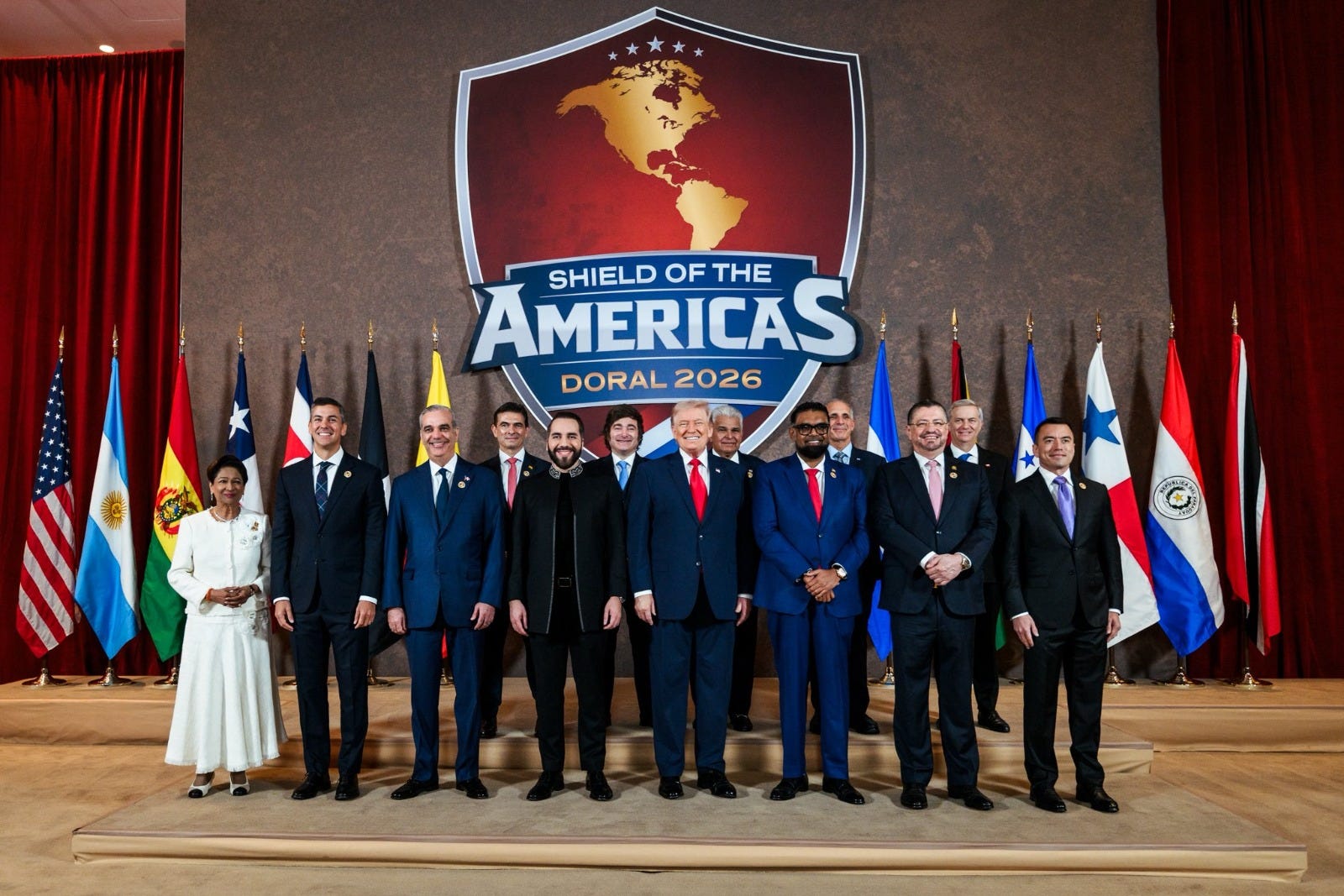
Paraguay’s president, Santiago Peña, was one of a dozen Latin American leaders to visit Florida on Saturday to sign a military pact with Donald Trump’s White House to take the fight to “narcoterrorist” groups across the hemisphere.
The deal — which creates a 16-member security organisation called Shield of the Americas — seeks to “train and mobilize partner nation militaries” in order to “dismantle cartels and their ability to export violence and pursue influence through organized intimidation”.
The other signatories included conservative US allies like Argentina’s Javier Milei, Salvadoran strongman Nayib Bukele, Bolivia’s new conservative leader Rodrigo Paz, and Chile’s incoming president José Antonio Kast.
Colombia, Brazil, and Mexico — home to several of the hemisphere’s largest and most powerful criminal organisations, but all ruled by left-wing leaders that have publicly rejected Trump’s military interventionism — did not take part.
“Just as we formed a coalition to eradicate ISIS, we now need a coalition to eradicate the cartels,” said Trump. “The courage and resolve of the great leaders here” — he added — “will make our nations safer, stronger, richer.”
Peña, whose nation has one of the lowest homicide rates in Latin America, previously praised Trump for restoring “hope” to the region’s struggle against transnational drug gangs. “Thanks to your leadership,” he added, “we’re solving the issues.”
Thousands of miles away, a separate deal heralding a greater presence of US troops in Paraguay was signed into law.
The Status of Forces Agreement (SOFA) was approved by Paraguay’s senate on March 5 and the chamber of deputies on March 10. The lower house passed it with 53 votes in favour, eight against, and four abstentions.
Peña gave the bilateral agreement his signature on Wednesday — along with Paraguay’s foreign minister and senior US diplomat Christopher Landau.
Paraguayan and US officials say the SOFA provides an off-the-shelf legal framework that makes it easier for members of the United States armed forces to visit for training, diplomatic, and humanitarian missions.
They deny that a permanent US military base is planned in Paraguay, and say that SOFAs have been signed with dozens of other nations.
But the agreement itself describes how visiting US military personnel and civilian contractors will be immune from prosecution in Paraguay for any crimes they commit on Paraguayan soil — akin to the privileges enjoyed by diplomats.

Opposition figures said this amounts to an unacceptable surrender of sovereignty: and a subordination of Paraguay’s foreign policy to US interests.
“We’re officially becoming the back yard of another country,” said congresswoman Johanna Ortega.
She claimed the SOFA was a bargaining chip for the removal of US sanctions on ex-president Horacio Cartes, Peña’s patron. “The Paraguayan people are still paying for the pardons,” she added.
As part of the deal, Paraguay’s Congress is meanwhile fast-tracking the purchase of US weapons: bypassing normal public bidding processes.
The deal has also angered the Lula administration in neighbouring Brazil: Paraguay’s most important partner for trade, investment, and energy.
And beyond routine training exercises, recent experience suggests that the SOFA could ramp up military operations against criminal groups in Paraguay — directed on the ground by US troops.
Ecuador signed a similar security arrangement with Washington in 2023 and recently carried out joint operations with US support attacking alleged narco-terrorist camps.
THE POST TAKE:
Violent criminal gangs are a very real scourge across Latin America.
Mafia groups fell forests, extort small businesses, recruit teens as footsoldiers, and get kids hooked on drugs — all with the collusion of corrupt officials.
A fifth of Latin Americans say crime is the most important issue facing their countries. The region is host to just 8% of the world’s population but 37% of its homicides.
But far from heralding a partnership of equals to tackle the issue, the Shield of the Americas summit seemed more like a show of submission by Latin American leaders desperate to avoid falling foul of the so-called Donroe Doctrine.
Not only did Trump engage in his traditional handshake machismo, yanking Peña’s arm back and forth as Paraguay’s president maintained a rictus-like grin.
He was also dismissive of Spanish — spoken by most of his guests, as well as hundreds of millions of Latinos across the hemisphere — which was widely used in what is now the United States long before English got a foothold in the Americas.
“I’m not learning your damn language,” Trump chuckled. “I haven’t got time.”
And he reportedly reneged on a promise to sit down for brief one-on-ones with each leader, where they could have shared concerns and ideas.
Instead, after leaving behind their duties at home and travelling for hours to Doral, they were restricted to a minute-long photo-op: handshake judo included.
The summit’s one-sided optics are mirrored by the wording of the US-Paraguay SOFA.
U.S. soldiers and contractors will not be subject to local laws or taxes. Any legal responsibility for crimes they commit will be determined exclusively in US courts.
This could make securing justice all but impossible for regular Paraguayans whose rights are violated by visiting troops – especially in the poor, rural communities where people often turn to marijuana production and drug smuggling to feed their kids.
The growing militarisation of the region’s security debate has also caught Lula’s attention.
The veteran leftist president recently warned that Brazil’s borders remain dangerously vulnerable, saying “one day someone could simply invade us”: a comment likely referring to the U.S. invasion of Venezuela in February to snatch alleged cartel leader Nicolás Maduro.
Asunción and Buenos Aires designated Primeiro Comando da Capital and Comando Vermelho as terrorist organisations last year. Reports suggest the United States is about to do the same: a move that would escalate the range of financial and military tools that can be used against them.
Brazil, where both drug-trafficking groups are headquartered, is trying to persuade Washington against the idea.
An alarming possibility is now swimming into view: of Paraguay being used as a launchpad for cross-border military operations without the consent of its largest and most powerful neighbour.
And as Trump rains missiles down on Iran — producing serious collateral damage and civilian casualties along the way — there is no telling how far he is prepared to go in what he clearly considers his backyard.
The Americas, as one State Department post recently put it, “is OUR hemisphere.”
Welcome back to The Weekly Post, your essential briefing on all things Paraguay.
Also in this issue:
Prieto under fire · Paraguay’s government to start mining bitcoin · IDB summit in Asunción · Saving Lago Ypacaraí · Narco senator convicted · Pension reform stalls
Want to keep reading? Claim your free trial — and unlock exclusive Insider Insight.