



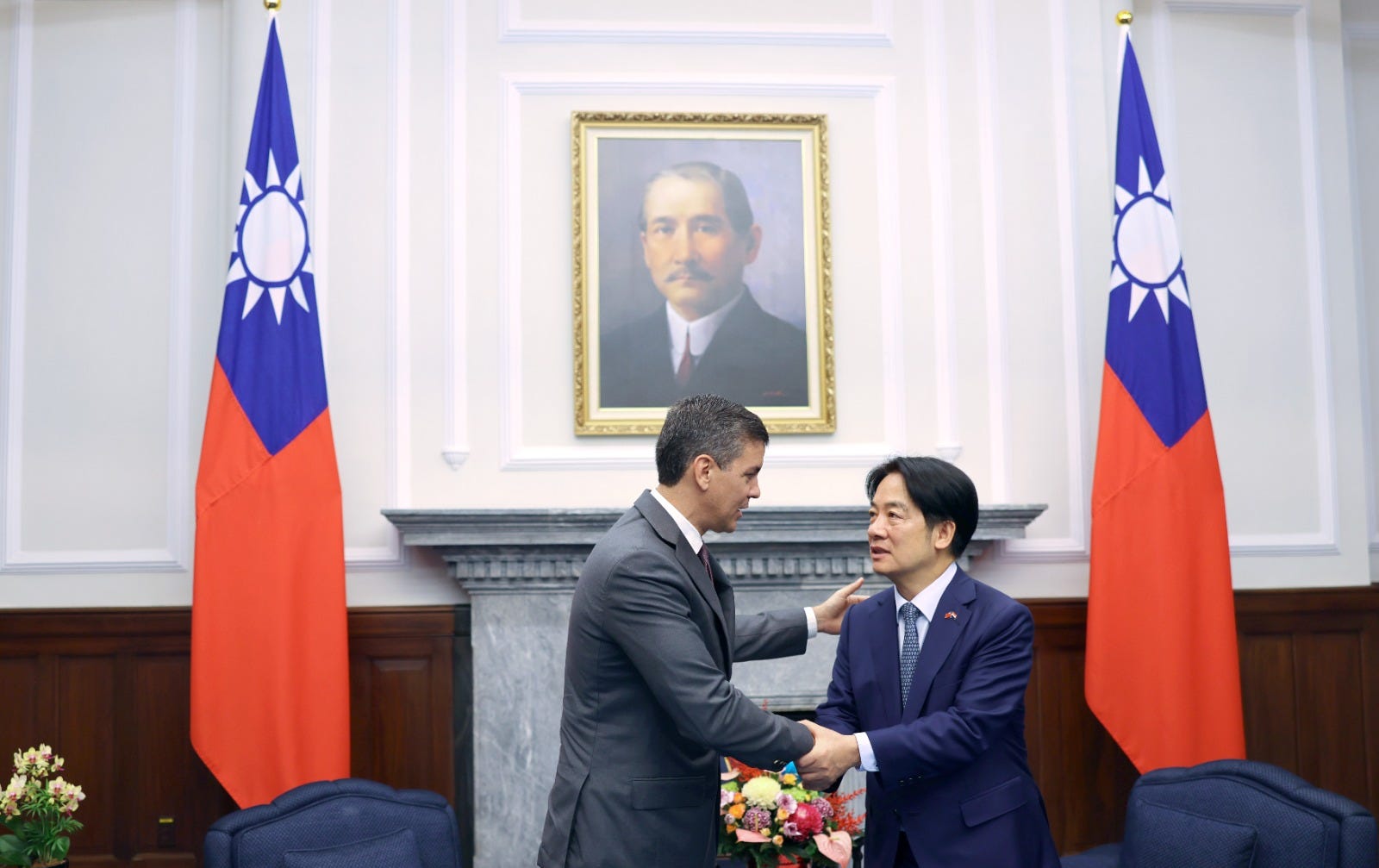
TOP STORY
The U.S. pressures Paraguay to stick with Taiwan
Whoever said long-distance relationships never last clearly hasn’t heard of Paraguay and Taiwan.
The East Asian island nation and its landlocked South American ally lie some 20,000 kilometres distant on opposite sides of the planet.
This trans-Pacific tryst dates back to 1957, when their Cold War dictators formed an alliance to stamp out Communism in their respective hemispheres. (Alfredo Stroessner was largely successful, Chiang Kai-shek not so much).
The unlikely couple have since settled into a comfortable marriage of convenience. Taiwan donates electric buses, a presidential plane, and second-hand helicopters that saw service in the Vietnam War. It paid for Paraguay’s spaceship-like Congress building, completed in 2003, and still funds repairs.
The Asian tiger, which manufactures over 90 percent of the world’s advanced microchips, also gives scholarships for dozens of Paraguayans to study STEM in Taipei every year. It is now building a campus near Luque for a technical university worth upwards of $18m. It’s also trying to kickstart a local fish-farming industry.
For its part, Paraguay sticks up for Taiwan at the UN and continues to recognise it as a sovereign state: one of just 12 countries to still do so worldwide. It’s a stance that irritates China, which considers Taiwan a breakaway province and makes no secret of its desire to (re)assert control.
Until recently, despite lacking formal diplomatic relations with Beijing, Paraguay seemed able to play both sides.
It ships large quantities of its soybean harvest indirectly to China through Argentina and Uruguay, much of it transported by Chinese agribusiness firm COFCO. Paraguay bought $5.6bn in Chinese goods in 2025: a third of its imports. Lawmakers have enjoyed all-expenses-paid trips to Taipei and Beijing.
Meanwhile, Paraguayan politicians have hinted that their loyalty to Taiwan has a price tag – former president Mario Abdo Benítez demanded $1bn in annual investment in 2022 – and an expiry date.
Paraguay is open to a regional free trade deal with China – then-economy minister Carlos Fernández Valdovinos told me last year – “as long as they don’t put conditions on who we can have a beer with.”
“Right now,” he added, “we want to drink a beer with Taiwan.”
Yet as I recently reported for The New York Times, this geopolitical love triangle is fast becoming a square, with the United States acting as an increasingly aggressive wingman for Taiwan.
Donald Trump’s White House is determined to fight China’s growing influence in Latin America, which it sees as its back yard.
It has pressured Chile to drop a proposed submarine fibre-optic cable to Hong Kong, pushed Panama into handing control of Chinese-operated harbours to U.S. firms, and warned Peru about ceding sovereignty to a Chinese megaport.
And in Paraguay, the so-called Donroe doctrine manifests as hawk-like vigilance over anything perceived as likely to tip the scales in favour of Beijing.
U.S. officials have accused Chinese hackers of being behind recent cyberattacks against Paraguayan government institutions, and praised Paraguay for excluding Chinese telecoms giant Huawei from bidding for a contract to roll out 5G.
According to local press reports and one Paraguayan official, the U.S. has withdrawn visas from at least 11 Paraguayan lawmakers – including two from the ruling Colorado Party – after they expressed support for China or travelled to Beijing at the invitation of the Chinese government last year.
When I asked the U.S. government about this, they deployed what you might call strategic ambiguity.
A spokesperson said the State Department can deny visas if the individual’s “proposed activities would have potentially serious adverse foreign policy consequences for the United States.”
THE POST TAKE:
The mounting U.S. pressure seems to be having a chilling effect on pro-China opinion. Several interviewees for my Times story were wary of voicing any sentiment suggesting the Paraguay-Taiwan friendship may not be eternal.
In 2022, Pedro Galli, the then-president of the ARP, an influential agribusiness lobby group, railed at how an alliance signed by “two bloodstained dictators” nearly 70 years ago is preventing Paraguay’s ranchers from selling their beef to China.
He called the alliance with Taiwan “stupid” and said it reduced Paraguayans to the status of “beggars”. He later threatened to “run naked through the street in protest.”
Galli didn’t reply to my requests for comment. And his successor is less outspoken: he cancelled our interview, then offered to answer written questions instead.
Jessica Chenu, a Paraguayan lawyer who is the commercial director of the Paraguay-China Chamber of Commerce – located in an old house a few blocks from Plaza Uruguaya – said Paraguayan firms are dying to do business with Beijing. But she was unable to connect me with any willing to speak on the record.
Chenu – who previously worked at the Chinese Military Museum in Beijing – was also desperate to reiterate that the Chamber is independent of the Chinese government and takes no position on diplomatic recognition.
She referred my questions on the topic to the Chinese consulate in São Paulo, saying she was visiting the following week and could chase them up.
The line from la embajada – as the U.S. Embassy in Asunción is widely known – is that Paraguay’s position on Taiwan versus China is for Paraguay to decide, and that the U.S. exercises no pressure behind the scenes.
Paraguay’s president, Santiago Peña, has argued the same. “Even if the United States were against it, I would still support Taiwan,” he told a local chat show in August.
But when U.S. officials publicly praise Paraguay for keeping China at arm’s length, and reportedly strip visas from Paraguayan politicians who stray too close to Beijing’s embrace, there can be little doubt as to where Washington’s preferences lie.
A raft of donations to Paraguay’s armed forces, and a seat at the top table at the Board of Peace for Peña, meanwhile illustrate the perks of staying in the good graces of Trump and Marco Rubio. This combination of carrot and stick are likely to keep Paraguay firmly on Team Taiwan for years to come.
Taiwan can also point to a deepening partnership on technology and trade: it’s now Paraguay’s top market for pork, and a major buyer of its beef. More cooperation agreements are due to be signed when Peña visits Taiwan this weekend, accompanied by top ministers and more than 50 business figures.
Others accuse the United States of hypocrisy: strong-arming Paraguay to shun China, when Washington has maintained diplomatic relations with Beijing since 1979 and did $660bn worth of business with the People’s Republic in 2024 alone.
“But us, their lapdogs, we’re not allowed,” opposition senator Esperanza Martínez told me, arguing that Paraguay is leaving billions in trade and investment on the table by turning its back on the PRC.
She said she had marvelled at China’s modern cities and high-tech industries on a recent visit, and recalled how – as health minister in the Lugo administration (2008-12) – the Taiwanese embassy had sent her flowers every year on her birthday.
“They’re using us,” she added. “And we’re selling ourselves very cheaply.”
— Laurence Blair
Welcome back to The Weekly Post, your essential briefing on all things Paraguay.
Also in this issue:
Solar strategy unveiled · Dollar plunges · High-tech weed labs · An ocean outlet for Paraguay? · Oil drillers target Médanos del Chaco · Rock doc returns to screens · Mangoré exhibit opens · Mercosur deal activated · A 25% wage hike?
Want to keep reading? Claim your free trial — and unlock exclusive Insider Insight.