


Paraguay is known for outlandish criminal heists. In 2017, a small army of tooled-up gangsters blew up a cash transporting company in Ciudad del Este, speeding to safety in Brazil with some ten million dollars. Robbers often dig their way into bank vaults and art museums. Prisoners tunnel out of jail, or simply walk out the front door.
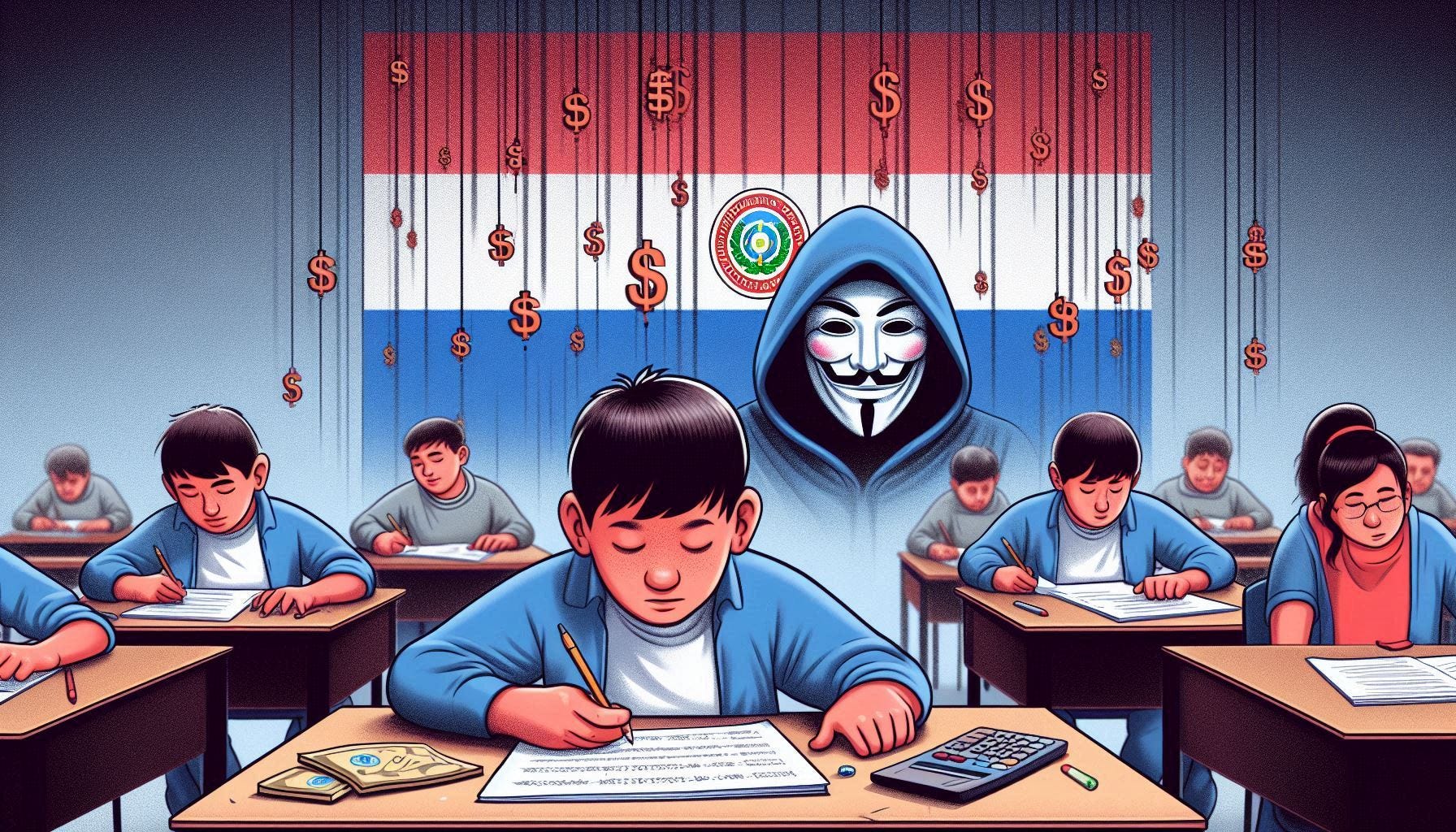
But last week saw an unusual — and entirely virtual — stick-up. Last Monday, Paraguay’s education ministry (MEC) reported a dramatic hijacking of their digital footprint. The culprits were hackers, seemingly from overseas, who had left a note on a server demanding a ransom of 15 bitcoins: roughly a million dollars.
Online services, remote learning, and internal comms were down for three days before the MEC could restore normal service. Swathes of personal information were made inaccessible and put at risk — from the names of teachers and the schools they work at, to student grades and the university degrees of the population at large.
The MEC was unable to confirm whether the personal data of children, learners and educators had been compromised, but promised to investigate — and to beef up its digital security. A contract worth US$2 million to renovate the ministry’s data center is currently open for bidding.
The case is not the first of its kind. In August 2023, it emerged that some 500,000 internal documents and images — including many belonging to foreign residents — had been taken from the database of Paraguay’s national police force and published by Distributed Denial of Secrets (DDoSecrets), a self-described “transparency collective” that some have branded “hacktivists.”
Curiously, the hackers made no subsequent efforts to claim the ransom, according to MEC officials. Was it a prank? An inside job? Or a dry-run for a more serious breach of another government institution?
“Technology is never 100 percent secure,” Maricarmen Sequera, the director of digital rights non-profit TEDIC, tells the Post. Hackers are constantly probing gaps in the armour of state agencies around the world. Even the toughest firewalls can’t keep out sustained assaults forever.
The challenge for Paraguay is to ensure that citizens are protected, even when cybersecurity defences are breached. “These databases need to be separated, encrypted, and anonymised,” Sequera argues, “so that when these things happen there’s no risk to life and security.”
“Together with Bolivia,” she adds, “we’re the only country in South America that doesn’t have a personal data protection law.” This means that Paraguayans have little legal recourse when government bodies — or the private companies that provide them with digital services — lose or misuse their personal information.
The government is currently developing a new national cybersecurity strategy, updating already-antiquated legislation from 2017. For Sequera, it can’t come soon enough. “We’re talking about sensitive infrastructure. We need to have an ambitious approach in terms of information sovereignty,” she says, that “puts the individual front-and-centre.”
What We’re Reading
Artificial intelligence poses an complex set of challenges for Paraguay’s democracy, reports Daniel Duarte for Ciencia del Sur. It’s cheap and increasingly easy to clone someone’s voice or face using open-source AI software online: political deepfakes have already been deployed in the US, Mexico, Ecuador, and Argentina. Two doctors in Paraguay recently denounced videos using their likeness to sell fake “miracle” cures. Paraguay is especially vulnerable given how many people get their (mis)information from WhatsApp. Legislation regulating AI has stalled in congress, but campaigns to boost digital literacy are also sorely needed. Check out the fake audio of congresswoman Johanna Ortega that Ciencia del Sur produced with her permission: it’s eerily convincing.
Stronista torturer Eusebio Torres gets thirty years. The 88-year-old was sentenced in February for his brutal abuse of anti-Stroessner dissident Carlos Casco, his pregnant wife, and brother in 1976. Survivors spoke of being whipped, electrocuted and nearly drowned by the former police officer on the dictator’s orders. His lawyers appealed, but judges confirmed the sentence on Friday. It’s a rare, if late, measure of justice. Just nine functionaries of the regime have been brought to trial, and most of the disappeared are still missing. Because of his age, Torres will spend his sentence under house arrest, reports EFE.
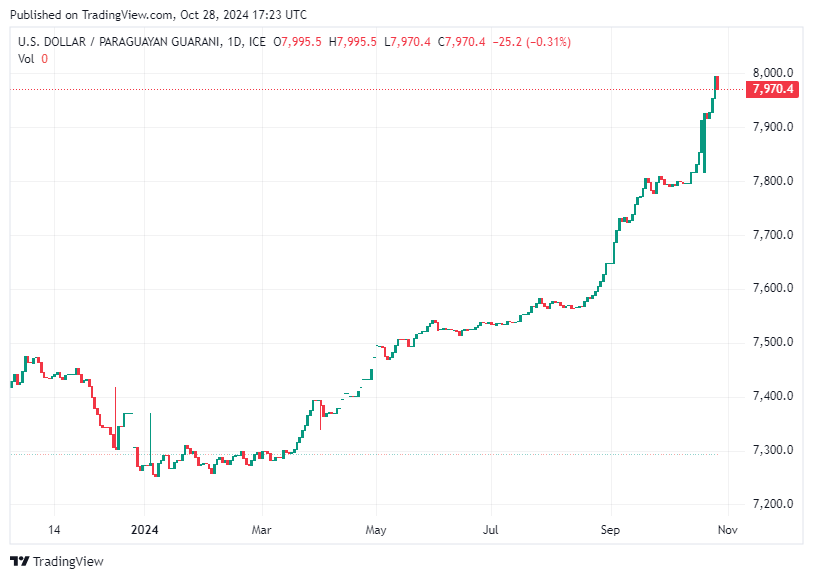
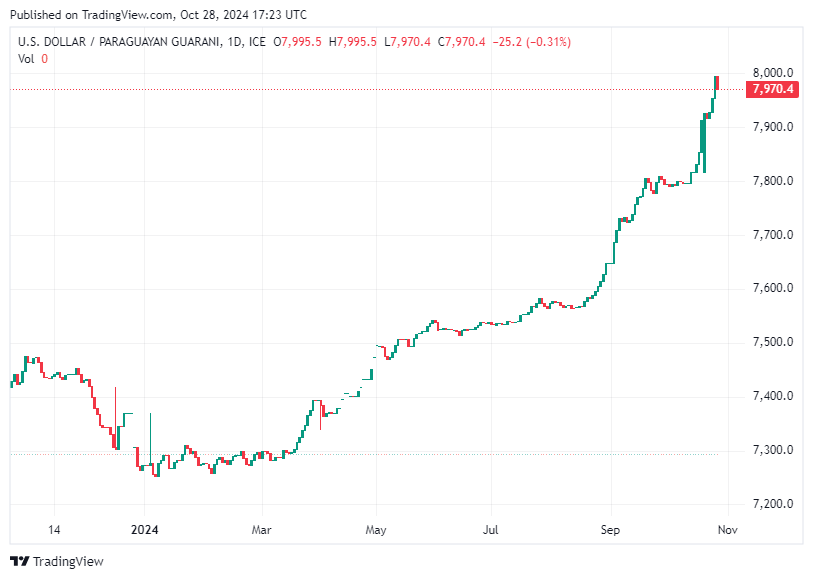
The guaraní, Paraguay’s famously stable currency, has lost over 10 percent of its value against the dollar since March, breaching the symbolic 8,000 PYG: 1 USD threshold on Friday for the first time since 2003. What’s going on? Prices for soybean, Paraguay’s top export after hydropower, have fallen. Drought in the Paraguay-Paraná river system is making imports (especially fuel) more expensive, piling downward pressure on the local currency, reports ABC Color. The BCP, the central bank, blames seasonal and external factors, and will inject at least US$15m daily into the forex market from today to try and calm the waters. But in the meantime, inflation may be stoked: unusually for an agricultural economy, Paraguayan households depend heavily on imported foodstuffs.
Created with TradingView
Culture Corner
🌎🍖🐆 Lonely Planet picks Paraguay. The prestigious travel publisher has selected Paraguay as one of its top ten countries to visit in 2025! For the print edition, I penned some highlights: the plunging waterfalls and picturesque pueblos of the Región Oriental, the rare biodiversity of the Chaco and Pantanal, and the increasingly buzzy food and drink scene in Asunción (my current recs: Táva, Mala Vecina, Toro, Óga). The country could market itself better, but I genuinely believe Paraguay has so much to offer curious, adventurous travellers.
👨🎨🖌️ Carlos Colombino masterworks on show. The late artist is perhaps best known for sculpture: the chopped-up statue of Stroessner beside the presidential palace, the piled-up chairs of Curuguaty. But he also conceived a new form of artwork — an expressive combination of woodcut and painting, dubbed xilopintura — showcased in a new exhibition at the Museo del Barro. The subject matter is “corruption, clientelism, constant violation of the laws … illnesses that seem to have no cure.” (Grabadores del Kabichu'i, free entry Friday and Saturday)
🥕🎺🏺 La Red Agroecológica, a farmer’s market in one of the capital’s best-kept parks, is my favourite place to spend Saturday morning. You can pick up organic vegetables, yerba, honey, yoghurt, and chicken directly from the producers, as well as snacks like chipa asador and payagua mascada. There’s often live music, and this weekend Trama are running a ceramics workshop. Top tip: get there early to grab free-range eggs and queso paraguay from Ña Mirta (the stall beside the stairs) before she runs out. (Plaza Italia, Saturdays 8am-2pm)
In other news: hands off that possum | Fitch holds PY below investment grade, citing NGO law | child labour in cement industry | Police tamper with journalist’s phone | Cartes & the Orbán playbook | Alliana is Cartes’s pick for 2028 | Santi sees red | Marito throws shade | Bachi’s brood of nepobabies | a mass wedding in Horqueta | rekutu redux? | INDI to relocate |