


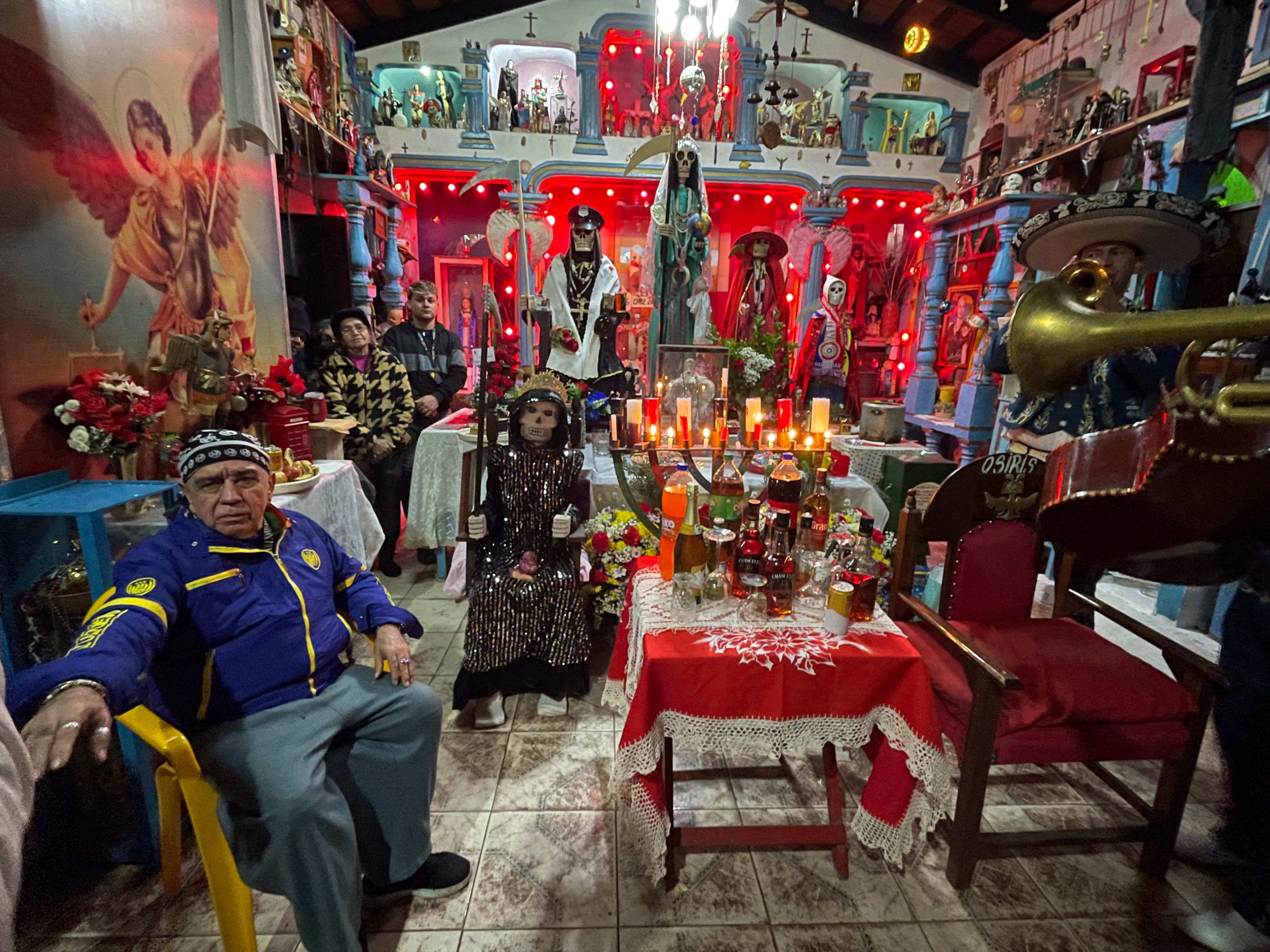
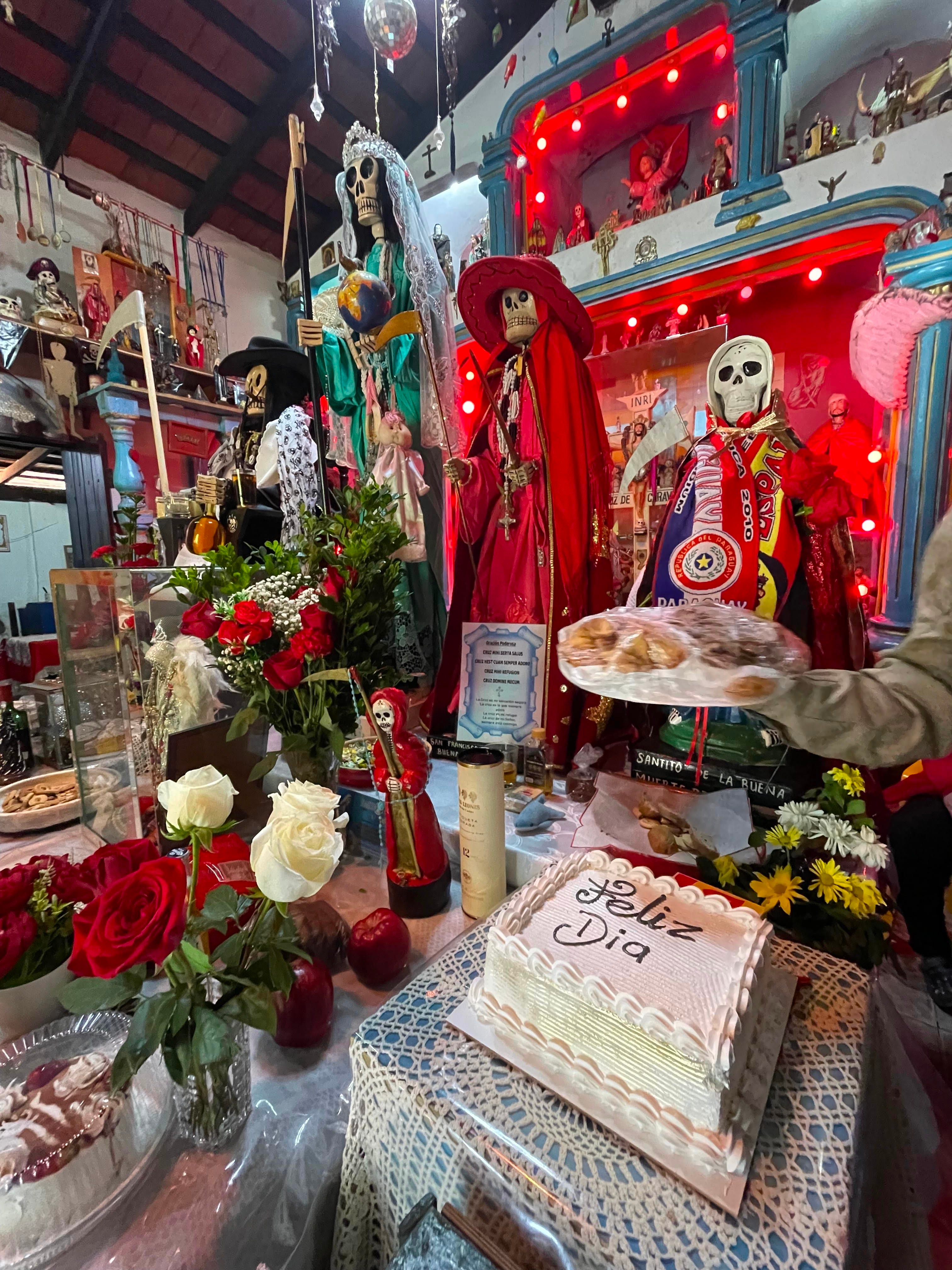
In a small wooden chapel in Itá, central Paraguay, the faithful gather every August 14 to wish death a happy birthday. They leave offerings of rum, whisky, beer, roast chicken, cigarettes and candy atop a candlelit altar before a skeletal saint, complete with a miniature scythe and a Paraguay scarf from the 2010 World Cup.
Offerings and relics line the walls and ceiling: deflated footballs, Chinese lanterns, Christmas baubles, skull-and-crossbones bunting, a figurine of Goku from Dragon Ball, a miniature red telephone box. A pig’s head lies snout-up on a platter before an icon of Eva “Evita” Perón. And seated at the centre of it all is Nicolás Benítez, 76, bearing a staff topped with a plastic skull, and dispensing blessings from a chair daubed with the name of Osiris, the ancient Egyptian god of the underworld.
This is the centre of the Paraguayan cult of San La Muerte. Worshippers — of whom Nicolás estimates there are 40,000 across the country — believe the coterie of grinning cadavers grant them protection, bring them good fortune, and even curse their enemies. Nicolás, a former folk dancer who sometimes dons the red turban of the Afro-Brazilian faith Candomblé, founded this chapel some twenty years ago. But he drew on a deep current of Indigenous Guaraní belief, Catholic superstition, and popular yearning for shelter against the rough-and-tumble of daily life.
You may have heard of La Santa Muerte: a deity with Mesoamerican roots, revered by hardbitten sicarios across Mexico, Central America, and the Latino diaspora in the US. Paraguay’s version — also known as El Santito — is a remote cousin, harking back to a mythical Jesuit sorcerer also venerated in Buenos Aires, northern Argentina, and Brazil. While clergymen including Pope Francis have branded the Mexican iteration “Satanic” and “macabre” , El Santito has so far flown under the radar.
But in the Internet age, no cultural phenomenon grows in isolation. A noticeable cross-pollination is at work: from the mariachi band who recently serenaded El Santito on his birthday, to the narcocorridos and gangster rap blasting from the cars outside. And — anecdotally at least — it seems the worship of the holy corpse is spreading among the Paraguayan criminal underworld.
I get talking to Javier, who grew up on the street before Nicolás took him in. Now 31, he recently served a five-year stretch in Tacumbú prison after being busted with a shotgun and a cargo of marijuana in his car. “I cried like a baby. None of my real family wanted to visit me,” says Javier, who has a skull inked across his forehead. Yet, on the inside, he prayed at a shrine of San La Muerte and found work as a butcher. Nicolás eventually secured his early release. “I left without a scratch, and with more money than I would have earned here,” he laughs. “And it’s all thanks to El Santito.”
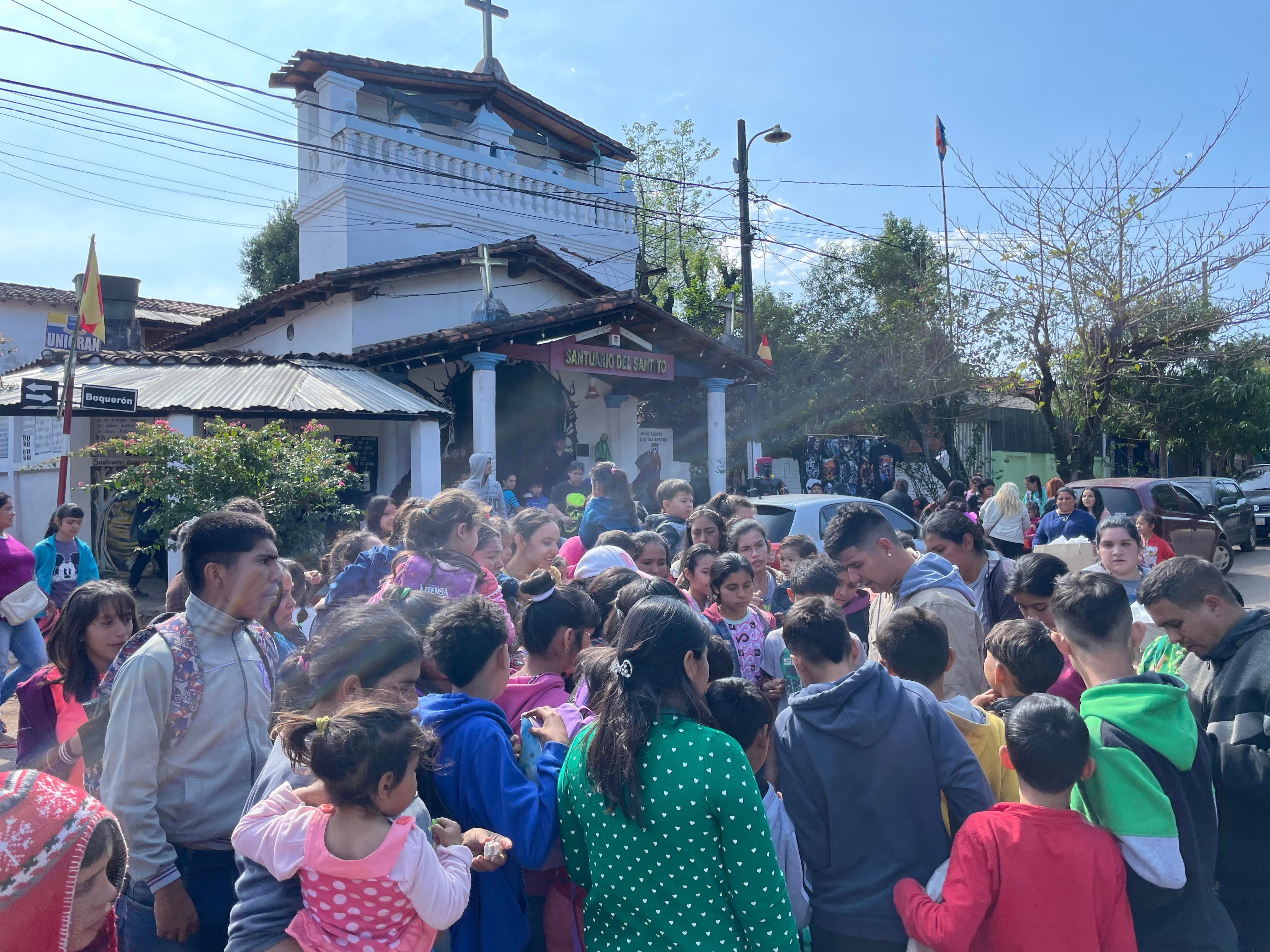
But San La Muerte offers shelter to many beyond bandits and ruffians. The sanctuary at Itá serves as a kind of community welfare centre, handing out donated food and cash to the needy, housing recovering drug addicts, even chipping in for the restoration of the local Catholic church. Interspersed amid his Tarot readings, Nicolás doles out financial, dietary and relationship advice. He holds weekly services on Monday nights — a mixture of Latin prayers, music, and processions — and throws a rowdy festival on October 31 to mark Halloween and his own birthday.
Margarita Carvalho, a diminutive high-school cleaner with deep creases around her eyes, had walked for two hours along dirt tracks with her daughters aged 14 and 4 to attend a recent service. She didn’t only come for the free dinner (rice-and-chicken stew, frosted sponge cake, and grapefruit-flavoured soda), she explains. The priest is a father figure to her children, and predicts the future — even when it hurts. “The saddest thing was that he said my boyfriend was going to leave me. And he left.”
And with Paraguay’s public hospitals in such a parlous state, and mental health disorders on the rise, it seems many find comfort in staring death in the face — and making their peace with him. I meet believers who credit San La Muerte with helping them recover from brain surgery, scoring them good marks, keeping their businesses afloat, protecting their homes from thieves, and saving them from suicide.
“There are lots of us devotees of El Santito,” says Luz Mendoza, a middle-aged acolyte with long, bottle-blonde hair. Her congregation of 160 people in Limpio are building the town’s biggest chapel to San La Muerte to date, she says. “It’s growing, every day, among all kinds of people. Even the kids like Saint Death.”
What We’re Reading
A Funeral for a Forest. Environmental activists and residents lit candles and stood vigil last Monday outside the Bosque San Vicente, a patch of forest bordering a major tributary in eastern Asunción. Most of the 117 trees on the privately owned property are now being cut down, as locals lament the loss of the neighbourhood’s last green area. Its former public park is currently being squatted upon by a branch of the Colorado Party, like dozens of similar civic spaces across the capital. Abroad, President Peña has spoken of his plans to turn Asunción into “the greenest capital in the world”. Such rhetoric seems to count for little back home against plans to build yet more supermarkets, pharmacies, and gas stations atop the few remaining bits of nature.
A mooted constitutional reform “would be catastrophic”, writes Alfredo Boccia Paz for Última Hora. President Peña said last month that he plans to modify Paraguay’s 1993 constitution to allow local town halls to retain 100% of property taxes. But many suspect that the real aim is to introduce presidential re-election: something tacitly confirmed by Colorado senate leader Bachi Núñez. The topic is deeply controversial: when Horacio Cartes tried to force through rekutu in 2017, it ended with congress in flames and police shooting dead an opposition party activist in the headquarters of the Liberal Party. Boccia Paz is not against re-election per se, but worries about the limited “intellectual and moral capacity” of the current congress: “Leaving the drafting of a new constitution in the inept and irresponsible hands of that shower could lead us to a democratic collapse.”
A Guinness Book of Records judge visited Itaipu on November 1 — Agencia IP trills — to celebrate the greatest energy output of any hydroelectric facility in the world, with over 3 billion MWh produced since 1984. In fact, the colossal dam already entered the reference tome in 2021 as the world’s most expensive object, costing $27 billion to build ($72 billion adjusted for inflation). The real price tag — factoring in multiple readjustments to the debt that Paraguay only paid off in 2023 — is likely much higher. And while Itaipu’s output is notionally shared 50/50, Paraguay is forced by a 1973 treaty to sell its surplus to Brazil. As a result, the lion’s share of all that power has fuelled the industrial development of the South American giant, while its poorer neighbour remains with cents on the dollar. The treaty is now being renegotiated, and — despite some piecemeal wins — many fear that the status quo will fundamentally remain the same.
Culture Corner
Bring your eargplugs: Alt-rockers Sukeban are debuting their second EP Exorbitante this Saturday at La Otra Bar. The high-octane offering (think Libertines crossed with The Offspring) is already racking up listens on Spotify. Support comes from shoegaze/noise merchants Mi Sueño Póstumo (whose latest single REAL SUR dropped last week) and experimental grunge purveyors Marcha Gamma. It feels like Asunción’s live music scene has come back swinging post-pandemic. (Herrera 875 c/Tacuary, 10pm, G30,000)
Also on Saturday, Post collaborator William Costa is presenting his translation of Paraguayan Sorrow by Rafael Barrett at Literaity. His uniquely florid and deeply human literary style aside, the writings of the Spanish journalist (1876-1910) are a fascinating window into turn-of-the-century Paraguay, and many of the cultural quirks and social injustices that Barrett registered remain relevant to this day. There’ll be food and music, and there are strong rumours of a possible reading in English by an extra-special guest. (Chile 1027, 7.30pm)
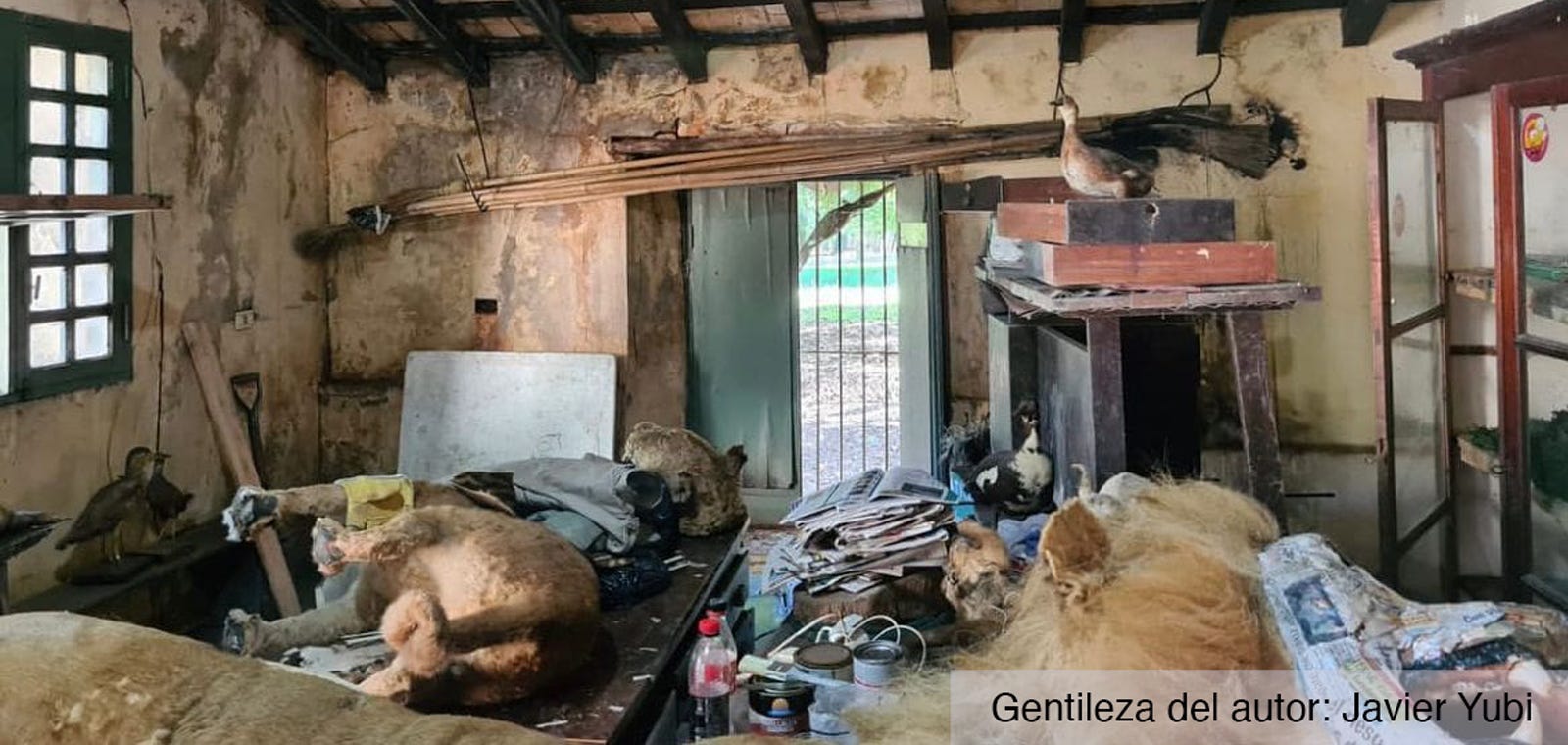
The Herbario Teodoro Rojas, located in the Jardín Botánico, is one of Paraguay’s oldest botanical collections. But it’s been abandoned, writes Bárbara Arce Querciola for MUPA. The walls and ceiling are crumbling from humidity. Insects are chewing the specimens. The archives are scattered amid discarded stuffed animals from the Natural History Museum next door. A plan was developed last year to build a new temporary space, rescue and digitise the records, and erect a statue to Rojas (1877-1954), a pioneering plant scientist who catalogued dozens of species. But nothing seems to be happening so far.
In other news: How much land did Stroessner steal? This chatbot can tell you | congress gets VIP benefits | Argentine mayor flees hitmen in Paraguay | Yaguarón gets paramilitary police | more deepfakes | a bus journey from hell | Bachi hoping for a Trump win | the Paraguay River is still falling | fighting corruption in the education system | PCC prisoners have knives, phones, and drugs | 2025 budget firms up | Santi interviewed by El País | the New Lithium Triangle stretches to the Chaco