


The victory of Donald Trump in last week’s US presidential election — while not exactly a shock outcome — was a seismic event that will have profound implications for the global economy, geopolitics, and even the Earth’s climate. But in Paraguay, many people had one question: what does it mean for Horacio Cartes?
The former president (2013-18) and current leader of the ruling Colorado Party has been subject to ratcheting US sanctions since 2022. The 68-year-old and his children are barred from the United States. His businesses, including cigarette manufacturer Tabesa, have been shut out of the US financial system. He stands accused — although not formally indicted — of disbursing millions of dollars in bribes to Paraguayan legislators and Colorado Party members, as well as doing shady deals with local proxies of Lebanese militant group Hezbollah.
Cartes has denied everything. And for some, these black marks can be washed away once Trump returns to the White House in January. “I’d love for [Cartes] to have a channel of communication to demonstrate that all of these accusations they have made against him aren’t true,” Santiago Peña — Paraguay’s president and Cartes’s political protégé — told reporters on Wednesday as the results became clear. He described the sanctions as “persecutions” and expressed hope that the United States would recognise Paraguay’s “enormous efforts in terms of human rights, strengthening institutions [and] combatting corruption.”
There are two schools of thought when it comes to the sanctions on Cartes. One is the view of the Peña administration and the cartista Honor Colorado faction: that they are personally motivated, based on false information provided by former president Mario Abdo Benítez and eagerly remitted to DC by Ambassador Marc Ostfield. In an interview with The New York Times last year, Peña called the thinking behind the sanctions “one of the great mysteries, along with: Could it be that man reached the moon?” In August, after the latest sanctions against Tabesa, foreign minister Rubén Ramírez Lezcano formally asked the US to speed up Ostfield’s departure. Under this line of thinking, a new administration — and a new ambassador — would iron out the misunderstanding and kiss and make up with Cartes.
The rival perspective — one maintained by Paraguay’s liberal opposition and the US Embassy itself — is that the sanctions are technical rather than political, based on solid intelligence, and unlikely to change no matter who sits in the Oval Office. They note that Hugo Velázquez, then-vice-president to Abdo Benítez, was also targeted by the 2023 sanctions. Washington’s man on Avenida Kubitschek, this argument goes, is merely a spokesperson for the remorseless, whirring machinery of the Treasury and State departments. His eventual replacement would have little choice but to maintain the pressure on Cartes, given the failure of Paraguay’s crooked judges and paid-off prosecutors to go after the country’s most powerful man — and the destabilising effects of organised crime in Paraguay on the hemisphere as a whole.
The reality probably falls somewhere in the middle. While the situation won’t change overnight, there is some scope for a shift in Washington’s approach to the Cartes conundrum. The sudden revival of Lezcano’s candidacy to lead the Organization of American States (OAS) suggests that Paraguay is counting on a friendlier White House. Trump — who has been convicted of falsifying business records and faces multiple other lawsuits — has long claimed to be the victim of a judicial witch hunt. He might be sympathetic to similar laments made by his Paraguayan fellow tycoon.
Marco Rubio, the Florida senator tipped to become Trump’s Secretary of State, may prove receptive to lobbying by the conservative Cartista bloc, keen to play up its family-values and anti-communist credentials. Two years ago, the Florida senator gave Peña a glowing write-up, praising his “staunch support for the American-led global coalition.” And Rubio shares the growing disquiet in DC about the Biden administration’s splatter-gun approach to sanctions, with more than 6,000 designations in the last two years alone.
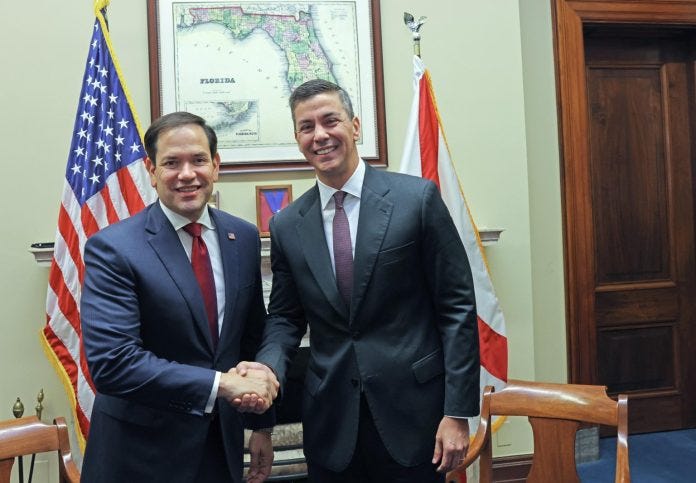
In February, he was one of eight GOP senators to sign a letter — published a few days after another meeting with Peña in Asunción — slamming Biden for having “politicized the sanctions process to target certain U.S. partners and undermine U.S. national and regional security while refusing to sanction egregious actions in the region by others,” with nods to Rafael Correa in Ecuador and Cristina Kirchner in Argentina. The letter didn’t namecheck Paraguay, but mentioned Guatemalan president Alejandro Giammattei — sanctioned for corruption in January despite having “strengthened relations with Taiwan, rejected ties with Beijing … and supported Israel’s right of self-defense”.
But let’s be real: Paraguay, while an important spear-head for Washington’s influence in the Southern Cone, is not exactly the top of any US president’s in-tray. Israel’s merciless assault on Gaza, Russia’s invasion of Ukraine, the possible outbreak of war with China over Taiwan, and the US-Mexico border will all be fighting for the attention of the next administration. It’s telling that Paraguay is one of just three countries in South America — along with Bolivia and Guyana — to have never been visited by a sitting or incoming US president.
Ostfield’s slated replacement — polyglot career diplomat Gabriel Escobar, who has formerly served in Serbia, Bolivia, Portugal, Pakistan and Iraq — seems unlikely to carve a radically different path to his predecessor. Even if the 47th POTUS were to ditch Ostfield and Escobar and parachute in some political appointee, it could be years before the US senate got round to confirming his post. As president, Trump will have the power to lift most sanctions. But the alleged link between Cartes and Hezbollah — currently at war with Israel — may dissuade Trump, Rubio and co. from cosying up to the former president on Avenida España.
My prediction: the visa and financial restrictions against Cartes, his associates, and Tabesa will remain intact in the coming years. But the press conferences held by the ambassador and visiting anti-corruption officials will be toned down significantly, and the possible third stage of sanctions recently hinted at by Ostfield — an extradition request — will fall by the wayside. Cartes will remain a weakened but dominant and vengeful figure. Washington will look on as the space for civil society shrinks further, and the papá guazú’s chequebook and media cutouts will deliver another Colorado victory under cartista candidate Pedro Alliana in 2028.
Meanwhile, there are other, more pressing dilemmas posed by the return of the MAGA movement to 1600 Pennsylvania Avenue. Some 30,000 Paraguayans live in the United States — especially in the New York and DC metropolitan areas, as well as Florida and California. How many will get caught up Trump’s promised deportation drive? Could his promised tariffs on foreign goods hurt Paraguay — already struggling to get its beef into the US — or even trigger a trade war and a global economic crash? Trump has dodged questions over whether the US will come to Taiwan’s aid if China invaded. Where would that leave Paraguay, one of just 11 countries that still recognises Taipei rather than Beijing?
I’d like to think that someone among Peña’s team is war-gaming how to shield Paraguayans from the economic and geopolitical turbulence that lies ahead. Instead, I see most of Paraguay’s political class united in guessing at what the transfer of power in the world’s foremost military-economic power means for tío Horacio.
It’s a morbid sign of how much Paraguay remains under the thumb of a man who never takes questions from reporters, doesn’t dare to leave the country, and was last elected to national office over a decade ago.
What We’re Reading
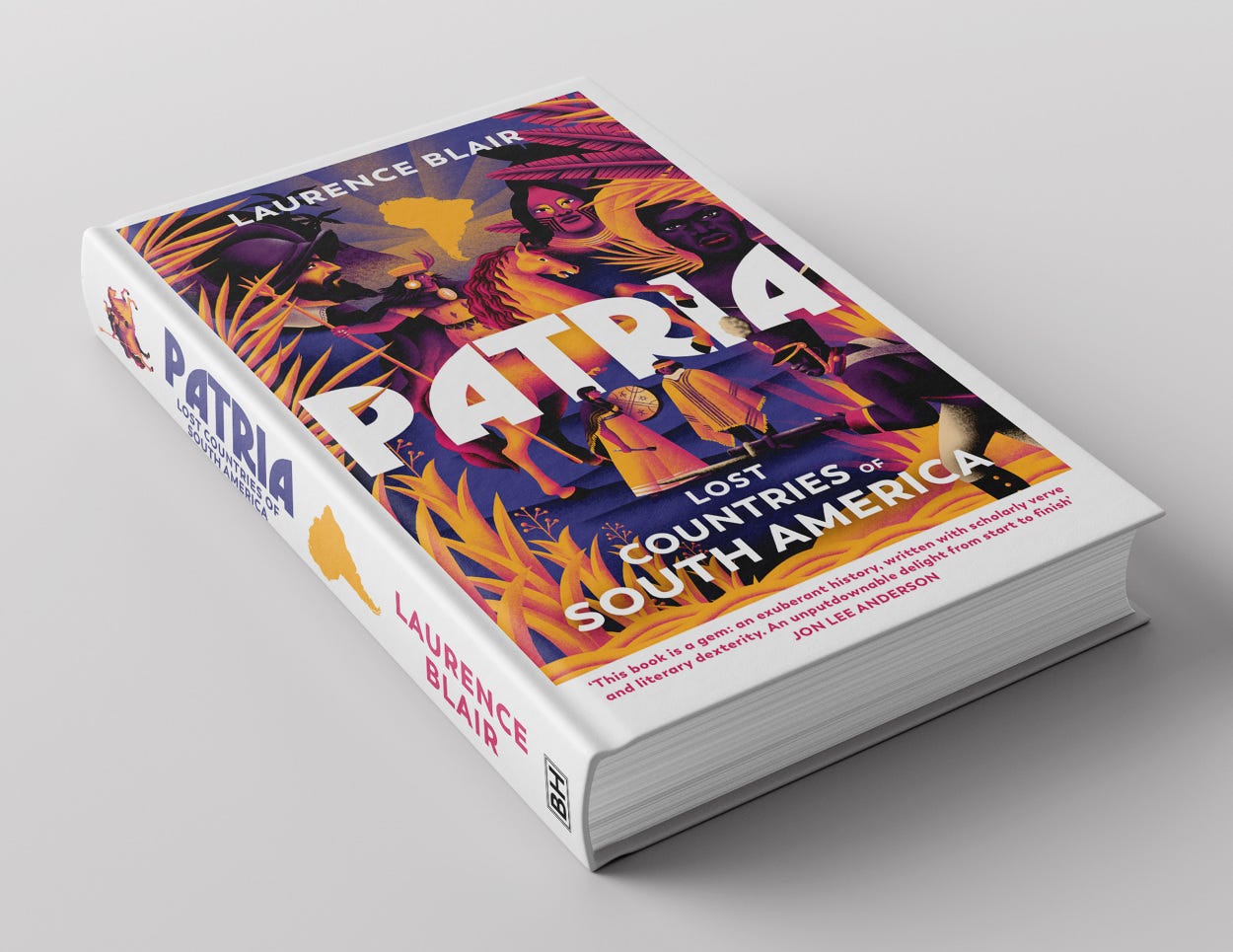
ICYMI: on Thursday, paid subscribers to The Paraguay Post got an exclusive look inside PATRIA, my debut non-fiction book on South American history. The introduction drops the reader into the frontlines of Paraguay’s drug war, as helicopter-borne special forces set fire to marijuana plantations in the very same northeastern jungle where Mariscal López — the self-styled Napoleon of the New World — was shot dead by Brazilian soldiers in 1870. Click the link below for a free trial and head here to find out more about the book, which is out now.
The latest issue of the Revista Historia Autónoma, the history journal of Madrid’s Autonomous University, is dedicated to Paraguay. There are some fascinating articles from local scholars and researchers from around the world, delving into the unexpectedly cosmopolitan society of early colonial Paraguay, British travellers to the newly-independent nation in the early C19th, Arab migration, women’s history, and representations of Stroessner-era Paraguay in the Brazilian tourist industry. Paraguay remains seriously under-studied, but this volume demonstrates just how much material there is to work with.
The Financial Times covers the anti-NGO bill: “Paraguay’s conservative president Santiago Peña faces pressure from investors and diplomats to veto a contentious law backed by allies of the country’s most powerful man, who helped propel Peña himself to power,” writes Ciara Nugent, Southern Cone correspondent for the FT. “The competing pressures over the bill to sharply increase government controls on non-profit organisations have presented business-friendly Peña with his toughest dilemma since he came to power last year, as he struggles to modernise an economy challenged by widespread corruption.”

Culture Corner
La Chispa celebrates its 10th anniversary on November 16 with the mother of all street parties. The DIY cultural space has resisted efforts to shut it down on spurious “noise pollution” grounds — there are a dozen open-air parties every weekend in el centro that are far more disruptive — by moving a few blocks away. But the line-up is punchy as ever, with headliners Milkshake, Dominika and Purahéi Soul compered by drag superstar Envidia Metenes. Last time, your correspondent sustained minor burns from flaming footballs and a molten judas kai. For something more sedate, turn up in the afternoon for street food, arts and crafts, and vintage clothes. (El Teatrario, Garibaldi y Presidente Franco, from 4pm)
Keeping with the history theme: the Archivo Nacional has inaugurated a new display of manuscripts related to Indigenous servitude in the yerba mate plantations of colonial Paraguay. Whether that’s your bag or not probably depends on how well you can read seventeenth-century scribal hand. But it’s a beautiful and well-kept space, and the archivists are always delighted to show visitors around. (Palma y Iturbe, M-F 7am to 6pm, Sat 8am to 9pm)
For Revista Pausa, Laura Ruiz Díaz interviews Lanto’oy’ Unruh, a prize-winning artist from the Indigenous Enhlet people of the central Chaco. He sketches wildlife scenes, photographs of community celebrations, and paints — skeletal, anthropomorphic trees; phantasmagorical hunters in feathered headdresses. Lanto’oy’ emphasises that his work aims at keeping the historical memory of his people alive. Decimated by invasions and epidemics, the Enhlet remain marginalised by Mennonite settlers. “We’re all here, regardless of the colour of our skin,” says the young artist, whose work is currently on display at the Alianza Francesca and the Museo del Barro. “We’re all Paraguayans, and all equals.”
In other news: Rafael Barrett in the Guardian | German consul killed in car crash | Tuberculosis in prisons | Santi and Horacio booed | plans for port regeneration revealed | Did Lalo shoot first? | Paraguay’s pumas adapt to ranches | Bitcoin boom rolls on | anti-Messi law