


TOP STORY
The Weird and Wonderful World of Paraguay’s Mickey Mouse
Visit pretty much any Paraguayan supermarket or convenience store and you’ll see a familiar — and surprising — sight.
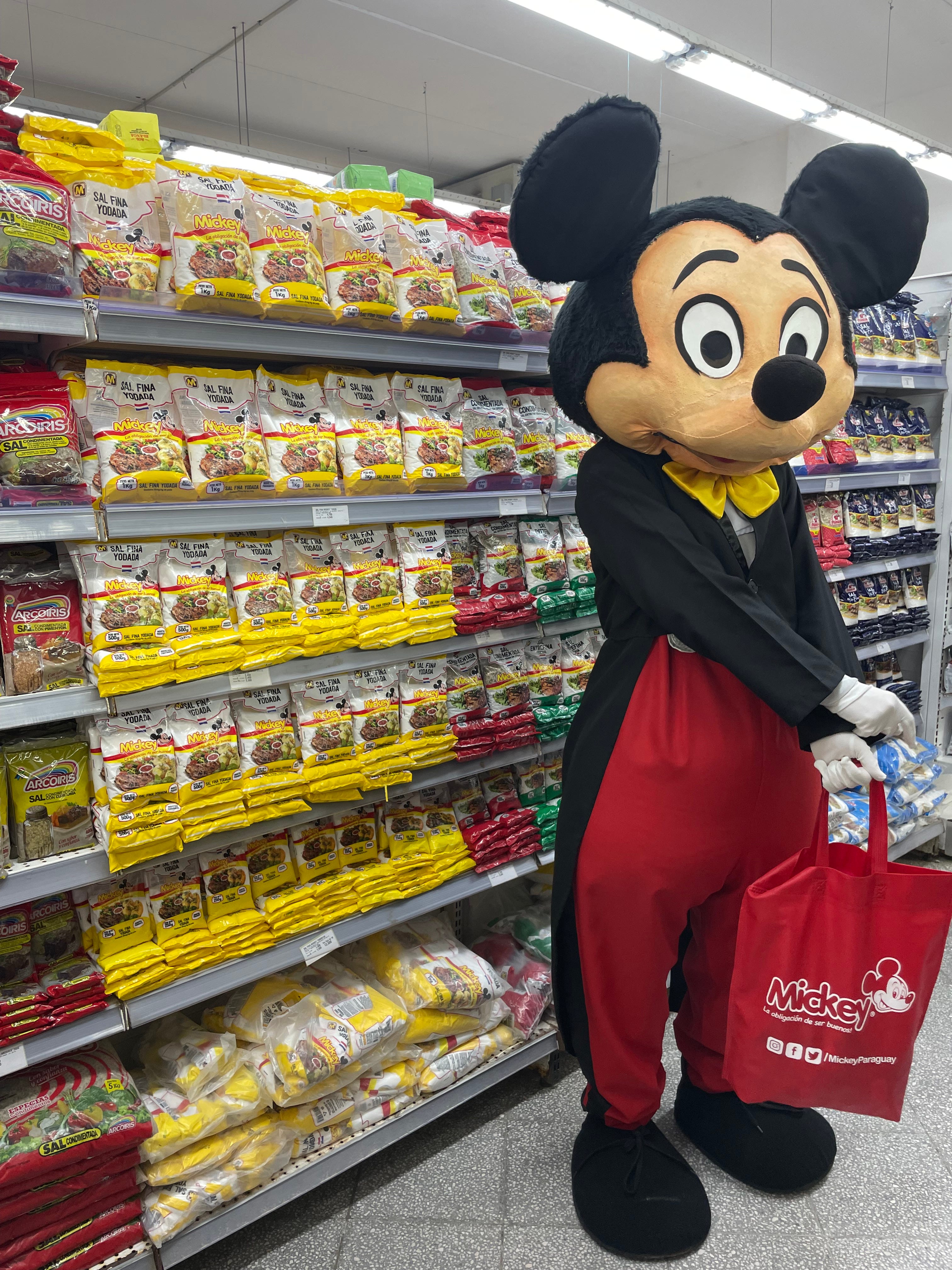
Packages of herbs, condiments, and baking ingredients decorated with a cheerful, button-nosed mouse: labelled with the name Mickey, and all but identical to Mickey Mouse.
When you first spot the red-and-yellow packaging, you might assume its part of a licensing agreement with the Walt Disney Corporation.
The impression of a corporate tie-up is only strengthened when you see the Mickey mascot out and about around Asunción.
Mickey — pronounced locally as MEE-kay — gives out free samples at supermarkets, presses the flesh at food industry events, and is even known to appear as the guest of honour at weddings.
But the true story is much stranger: and speaks volumes about Paraguay’s distinctive history, gastronomy, and popular culture.
The legend of Mickey — as I wrote for a story that featured on the front page of The New York Times — began in 1935.
The Blasco family, recent immigrants from Italy, opened an ice cream parlour in downtown Asunción. Perhaps inspired by the early black-and-white movies of Mickey Mouse, they called their shop Mickey.
Their cheerful branding was a hit with Paraguayans still suffering from the aftershocks of the cataclysmic Triple Alliance War (1864-70) as well as the Chaco War (1932-5), which saw 100,000 Paraguayans and Bolivians perish in the parched, thorny outback.
By 1969, the family business was selling packages of baking soda decorated with the famous rodent.
In 1978, they moved into a larger premises — the company’s current location on Avenida Félix Bogado — topped by a 62-metre Christmas tree. Some say the tree being switched on is the official start of the festive season.
Today, Mickey is a household name whose spices, seasoning and herbs — from boldo to begonias to yerba mate — fill cupboards, stews, soufflés and yerba mate gourds across the nation, including the Chaco.
Mickey scratches the sweet spot in the Paraguayan psyche, the TV chef Euge Aquino, who promotes the company’s products to her Instagram following, told me.
It conjures up sentimental images of Christmas, of Disneyland, of your abuela’s cooking — and even nationalistic pride.
On August 16, Paraguay celebrates Children’s Day. The date commemorates the massacre of Paraguayan child soldiers by Brazilian troops at the Battle of Acosta Ñu during the Triple Alliance War.
The Mickey mascot marks the occasion by handing out sweets and popcorn to a horde of children outside the factory gates.
“People came from the countryside to see him,” Aquino told me, recalling how she lined up with friends to meet Mickey in the 1980s. “It was a religion.”
The firm’s commercial director, Viviana Blasco, asked me not to disclose the real identity of the mascot in order to preserve the “magic” of Mickey.
But The Paraguay Post can reveal that a father-and-son duo who have worn the Mickey suit for decades — usually in shifts, to cope with the sweltering summer heat — are preparing to pass the torch.
The elder is a long-serving factory worker, the younger a mechanic. But the apprentice is a professional mascot.
“I auditioned to be the Duracell Bunny,” said the new recruit, warming up inside an office. “But it’s a nightmare to put on that outfit, with all the padding and the big battery on the back. This one’s much easier.”
“We don’t do it for the money,” he added, before donning the felt-and-fibreglass rodent head, getting into his silent character, and strolling out to his adoring public.
Mickey’s rise to the status of national treasure was nearly derailed in 1991 when Disney’s lawyers finally came knocking.
Blasco vividly remembers being given the news: “We have a problem.”
The global entertainment behemoth filed an IP violation complaint with Paraguay’s Business Ministry, then a trademark tribunal, before the case worked its way up to the country’s highest court.
Wading through stacks of the litigation, I found that one Supreme Court minister agreed people could easily confuse the Paraguayan Mickey with Disney’s Mickey.
But the Blasco family business had a formidable advocate in its corner.
Elba Rosa Brítez, a 72-year-old senior partner at local legal firm PSTBN, received me in a study lined with rusty sabres and cannonballs from the Triple Alliance War.
”I was a born litigant,” she said, recalling how her practice normally defends multinationals like AB InBev and American Cyanamid against upstart challengers and copyright thieves.
“This was the exception,” Brítez added. “I wanted to help my fellow countrywoman, a Paraguayan business. And I found a legal loophole to defend them.”
The Blasco family had registered the Mickey trademark in Paraguay decades previously — and repeatedly renewed it — without any protest from Disney.
Perhaps the Corporation simply hadn’t heard of Mickey until then, Brítez suggested.
In any case, in 1998, the Court ruled that Mickey had — through years of uninterrupted use — acquired the right to be Mickey.
“You don’t know how I jumped for joy when they issued the ruling,” Brítez told me, dismissing the popular legend that the Blascoes had hoodwinked Disney’s lawyers by registering the image of Mickey in profile rather than face-on.
I asked her if Disney could mount another challenge in the future — especially if Mickey tried to sell its products beyond Paraguay.
“Maybe,” she conceded. “Nothing lasts forever, right? But it will be hard for them to win through the courts.”
The Blasco family, she added, “has acquired rights, and that’s respected. Mickey will still be around for a while yet.”
THE POST TAKE
You can read different morals into the tale of Mickey.
One is that Paraguay has long been something of a wild west when it comes to copyright protection and intellectual property.
The authorities occasionally bust factories producing fake designer sportswear of the kind that lines the passageways of the Mercado 4.
In July, DINAPI, Paraguay’s intellectual property agency, confiscated 200,000 bottles of counterfeited perfume — probably imported — in a private port at Villeta. Overall, the country seized nearly 985 tonnes of illegal merchandise in the first seven months of the year.
Until recently, a fake “Harvard University” handed out bogus legal and medical degrees from a tower block in Ciudad del Este.
Paraguay — like Peru, Brazil, and Argentina — remains on the USTR’s Watch List, which cites “serious IP enforcement challenges” and describes Ciudad del Este as a “notorious market for counterfeiting and piracy.”
The elephant in the room — one rarely disturbed by inspectors — is Paraguay’s production of roughly 45 billion cigarettes annually when domestic demand is barely 1.5 billion. The rest are smuggled abroad.
But the enduring popularity of Mickey also speaks to Paraguay’s sense of itself as a scrappy underdog, up against the world: a societal personality trait which also came to the fore during the World Cup.

Outsiders may cry foul at Paraguay’s gutsy, physical defence on the football pitch or its less-than-spotless business practices.
But defying powerful rivals and inventing ingenious workarounds is something of a national pastime.
The trend is exemplified by the phrase — usually deployed when someone has turned their glove box into an iced water dispenser for tereré, or transformed a motorbike engine into a petrol-powered plough — “Paraguayans haven’t conquered the world because they can’t be bothered.”
In the course of my reporting on Mickey, I found many people had taken the company’s dark horse victory against Disney to heart as a symbol of national pride.
“It’s nice,” one working-class mother told me, queuing up with her kids to meet Mickey outside the factory in August. “At least we won at something.”
Also in this issue:
Cartes turns on Ueno Bank · Opposition politicians jailed · IMF highlights deficit, consumer debt · The hunt for Chinese and Cuban agents · Jailed governor hospitalised · Doctor strikes resume · Marset ally busted
Want to keep reading? Claim your trial to unlock everything we publish, and access exclusive subscriber benefits.