DAY 1
Just after three in the morning on November 3, while most of the country was asleep, Paraguay’s Central Bank announced it was shutting down Ueno. The popular digital bank had slipped into insolvency.
Almost three million Paraguayans woke up unable to access their money. Many couldn’t pay for food, fuel, medicines, or the bus fare to get to work.
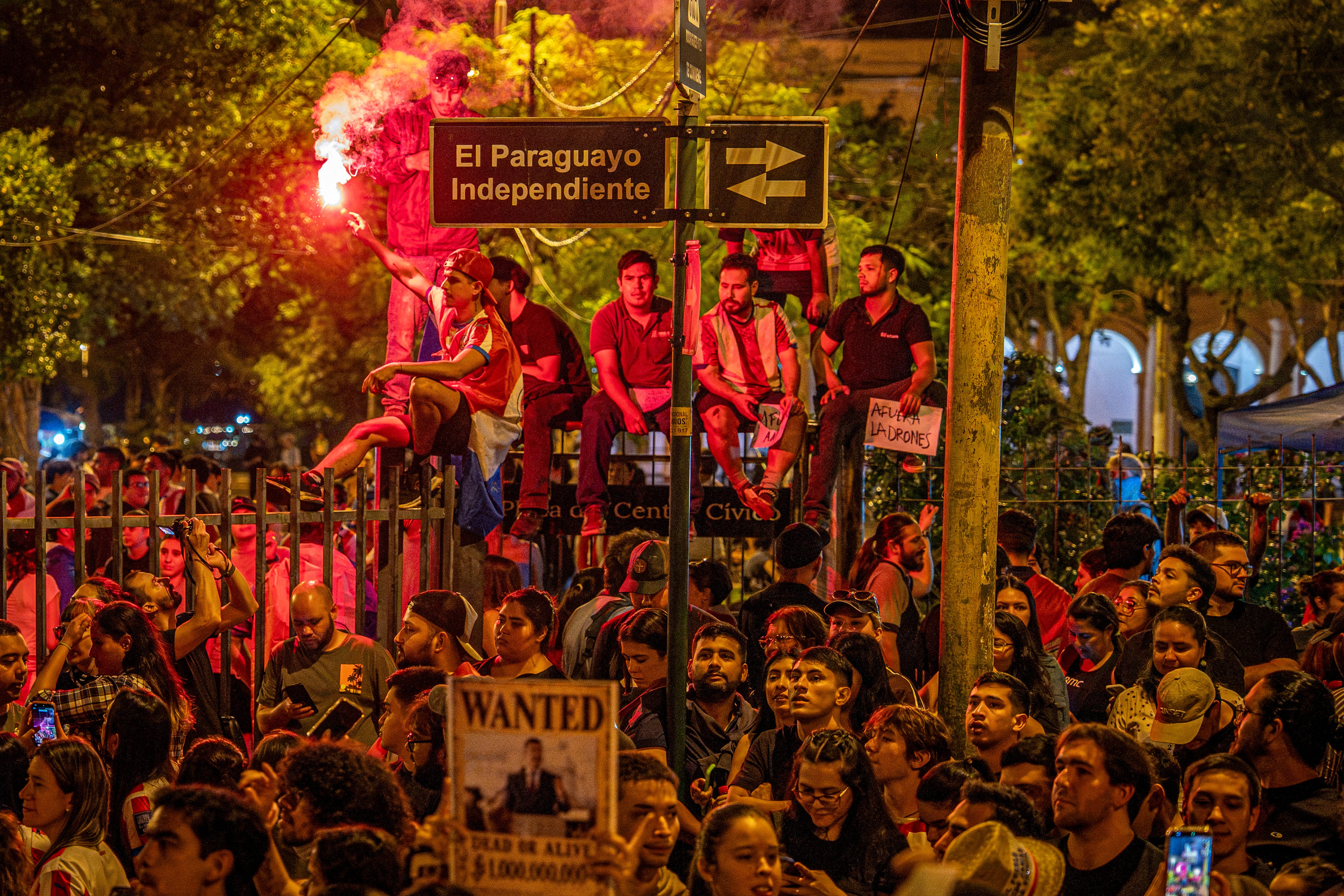
As the scale of the crisis became clear, protesters begin to gather outside the National Pantheon of Heroes.
The neoclassical church in downtown Asunción, the capital, holds the remains of Paraguay’s founding fathers. It’s the epicentre of night-long celebrations whenever the country’s football team, popularly known as la Albirroja, snatches a victory.
But this is no block party. Most of those present are young people, whose faces betray feelings of anguish, rage, fatigue, and pain.
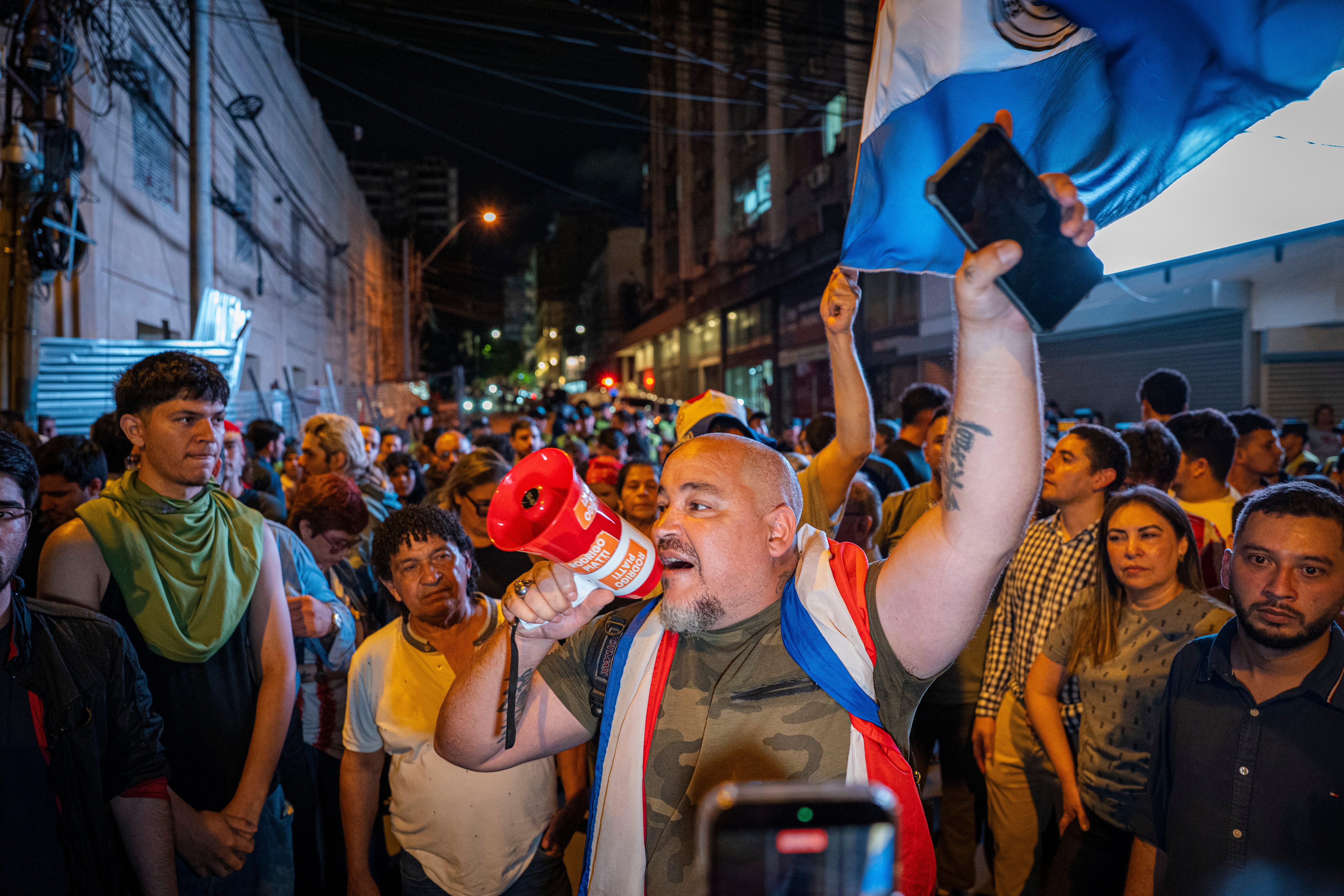
“I woke up without a single guaraní,” one demonstrator yells into a megaphone. “I had to borrow money from a friend to get here.”
“I’m here for my grandmother,” says another. “She was robbed. Her whole life savings are trapped in that bank and she’ll probably never get them all back.”


Some also broadcast live on social media with their cellphones, defying people at home to join them:
”Where is everybody who celebrates so hard whenever la Albirroja wins?”
The crowd swells. People want their money back from Ueno, the president gone, and those responsible in jail.
One young woman proposes abandoning the Pantheon and instead marching on Congress: “We’re not going to get anything done yelling at a bunch of dead people.”
The building pressure in the streets seems to spur the authorities into action, after years of sitting on their hands.
Ueno’s executives, including CEO Miguel Vázquez, are arrested on fraud charges. TV news shows several in hoods and cuffs. The Central Bank president Carlos Carvallo, formerly Ueno’s chairman, resigns.
But most of the top politicians behind the crisis remain in place.
President Santiago Peña, a conservative economist, held shares in Ueno’s holding group until last year — and borrowed half a million dollars from the bank to build a mansion.
DAY 2
The next day, fuel is poured on the flames of simmering social discontent.
An image of the president’s daughter, who attends Columbia University in New York, circulates on social media.
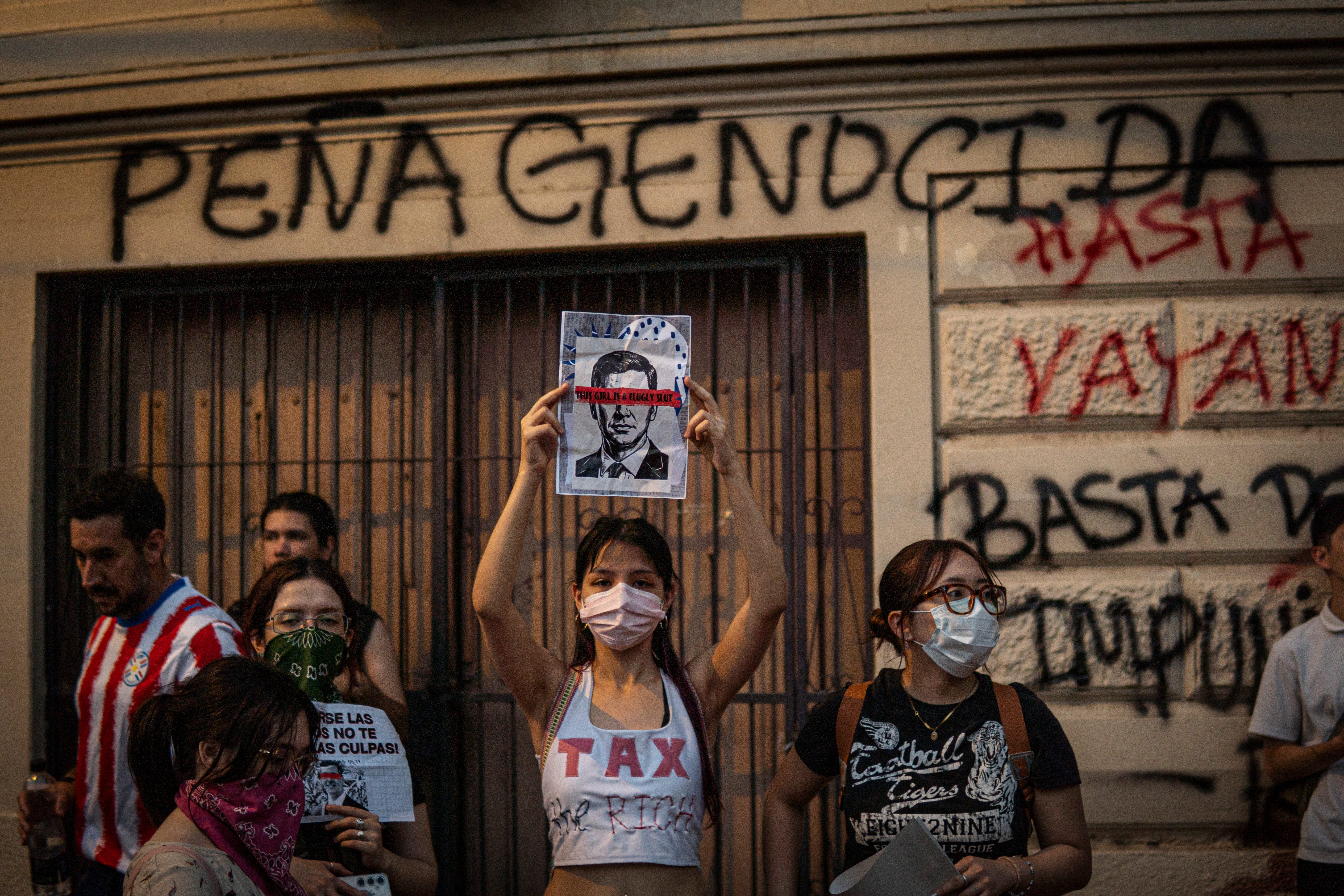
It appears to be an Instagram story posted by Constanza Peña taking a mirror selfie in the gym. She wears a T-shirt that reads Tax the Poor.
The implosion of Ueno — which captured $1bn in public deposits, and sucked in working-class savers with extravagant cashback deals of up to 50% — seems to have done exactly that.
Posters, banners and cardboard signs begin to multiply: Tax the Rich. Hang the Rich. Decapitate the Rich.


That evening, around 5,000 people gather outside Congress to demand the president’s impeachment.
The throng of people advances downtown towards the presidential palace, where police block their way.
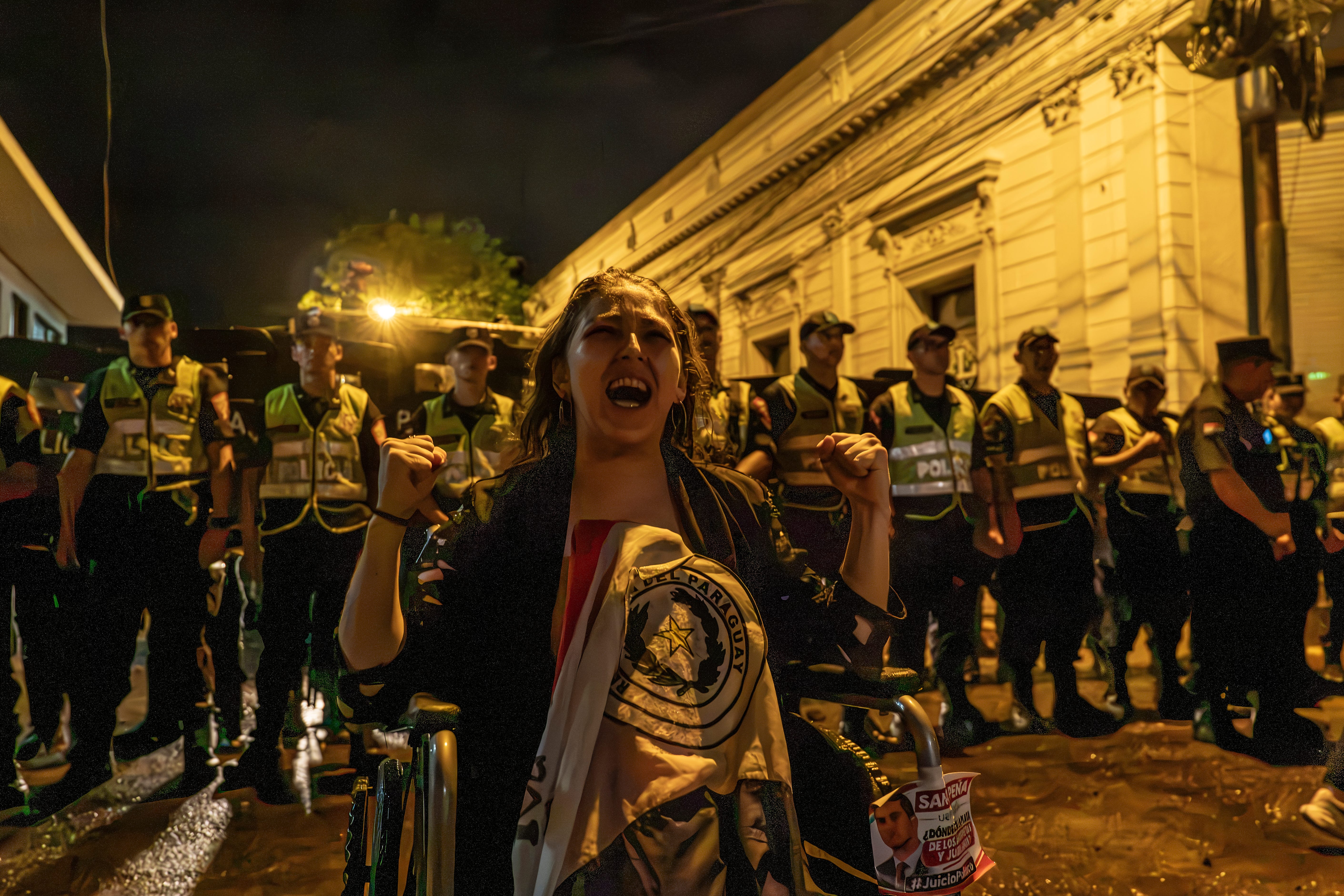
There are scuffles. The cops fire tear gas and rubber bullets; a water cannon mounted on a truck drenches the front ranks of protesters and police alike.


As the demonstrators scarper and regroup, Maya Yaluff, a young woman in a wheelchair, faces off against a phalanx of batons and riot shields.
“You don’t scare me!” she screams, her clothes soaked and torn.
The dramatic scene goes viral worldwide.
DAY 3
Santiago Peña resigns, with an apology that isn’t really an apology.
But opposition lawmakers, and the swelling protest movement, refuse to accept it. If he’s allowed to quit, he’ll become an honorary senator, and probably be immune from prosecution.
Most of those who have turned out are under 30. They’re students, precarious workers, and NEETs. Some wear hoods and masks and carry cardboard shields. Others wear costumes inspired by videogame characters. For many, it’s their first protest.
The Gen Z protests of September 2025 in Asunción — a viral movement with roots in Nepal and Bangladesh — soon fizzled out. But they seem to have provided a blueprint for the anti-Ueno, anti-Peña mobilisation.


The time and location of demonstrations seem to emerge spontaneously, passing from TikTok to WhatsApp groups to Instagram stories. Live-streamers spread the summons far and wide.
Women, who experience violence every day in the street and at home, take clear leadership roles: putting their bodies on the line once more.
Young activists from social movements also step up, sometimes producing disagreements about how to take over public space and attention.
In a highly informal and gig-based economy, and with weakened opposition movements, organising around a common goal is a challenge that demands new ideas.
Ernesto Ojeada is the leader of the Mbaeiko Jajapota gig workers’ movement. Its name, in Guaraní, is a nod to Lenin’s What is To Be Done? pamphlet from 1902. But in popular speech in Paraguay, it’s a common expression of resignation: What are you gonna do?


Ojeda puts forward a proposal: the formation of a mass union of workers precariously engaged as Bolt drivers, shoeshiners, streetsellers and an infinite number of other part-time gigs, known in Paraguay as changas.
Improvised assemblies and conversation circles meanwhile pop up on the grass of public squares.
Participants complain time and again of the same problems. How Paraguay’s young people lack any hope for the future. Of the broken promise that, if they studied and worked hard, they would get on in life.
How Paraguay’s politicians and corporate media talk of success gained through merit and effort: a smokescreen for insider advantages and inherited privileges.
A firebrand populist called Paraguayo Cubas, who picked up a quarter of the vote in 2023, tries to join the protests — but is egged by the crowd and bundled away.
DAY 4
On the evening of November 6, Paraguay’s Senate unanimously votes to impeach Peña.
A few hours later, he is arrested at his private Asunción residence — also surrounded by demonstrators — and taken to a military base to await trial. Carvallo, the former Central Bank president, hands himself in.
The crowd outside Congress celebrates Peña’s ouster. They pogo and chant: “If you don’t jump, you’re a Colorado” — meaning the red-shirted conservative moment that has ruled Paraguay for most of the past 80 years.


The vice-president, Pedro Alliana, is sworn in as Paraguay’s new leader. But he also belongs to the Colorado Party.
And he also took out a huge loan from Ueno — and was nearly impeached himself, before Colorado congressmen loyal to Horacio Cartes, a powerful ex-president and tobacco baron, saved his skin.
The jubilation in the streets is tempered with cynicism. A new slogan emerges: “Alliana and Peña are the same shit.”
AFTERMATH
Thanks to a deposit insurance fund, some 1.7 million people gradually get their money back. The nearly $1bn in public money, including some $500m in pensions, is yet to be recouped.
The trickling-down of people’s funds, and the need to make a living, causes the protests in the capital to lose steam.
But teachers strike on November 9 and 12 over their pension payments frozen with Ueno. Volunteer firefighters, whose most recent fundraising drive worth $300,000 is also trapped in the bank, blockade congress.
Larger savers not covered by the insurance scheme, which only guarantees deposits up to $38,000, also picket the Central Bank on November 17.
The following day, the new Central Bank boss says the deposit fund, and seized assets from Ueno, will be used to fully reimburse every individual and institution that held deposits with the bank.
But Ueno’s Wall St bondholders and local investors won’t get their money back, he adds, and could sue the government: “We need to be prepared.”
The Colorado Party remains in power. The opposition is divided. Paraguay’s next elections, in 2028, are under 18 months away. As the squares and streets empty, who will carry on the fight for a different future?