



TOP STORY
Paraguay’s financial reckoning
For months, Paraguay’s government insisted it was on course to bring the fiscal deficit back within the legal limit of 1.5% of GDP this year. It now admits that was never realistic.
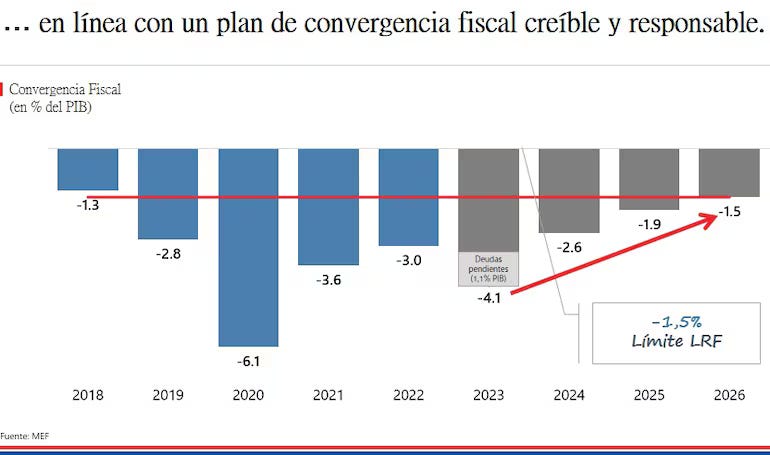
Economy Minister Óscar Lovera has confirmed that the gap between what the state spends and what it takes in will instead reach 3.2% of GDP in 2026, more than twice the target. Worse, the government expects it to rise further to 3.9% in 2027 — before supposedly plunging back to 1.5% in 2028, Santiago Peña’s final year in office.
The reason is simple: Paraguay owes a lot more than its official accounts let on.
At the end of 2025, the state had accumulated $1.27bn in unpaid bills, according to Lovera — around $1.05bn owed to pharma suppliers and another $220m to public-works contractors. The government had treated much of this as deuda flotante, or floating debt: invoices that had not yet been paid and therefore did not show up in the headline deficit in the same way as actual cash spending.
Think of it as balancing your household budget by simply leaving several months of utility bills unopened on the kitchen table. Your bank account may look healthy, but your true financial position is not.
This is precisely what critics have long accused the Peña administration of doing.
In November, the Post reported that delayed payments to drug companies, road builders, and suppliers to the Hambre Cero school-meals programme were allowing the government to present an artificially flattering fiscal picture. Former Central Bank president José Cantero estimated that including those unpaid obligations would push the real deficit towards 3.9%.
The government’s new figures amount to a belated admission that those concerns were justified.
Lovera argues that the underlying picture is less dramatic. Strip out the accumulated arrears, he says, and this year’s deficit would be around 2%; in 2027, about 1.9%. The extra spending is effectively the cost of finally putting old invoices through the books. Slower tax revenues — partly blamed on the strong guaraní reducing customs receipts — and lower income from the binational hydropower dams like Itaipú have also complicated matters.
But this is now Paraguay’s third attempt to return to the 1.5% ceiling established by its Fiscal Responsibility Law, last achieved back in 2018 (1.3%). The original post-pandemic timetable envisioned reaching it in 2024. When Peña took office in 2023, he accused his predecessor Mario Abdo Benítez of hiding unpaid debts to make the deficit look smaller, borrowed an extraordinary $600m to clear the slate, and pushed the deadline to 2026.
Three years later, Peña’s government is doing essentially the same thing — only with an even larger pile of unpaid bills.
The political backlash has been broad. Opposition senator Rafael Filizzola accused the administration of lying to Congress and the public about respecting fiscal limits, claiming that international scrutiny from the likes of the IMF ultimately forced it to acknowledge the true situation. Dissident Colorado senator Mario Varela likewise called for a more transparent and predictable fiscal policy.
Even Gustavo Leite, one of the more combative senators from Peña’s own Honor Colorado movement, has called the deficit revelations “very serious,” demanded around $400m in spending cuts, and lashed out at “inept” Economy Ministry officials. Others, like Yo Creo senator Rubén Velázquez, suggested raising the legal limit to 2.5%, given the current ceiling has only been respected three times in eleven years of the law’s existence.
The private sector is nervous, too. Economists and bankers warn that Paraguay’s hard-won investment-grade status can’t be treated as permission to keep accumulating debt. Former finance minister César Barreto says Paraguay’s reputation has already been damaged by repeatedly missing its fiscal promises.
And the new 2028 target may prove the least believable promise of all. Hitting 1.5% would require either significantly higher tax revenues, substantial spending restraint, or both. Yet 2027 brings mounting expenditures on social programmes, thousands of new government employees, and pressure for public-sector wage rises.
2028 after all, is an election year: hardly the moment when politicians take an axe to spending.
THE POST TAKE
There is nothing inherently scandalous about Paraguay temporarily running a deficit above 1.5%.
Governments sometimes need to borrow to clear overdue obligations or invest during difficult periods. Paraguay arguably can afford to tax, borrow and spend much more on things like health, education, and infrastructure.
The scandal is the accounting theatre.
Peña came to office as the technocrat who would tidy up Paraguay’s finances. A former finance minister and IMF economist, he castigated Mario Abdo Benítez for leaving unpaid invoices off the books, borrowed hundreds of millions of dollars to clean them up, and promised that fiscal normality would quickly return. Then his own administration allowed the same arrears to pile up.
Paraguay’s economic success story is built less on spectacular wealth than on a reputation for reliability: low inflation, manageable debt, predictable rules, and conservative fiscal management. Those credentials informed decisions by Moody’s and S&P to award the country investment-grade status and underpin Peña’s relentless pitch to overseas investors.
Being seen to cook the books — even through accounting practices that may technically be legal — corrodes precisely that asset.
The gimmick wasn’t harmless. The government spent months trumpeting growth, investment and macroeconomic stability while construction companies went bankrupt and laid off workers and patients complained of missing hospital supplies. All the while, former Economy Minister Fernández Valdovinos dismissed any suggestion of raising the debt ceiling.
Cleaning up the arrears will make the headline deficit look much worse in the short term, but that is preferable to continuing the fiction. The harder question is what comes next.
Returning from 3.9% to 1.5% in a single year would demand considerable political pain. Raising taxes remains taboo. Cutting popular programmes is electorally toxic. Slashing patronage, privileges, and inefficient spending would mean confronting interests inside the Colorado Party itself.
And the timing could hardly be worse. An emerging El Niño is expected to bring greater rainfall volatility and extreme weather over the coming months. For an economy heavily dependent on soy, beef, river transport, and hydroelectric power, floods, crop losses, or disruption along the Paraguay-Paraná waterway could weaken revenues just as the government needs them most.
Paraguay’s fiscal problem is therefore no longer mainly an accounting question. It is a test of whether Peña’s government is willing to make difficult choices or simply hand the bill, once again, to whoever comes next.
You’re reading The Weekly Post, your essential briefing on Paraguay.
In this issue:
Shell station on Costanera stirs scandal · Asunción mayoral race kicks off · Prieto heads to trial · Pharmacy mega-merger advances · Crypto entrepreneur found dead in Asunción · Real-estate developer calls in creditors · Cartes to the Senate?
Want to keep reading? Claim your trial to unlock everything we publish, and access exclusive subscriber benefits.
SPRING SPECIAL OFFER: Two months for free!