


TOP STORY
Here comes the rain
A potentially historic El Niño is gathering strength in the Pacific — and Paraguay is preparing for months of unusually heavy rain and hugely disruptive floods.
The US Climate Prediction Center says the weather phenomenon has an 81% chance of becoming “very strong” between October and December, potentially ranking among the most powerful El Niño events recorded since 1950. In Paraguay, officials expect a wetter spring and summer, with especially heavy rains from September through December and possibly into early 2027.
Eduardo Mingo, Paraguay’s director of Meteorology and Hydrology, says the first local sign is a relatively mild end to winter. As the phenomenon gathers energy, it could then intensify the thunderstorms that normally accompany Paraguay’s transition into spring and its hot, humid summer.
Every El Niño is different, Mingo cautions. The 2023–24 event produced serious flooding along the Paraná basin in Ñeembucú, Misiones, and Itapúa, while parts of the Chaco were drier than normal. Even so, some officials are sounding apocalyptic.
Defence Minister Óscar González claimed on Monday that there was a 99% chance of El Niño affecting Paraguay “in its worst version” from late August.
He put military vehicles at the disposal of the remote Alto Paraguay department and is negotiating fuel-storage facilities with Petropar in Chaco towns like Fuerte Olimpo, where prolonged rain can turn roads and airstrips into mudbaths and isolate settlements for weeks.
Emergency Minister Arsenio Zárate has meanwhile warned that Paraguay could receive around 200mm more rainfall than usual in late 2026. Engineering units have been deployed to clear waterways in Asunción and the surrounding Central department.
Cities in Paraguay face two distinct flood risks. Intense storms can unleash raudales — violent torrents that rush through streets, damage homes, and sweep away pedestrians and cars. These are worsened by the rubbish clogging streams and drains, while asphalt and concrete make it harder for water to disperse.
A slower, more inexorable danger comes from sustained rainfall across the Pantanal and the Paraguay and Paraná river basins, which can eventually push rivers over their banks.
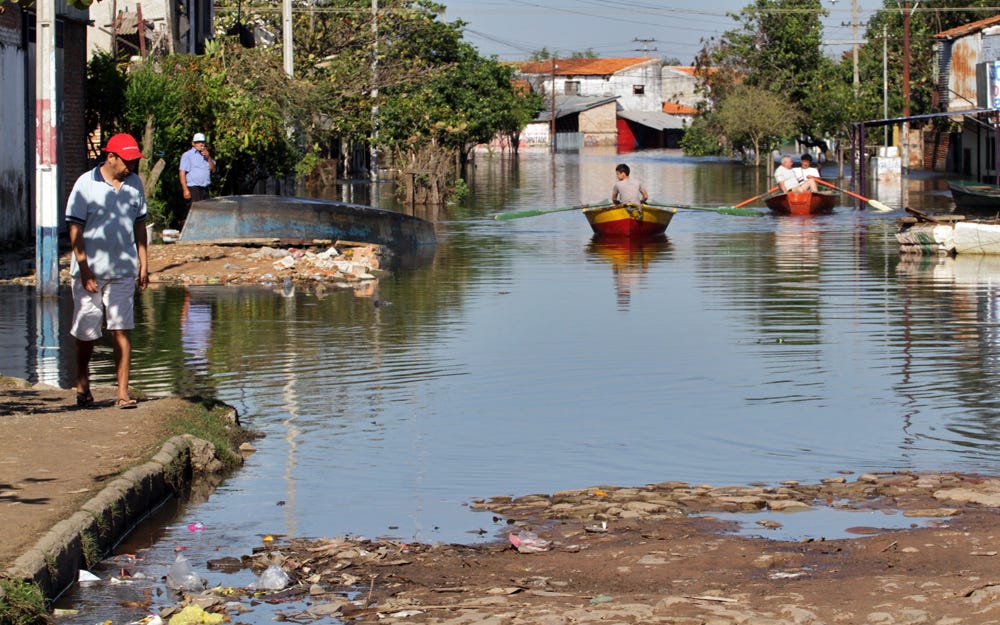
For riverside communities, especially Asunción’s bañados, that second danger can mean evacuation into improvised roadside camps. In Alto Paraguay and Ñeembucú, entire settlements may become accessible only by boat or aircraft. In the exceptionally strong El Niño of 2015, roughly 27,000 people were registered as flood victims in the capital alone.
For Paraguay’s export economy, however, rising rivers are a mixed bag. The landlocked country moves most of its international trade by barge through the Paraguay–Paraná waterway. More water can improve navigability, allow heavier loads and reduce delays caused by low river levels — although unusually high water, storms and strong currents can also disrupt ports and navigation.
The same ambiguity extends to agriculture. Édgar Mayeregger, the Agriculture Ministry’s risk-management coordinator, says crop and livestock yields during El Niño years often exceed national averages. Abundant rain can replenish soil moisture and revive pastures, but too much at the wrong moment can delay planting and harvesting, prevent machinery from entering fields, reduce crop quality, and favour pests and fungal diseases.
Hugo Pastore of grain exporters’ association Capeco says the sector’s biggest concern lies “outside the farm”: heavy rain can turn unpaved rural roads into mud, leaving grain and livestock stranded way before reaching silos, ports, or slaughterhouses.
Paraguay’s hydroelectric dams Itaipú and Yacyretá may benefit from stronger Paraná River inflows, lifting electricity generation after weaker hydrological conditions. But Paraguay is consuming more and more of its allocated power, meaning that less of this surplus will be available for sale to Brazil and Argentina.
THE POST TAKE
The government’s early preparations are welcome: meteorological agencies have been coordinating since March, the SEN is running simulations and stockpiling supplies, and municipalities are clearing channels and drawing up evacuation plans.
But there is a major gap between preparing to respond to a disaster and reducing the conditions that turn heavy rainfall into one.
Storms do not create rubbish-choked streams, neglected flood defences, homes built on floodplains, or roads that dissolve into mud. They expose failures that have accumulated for decades — in places officials already know, from past El Niño events, will suffer first.
The SEN is right to urge residents not to throw trash into waterways. But that message risks shifting responsibility onto individuals for failures rooted in irregular waste collection, uncontrolled urbanisation, and decades of weak drainage and housing policy. In Asunción, families are repeatedly evacuated from the bañados into improvised camps of clapboard houses in public squares — only to return to the same floodplain once the river falls.
The same contradiction runs through the economy. Record yields will mean little if crops cannot leave the farm, while extra hydropower will offer limited relief if the grid remains fragile, household demand surges, and the country continues courting power-hungry data centres.
Paraguay could emerge from El Niño with fuller rivers, stronger harvests, and greater electricity generation. Or excessive rain could swamp fields, cut off towns, spread mosquito-borne diseases, and once again drive thousands of poor families from the riverbanks.
Most likely, it will do some of both.
El Niño will therefore be a nationwide test of whether the government’s preparations amount to more than press conferences — and whether one of Latin America’s fastest-growing economies has invested enough in the roads, drainage, housing, and planning needed to withstand a predictable climate shock.
You’re reading The Weekly Post, your essential briefing on Paraguay.
In this issue:
2028 field gets crowded · Peña eyes extractive energy boom · New fiscal deficit ceiling? · More jobs, more underemployment · Paraguay signs US nuclear cooperation deal · Yankiguayo influencer accused of exploiting Ayoreo · Paraguay’s gift to friendship
Want to keep reading? Claim your trial to unlock everything we publish, and access exclusive subscriber benefits.
SPRING SPECIAL OFFER: Two months for free!