



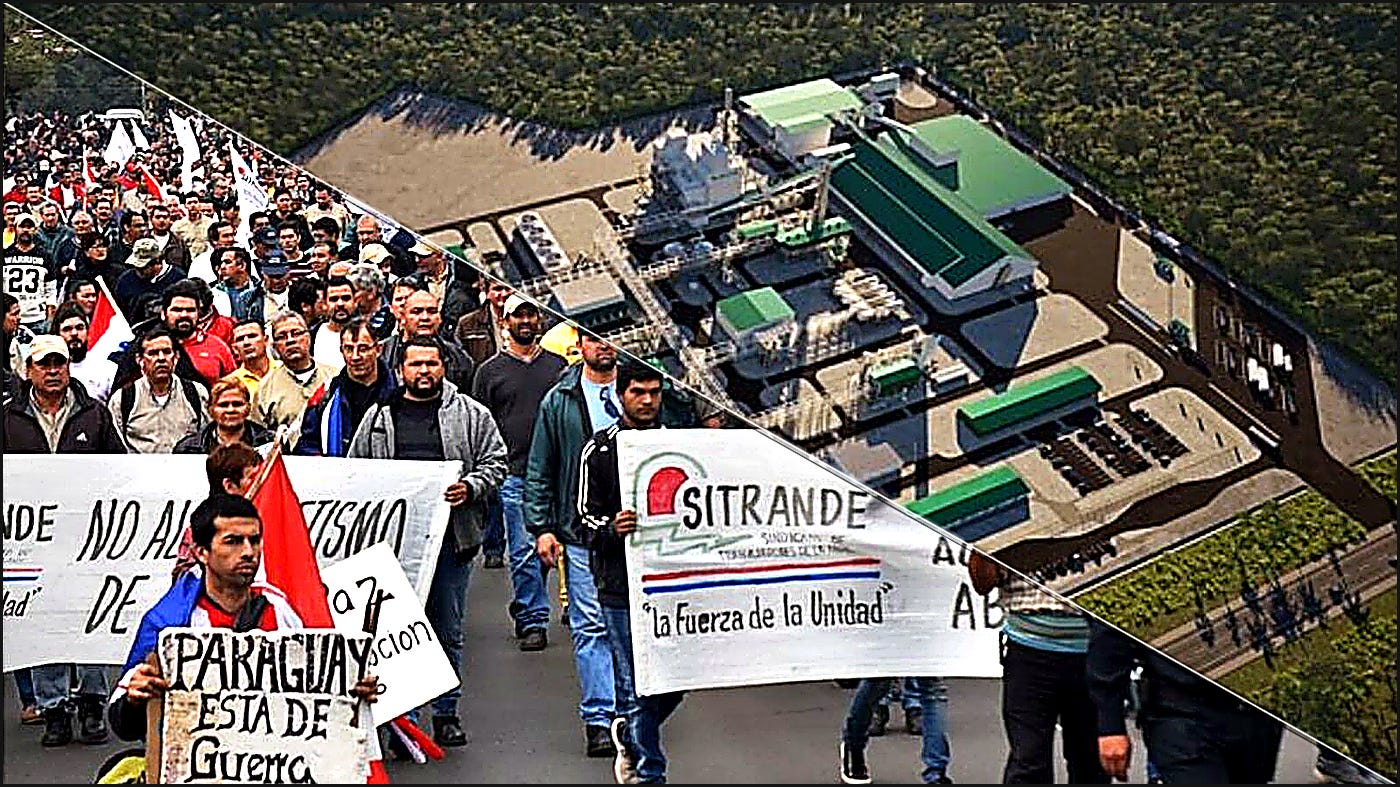
TOP STORY
Union opposition puts massive fertiliser plant on the skids
By Laurence Blair
It’s slated to be one of the largest private investment projects in Paraguay’s history.
In late 2021, British company Atome announced plans to build a fertiliser plant worth half a billion dollars near Villeta, some 60km south of the capital, Asunción.
The riverside factory will use Paraguay’s cheap, plentiful hydroelectricity – most of it produced by the massive Itaipú dam – to split hydrogen from water via electrolysis.
Early talk of this clean-burning gas being deployed to decarbonise Paraguay’s diesel-dependent trucks and buses has since fallen by the wayside.
But the facility will still combine said hydrogen with nitrogen to produce 260,000 tonnes of low-carbon fertiliser per year.
This product will reportedly be 20% cheaper than the usual fossil-fuel based ammonium nitrate produced by places rich in natural gas like Russia – and the Persian Gulf, where the war with Iran has bottled up a third of global fertiliser supplies.
“It’s not a green story,” Atome CEO Olivier Mussat recently told the Financial Times. “It’s actually a food security story.”
Meanwhile, the company has promised to create over 5,000 direct and indirect jobs: music to the ears of president Santiago Peña, who has made a top priority of boosting formal employment and diversifying the economy beyond crops and cows.
Since 2022, Atome has held a contract with Paraguay’s state electricity firm ANDE for a variable tariff of roughly $33/MWh. But the company has reportedly lobbied for a sweeter deal – a rate of $30/MWh, frozen for 15 years – citing the need for predictability.
Peña played ball. In January, he issued Decrees 5306 and 5307, which create a cheaper tariff category for “convergent industries” like green hydrogen, AI and crypto-mining.
After years of struggling to scrape together enough capital, in April Atome finalised a $665m package anchored by equity from investment management firm Hy24 ($115m) and $420m in debt financing from the likes of IDB Invest and the Green Climate Fund.
Mussat hailed the deal as a breakthrough, saying Atome’s “bankable industrial platform” would “revolutionise the global agricultural sector.”
But this arrangement blew up last week, after Peña abruptly annulled his energy-related executive orders. The 2022 deal with Atome was still intact, his ministers indicated, but the price freeze was off the table.
In a briefing to investors seen by the Post, Atome chairman Peter Levine said the company was “perplexed by this unforeseen development” and that only “urgent” talks with the Peña administration could prevent the project falling through and Paraguay’s investment and growth climate being seriously damaged.
The pin that punctured Paraguay’s hydrogen bubble? ANDE, or rather its union Sitrande.
Union members had threatened walkouts and a constitutional challenge to the decrees, arguing the real cost of powering a project like Atome is $44/MWh – and that selling below that means a $1bn shortfall for the cash-strapped public utility, a loss that will eventually be passed on to consumers.
Sitrande general secretary Adolfo Villalba accused government officials of being traitorous “sellouts” for offering the British energy company a “privileged contract.”
ANDE’s diminutive president, Félix Sosa, was caught in the middle. In a press conference, he denied being pressured by the Peña administration to wave through an overly generous deal for Atome, and suggested that “creative ideas” could be found to keep the project alive.
THE POST TAKE
Whether or not you’re wowed by Atome’s promises of cheap, green fertiliser for the world, all the flip-flopping is not a good look for Paraguay.
Large-scale, long-term investments like this are seriously complex to pull off. They have to factor in unstable global markets, commodity prices, geopolitics, fluctuating exchange rates and climatic conditions, and the quirks of Paraguay’s business environment (until the start of this year, for example, the country had three separate land registries).
Those calculations aren’t made any simpler if energy prices can be slashed or hiked overnight by a president’s pen or pressure from disgruntled union bosses.
Part of the problem is Peña’s penchant to micro-manage, court investors in person, and govern by decree, bypassing institutional channels. He is also known to conduct government business and coordinate press engagements via his personal WhatsApp.
But it’s also true that making further carveouts for a firm which already enjoys market-beating terms – Paraguay’s cheap land, affordable labour, and open-ended tax breaks under an FTZ concession granted in 2023 – has the whiff of subservience, even desperation.
Atome proudly says its model proves “the green transition doesn’t need subsidies to be profitable.” But as one friend of the Post put it: if your business model depends on securing publicly-owned energy at bargain-basement rates, maybe it’s not that much of a business.
The scandal has seen the press and pro-government commentators heap outrage on Sitrande: an unusually muscular union in a country where organised labour is far weaker than in neighbours Brazil and Argentina.
Some, including those who would love to see ANDE privatised, have accused the union of holding Paraguay’s development hostage to defend its own privileges.
Atome executive director James Spalding, the former director of the Paraguayan half of Itaipú under president Horacio Cartes (2013-18), has scorned the union’s public defence of “our energy”.
“It turns out they were talking about their energy,” Spalding retorted. “It belongs to them, and they’ll decide who to sell it to, for how long, and for how much.”
Seen in a more sympathetic light, Sitrande is sticking up for transparency, due process, and one of Paraguay’s few strategic assets – its huge hydroelectric surplus.
The question of how to turn all that energy into lasting development is one that has vexed Paraguay for decades.
And it’s becoming more urgent as Brazilian factory owners flock to Paraguay, massive data centre projects backed by Taiwan and the US wait in the wings, and the country’s spare electricity is forecast to run out by 2030.
The old adage doesn’t just apply to money. In Paraguay, power – who has the right to it, under what terms, and for what purposes – is also power.
You’re reading The Weekly Post, your essential briefing on Paraguay.
Also in this issue:
Consumer confidence plunges · A second pulp giant? · Taiwan plans data centre in Paraguay · Public funds allegedly used for attack ads · Commando heist in Santa Rita · Manzoni threatened for environmental reporting · World Bank backs growth outlook
Want to keep reading? Claim your free trial: