


MUNICIPAL ELECTION SPECIAL
Mother of cities, mother of battles
Residents of Asunción go to the polls on October 4 to decide who will run Paraguay’s beloved but dysfunctional capital for the next five years: a period when the city will be in the global spotlight like never before.
Sunday’s municipal elections, also taking place in 263 districts across the country, will pit the centrist former housing minister Soledad Núñez, 43, against longtime Paraguayan Olympic Committee boss Camilo Pérez, 57.
Both claim to represent change. Each has promised to reduce traffic, improve public transport, tidy up the streets, and fight waste at City Hall.
Polls suggest Núñez — who heads the Juntos por Asunción alliance of 16 small opposition parties, as well as being backed by the larger Liberal Party — is the underdog.
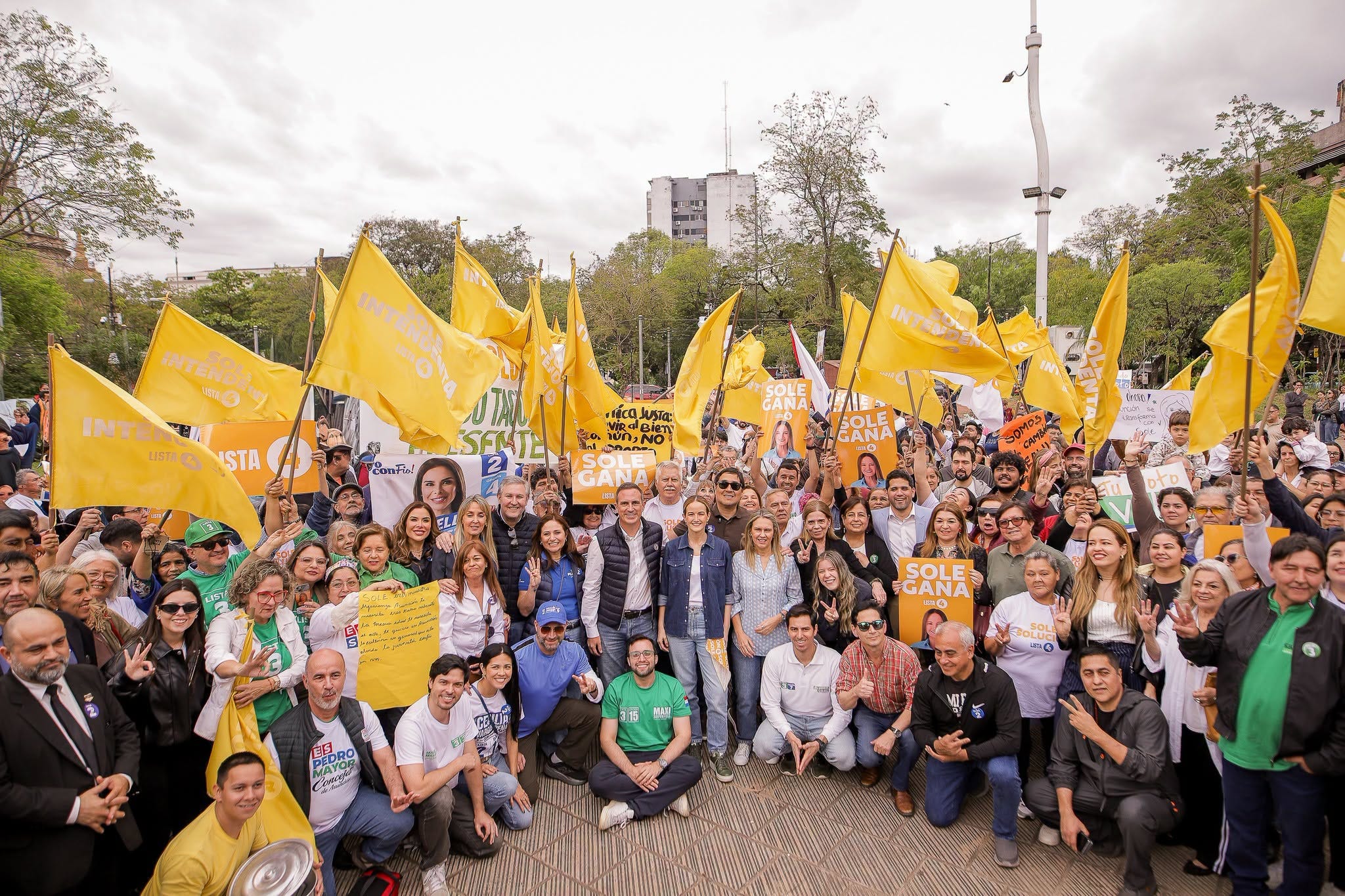
But the photogenic civil engineer has led an energetic campaign, reportedly touring all 69 of the capital’s neighbourhoods to listen to and canvas locals.
She has dismissed the surveys predicting a landslide victory for the ruling Colorado Party as a “sham”, and accused Pérez of being in the pocket of former president Horacio Cartes (2013-18).
“If we turn out on Sunday, the people win,” Núñez said at a closing campaign rally on Tuesday, where she appeared alongside opposition figures including Miguel Prieto, Johanna Ortega, and Ricardo Estigarribia.
“If we don’t, dirty money wins,” she added, calling on people to “trust that Asunción can be fixed if we come out to vote for something different.”
Núñez’s most eyecatching pledge is abolishing wheel clamps and the capital’s traffic cops, who are widely loathed for soliciting bribes. She says she will replace them with an “urban mobility agency” and a smart CCTV system using AI sensors.
Núñez has also vowed to kick out planilleros, penpushing time-wasters, from the 9,000-strong municipal payroll — and cut off “parallel cash flows” that she claims divert some 40% of the city’s budget to private individuals’ pockets.
“Nobody put me here and I owe nothing to anyone apart from you,” she said in a video message to social media followers on Thursday. “Enough with the abandonment of our city.”
Her campaign has also fielded a battery of other policies, from a 24/7 mental-health phoneline to free bus fares for students. She has also promised to restore a tram network to encourage visitors to rediscover the neglected historic centre of Asunción at the weekends.
Her pitch as a technocrat with advanced degrees from Oxford and Madrid is exemplified by her campaign jingle, Sole Solución (Sole Will Solve It).
But to put any of that into practice, she’ll have to defeat Pérez.
Formerly Paraguay’s top junior water skier and a South American Rally Champion, Pérez has no experience of elected office.
But he was handpicked by Cartes to succeed Óscar “Nenecho” Rodríguez and interim mayor Luis Bello, also Colorados, at City Hall.
Mayor Rodríguez resigned in 2025 after a probe found he diverted 500m guaraníes ($90,000) in bonds to pay for things like salaries. The cash was meant to go towards storm drains: the lack of which sees even wealthy avenues swamped by floodwater and sewage during heavy rains.

The avuncular Pérez has also strived to present himself as a breath of fresh air, with the managerial experience needed to get the house in order.
He says he will put Asunción’s best foot forward as it hosts an opening match of the 2030 FIFA World Cup as well as the 2031 Pan American Games — and prepares to mark its 500th anniversary in 2037.
“Asunción is going to be the capital of South America,” Pérez told Última Hora in June.
But he admitted that the financial debacle under Rodríguez had left City Hall in “intensive care”, and that there was “a lot of work to do” to reach his objective of a clean, safe, and pothole-free capital.
The backing of Cartes, one of Paraguay’s richest men, means the former youth tennis star has a formidable warchest and party machine behind him.
According to official filings, Pérez spent nearly 2.4bn guaraníes ($400,000) of his own money on municipal primaries earlier this year in which he handily beat dissident Colorado candidate Arnaldo Samaniego.
That’s more than seven times the amount Paraguay’s president, Santiago Peña, spent on his own primary campaign in December 2022.
Cartes’s support, say critics, comes with strings attached — and will limit Pérez’s ability to meaningfully clean up City Hall, widely considered to be a Colorado vehicle of jobs-for-votes.
The Colorado candidate has denied being a soft touch on deadbeat desk jockeys, saying he will cut 3,000 jobs through a programme of voluntary redundancies financed by the Inter-American Development Bank.
”Being a planillero is a crime,” he recently told TV news, “and it won’t happen under our administration.”
THE POST TAKE
Perhaps conscious of these liabilities, Pérez has declined Núñez’s challenge to hold a public debate, depriving asuncenos of the chance to hear them defend their proposals.
But Núñez also has weaknesses. She has no party machine of her own. Her tenure as housing minister (2014-18) under Cartes is a double-edged sword.
She points to a track record of delivering 10,000 units of social housing per year, up from 1,600 in the previous period, and running the department without any credible allegations of corruption. Her time in government also shows she can work with the Colorados where necessary.
But serving under Cartes — who had already been linked by press reports and leaked US diplomatic cables to drug-trafficking, and was later sanctioned by the US for corruption, allegations he denies — weakens her claim to represent a break with the Colorado “regime”.
In 2023, Núnez was on the opposition ticket to become vice-president to Liberal Party presidential candidate Efraín Alegre. Their lacklustre campaign contributed to the opposition vote fragmenting, and the cementing of Colorado control over the presidency and Congress.
In the weeks before the polls, The Paraguay Post repeatedly communicated with Núñez and her press team, as well as a spokesperson for Pérez, but neither campaign agreed to provide a time or place for an interview.
Two minor candidates — Rodrigo “little Bukele” Franco, who vows to purge City Hall of “parasites”, and Arlene Aquino, a notary who prioritises tackling potholes and trash — are unlikely to pick up many votes.
Whoever wins will likely have to cut deals with a divided junta municipal, or city council. Núñez is fielding a slate of candidates from a range of centrist movements.
Prominent figures on Lista 3 include urban environmentalist Rosa Vacchetta, the anti-corruption advocate and sitting councillor Pablo Callizo, and public transport campaigner Mauricio Maluff.

But these will face competition for the opposition vote from a leftist bloc, the Alianza Socialista Unida, which contains figures like María Denis: a community organiser who ran soup kitchens in the deprived Tacumbú neighbourhood during the pandemic.
The current council has 15 Colorado members and nine from the opposition. 70 percent of the incumbents, including two who have served for 25 years, are seeking re-election.
And the mayor’s formal power only extends to the limits of Asunción proper, whose population is under 500,000 and falling.
This means she or he will have to work closely with local mayors — including those in Luque, Lambaré, San Lorenzo, and Mariano Roque Alonso — to tackle traffic and transport across the metropolitan area of 2.3m people.
Outside the capital, the Colorados hope to recapture local government in Ciudad del Este from Prieto’s Yo Creo Movement, and retake city hall in Encarnación from an opposition alliance.
Nestled in a bend of the Paraguay River, Asunción has been romanticised in song as the “capital of lovers, orange trees and flowers.” Locals grumble about how the capital is run, but are remarkably attached to it.
Recent surveys by the CIIS, a think-tank, shows 38% of asuncenos love their city, while 43% like it despite its defects. Half said it had got worse in the past five years, compared to a third who said it had improved.
Over a quarter said corruption at City Hall was the capital’s main problem, followed by 10% for public transport, 9% each for crime and public health, and 8% the state of roads. A striking 42% said they never or almost never visited squares or parks, mainly because they were afraid of crime.
Of 1700 participants, 45% were affiliated with the Colorados and less than 10% with opposition parties. But only 29% said they actually supported the Colorados, while nearly half said they were fans of no political party at all.
Such data suggest that private polling by Núñez’s campaign indicating a groundswell of anti-Colorado sentiment could play into her favour.
And while the Asunción municipal race has typically proved a poor predictor of presidential polls, some are treating Sunday as a dry run for whether the opposition can come together to beat the Colorado machine in 2028.
A defeat for Núñez could be read as a failure of her managerial, apolitical style and strengthen the case for a more populist figure like Prieto — or even Payo Cubas — to be on the opposition ticket in 18 months’ time.
Sunday’s result is unlikely to make international headlines, or to change things overnight in Asunción. But it could subtly change the course of Paraguayan politics for years to come.
How to vote in Paraguay’s municipal elections
When: Sunday 4 October, 7am to 5pm
Who: Paraguayan citizens aged 18 and over, and foreigners with permanent residence registered on the electoral roll by 30 December 2025.
Where: Find your local polling station and table at padron.tsje.gov.py
Bring: Your cédula de identidad, valid or expired. Photocopies are not accepted.
How: On the machine, tap a mayoral candidate, a council list, and (if you want) a councillor within that list. The machine prints your ballot. Fold it and drop it in the box. Phones aren’t allowed in the booth.
Results: The preliminary count should start around 6pm, with a clear picture by 8pm.