



TOP STORY
Indigenous demonstrators blockade highway
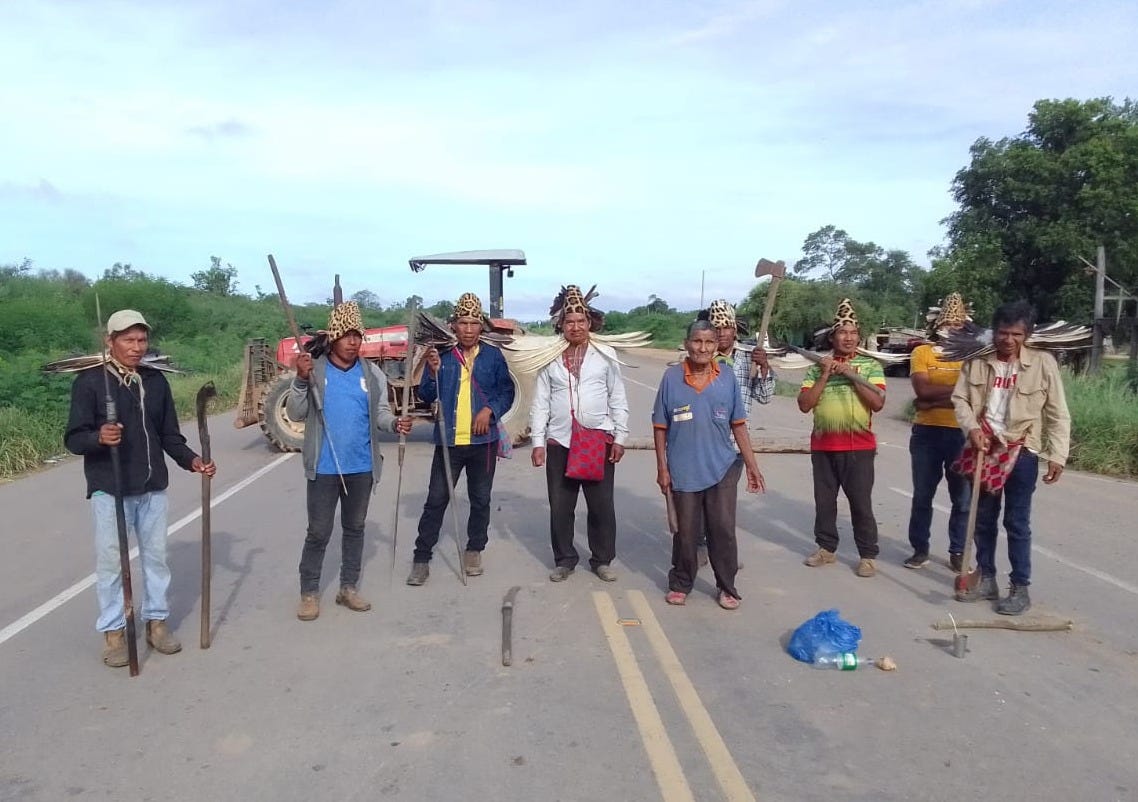
Over a hundred members of the native Ayoreo people blockaded a major highway in the Chaco in northern Paraguay on March 11 in protest of the “destruction” of their ancestral forest home.
Photos shared by Survival International, an NGO, showed Ayoreo elders wearing jaguar-hide caps — traditionally reserved for the fiercest warriors — and bearing spears and axes fanning out across the two-lane Bioceanic Road Corridor.
The Indigenous demonstrators also parked a tractor and laid tree trunks across the recently-asphalted route connecting agribusiness hubs in the central Chaco with ports on the Paraguay River.
“After forced contact, we have been abandoned by our government, which ignores our rights while allowing big companies to destroy our forest,” said Porai Picanerai, one of the Ayoreo leaders.
“Our uncontacted relatives depend on the forest,” he added. “We also depend on the forest. But it’s being destroyed by bulldozers and fires. Others make money from our forest while we are left with nothing, and our needs and rights are ignored.”
Demetrio Picanerai, a teacher from the Ayoreo community of Chaidi, also said the government had promised and failed to deliver emergency food supplies — as well as finish improvements to their school and drainage for their floodprone access road.
The Ayoreo — nomads who have long roamed the thorny Chaco outback between Bolivia and Paraguay — were one of the region’s last native cultures to enter into regular contact with the outside world. From the mid-twentieth century onwards, evangelical groups kidnapped them; Mennonite ranchers enslaved them. Many were killed or perished.
That process is still ongoing: the most recent group left the forest in 2004. And settled Ayoreo villagers say small groups of their isolated relatives are still out there. They are said to leave signs, tools, shelters — and are sometimes spotted flitting between the last patches of vegetation. They are the only group of their kind in the Americas outside of the Amazon.
“The satellite photos of western Paraguay paint a harrowing picture: just a few decades ago this was a vast area of Indigenous forest – now it’s a wasteland of destruction,” said Survival’s director, Caroline Pearce. “The uncontacted Ayoreo are trapped in a forest island that’s being destroyed by the day.”
The Chaco is by some counts the world’s fastest-vanishing forest. Around 27% of Paraguay’s portion of the little-known, arid ecosystem — a major carbon sink, and home to tapirs, jaguars and giant anteaters — equivalent to some 65,000 square kilometres has gone up in smoke since 1987.
The main culprit, say campaigners, are ranchers that fell the undergrowth to rear cattle for beef and leather that ends up in supply chains around the world. Pasubio, a leading European leather manufacturer that supplies luxury car brands like Porsche, recently said it was divesting from suppliers linked to deforestation in Ayoreo territory.
But Paraguay’s government has been slower to take action. The protestors accused it of failing to abide by a 2016 decision by the Inter-American Commission on Human Rights (IACHR) that called on the state to protect the Ayoreo, prevent incursions into their territory, and halt ongoing deforestation in the area.
Paraguayan law allows landowners in the Chaco to tear down 75% of vegetation on their property, providing small patches are left as windbreaks and beside roads and streams.
And previous protests by Ayoreo communities over lack of food and drinking water amid punishing droughts have been met not with assistance but with lawsuits – filed by the very officials tasked with protecting them.
It was unclear how long last week’s protest lasted or how much disruption it caused to transit. Similar picket lines imposed by native groups across Paraguay often function more as go-slows – with traffic allowed to pass every few hours – than permanent protest camps.
But while the protestors stood in the way of trucks, other Ayoreo leaders were delivering their message to policymakers and investors gathered in Asunción for the Annual Meetings of the Boards of Governors of the Inter-American Development Bank (IDB) Group.
Longwinded title aside, this year’s conference was an opportunity for the government of Santiago Peña to pitch Paraguay as a top destination for investment – and for the lanyard class to mingle at the Palacio de López and reassure each other that Peña’s Paraguay is on the up.
Yet taking the microphone in roundtables on the summit’s sidelines, Ayoreo elders punctured the rosy picture — and slammed the development bank for providing $200m to pay for major new extensions of the Bioceanic Highway that will further bisect their territories and pile greater pressure on native ecosystems.
“The highway affects families, our uncontacted brothers,” said Ronald Sereda Picanerai, the secretary of Ayoreo federation UNAP. “The authorities should talk with us and listen beforehand.” The new road will “benefit the soybean farmers,” he added, but for us, the Ayoreo, the highway brings negative as well as positive things.”
According the IDB, which is headquartered in Washington DC, the latest batch of tarmac will improve the access of around 28,700 people to hospitals: including more than 1,700 from Indigenous communities. And 99 population centers, including 23 Indigenous villages, will reportedly be able to reach secondary schools more easily.
In a statement, the bank said in addition to consultations held in 2017 when the Bioceanic Highway was planned, throughout 2025 it supported 36 free, prior and informed consent (FPIC) meetings with eight local Indigenous communities to discuss the road extension. Led by Paraguay’s public works ministry (MOPC) with the Indigenous institute (INDI) and with an Ayoreo translator, these ongoing meetings sought to understand and address the needs of the community.
Steps were taken, the IDB adds, to minimise the environmental impact of the new section of road – including rerouting it at certain points and installing underpasses for animals – which it says will generate “holistic human development” for locals.
Carlos Diri Etacore, an elder from the Ayoreo community of Ijnapui, expressed concern that future road projects would run through the Defensores del Chaco National Park: perhaps the largest remaining fragment of the forest, and known to be a refuge of uncontacted groups. “Everyone knows that the Ayoreo people survive from the forest,” he explained. “It contains lots of food and natural medicines.”
Aquino Picanerai, a leader from Campo Loro, said the IDB had “supported the government and given them tools to deforest [some of] the last forests in the world” rather than listen to the Ayoreo’s concerns. “I’m outraged,” he added, referring to plans to build a new paved road through 100 kilometres of pristine forest between Agua Dulce, Paraguay and Roboré in Bolivia. “They’re not consulting the people whose ancestral territory it belongs to.”
The IDB told the Post it wasn’t involved in any Ruta 16 project and referred questions on the topic to the MOPC.
In a separate development, a statement issued on Sunday warned that outsiders with tractors, trucks and chainsaws have been carrying out “illegal mass deforestation” in the territory of Yvy Pyte, a native Pãi Tavyterã village in Amambay, northeast Paraguay.
The press release — signed by seven NGOs and multiple prominent figures from the Church, the arts, left-wing politics and academia — said the destruction had surged since the start of this month and threatened to reach Jasuka Venda, a sacred forested hill considered by the Pãi, a Guarani-speaking people, to be the centre of the earth.
Logging of primary forest is technically illegal anywhere in eastern Paraguay, where a zero-deforestation law was passed in 2004 — but not before 75% of its biodiverse Atlantic Forest had already been chopped down, bulldozed and burnt.
The statement was accompanied by images of felled tree trunks beside a local school, and contained a single, collective quote from an assembly of Pãi leaders: “Our forest is being hollowed out before our eyes.”
THE POST TAKE:
The Ayoreo roadblock in the Chaco — and the Pãi Tavyterã’s denunciation of illegal deforestation on their territory in Amambay — should concern Paraguay’s government and would-be investors for multiple reasons.
The most important is that Paraguay’s Indigenous peoples, who make up less than 2 percent of the country’s population, rarely raise their voices unless the situation is absolutely critical.
A day spent holding up traffic is a day without hunting or working — typically hard labour on a nearby ranch — and often means going hungry. It can earn the disapproval of powerful groups and employers, be it Mennonite cooperatives or ranchers’ associations. And calling out illegal activity is a risky and even deadly business when you’re surrounded by armed groups: uniformed and otherwise.
So when the Ayoreo and the Pai say they are starving and fearful for the future of their territories, it should give pause to policymakers like Santiago Peña who claim to be making Paraguay great again and building a better tomorrow for all its people.
But the protests also underscore enduring weaknesses in Paraguay’s business environment and its adherence to the rule of law: especially in northern regions that are touted as future motors for the national and even regional economy.
Standstills on the Corredor Bioceánico are disruptive enough when it only affects through-traffic from central Chaco towns like Loma Plata to riverside settlements like Carmelo Peralta and Fuerte Olimpo.
But when the international bridge linking Carmelo Peralta with Porto Murtinho, Brazil is completed — either this year or next — the 3,800 km highway will supposedly connect the Atlantic with the Pacific and become one of the continent’s major agribusiness corridors, funnelling thousands of trucks laden with beef, soybean and minerals towards Chilean ports with their cargoes bound for Asia.
That’s a lot of upheaval — and leverage — that barely a dozen native communities can bring to bear unless their complaints are heard. Add in the possible gas pipeline projected to hug the western portion of the highway, recently backed by the CAF multilateral bank, and the potential for disruption becomes even greater.
The northeast, too, is registering a spurt of private-sector activity: not just from traditional mainstay ranching, but especially forestry. The plantations of the eucalyptus and pulp giant Paracel extend from neighbouring Concepción into the dramatic table-top hills and patchwork native forests of Amambay.
If the land titles of communities that have lived here since time immemorial aren’t respected — foreign investors may reason — what guarantee is there that foreign businesses managed from thousands of miles away will be left to operate in peace?
The government of the day may promise streamlined paperwork, generous tax breaks, and enhanced security protection: including from U.S. military rotations.
But for all the sunny macroeconomic headlines of late, Paraguay’s greatest Achilles’ heel continues to be its lack of predictability: juridical, political, or social.
That uncertainty can translate into not knowing where your next meal is coming from, whether your community’s ancestral forest or your urban neighbourhood’s last green space will be here tomorrow – or if your multi-million dollar investment will turn out to be built on quicksand.
Welcome back to The Weekly Post, your essential briefing on all things Paraguay.
Also in this issue:
Will Marset sing? · Government revenues plunge · Growth stalls · Economy on “war footing” · Beijing turns up the heat · “Gringo night” sparks sex-tourism backlash
Want to keep reading? Claim your free trial — and unlock exclusive Insider Insight.