



TOP STORY
Paraguay’s health system in crisis
Paraguay’s government is struggling to calm the waters after a five-day strike by doctors and mounting resignations over pay and resources.
Medics say stagnant salaries and shortages of medicines are stretching personnel to breaking point — and putting patients’ lives in danger.
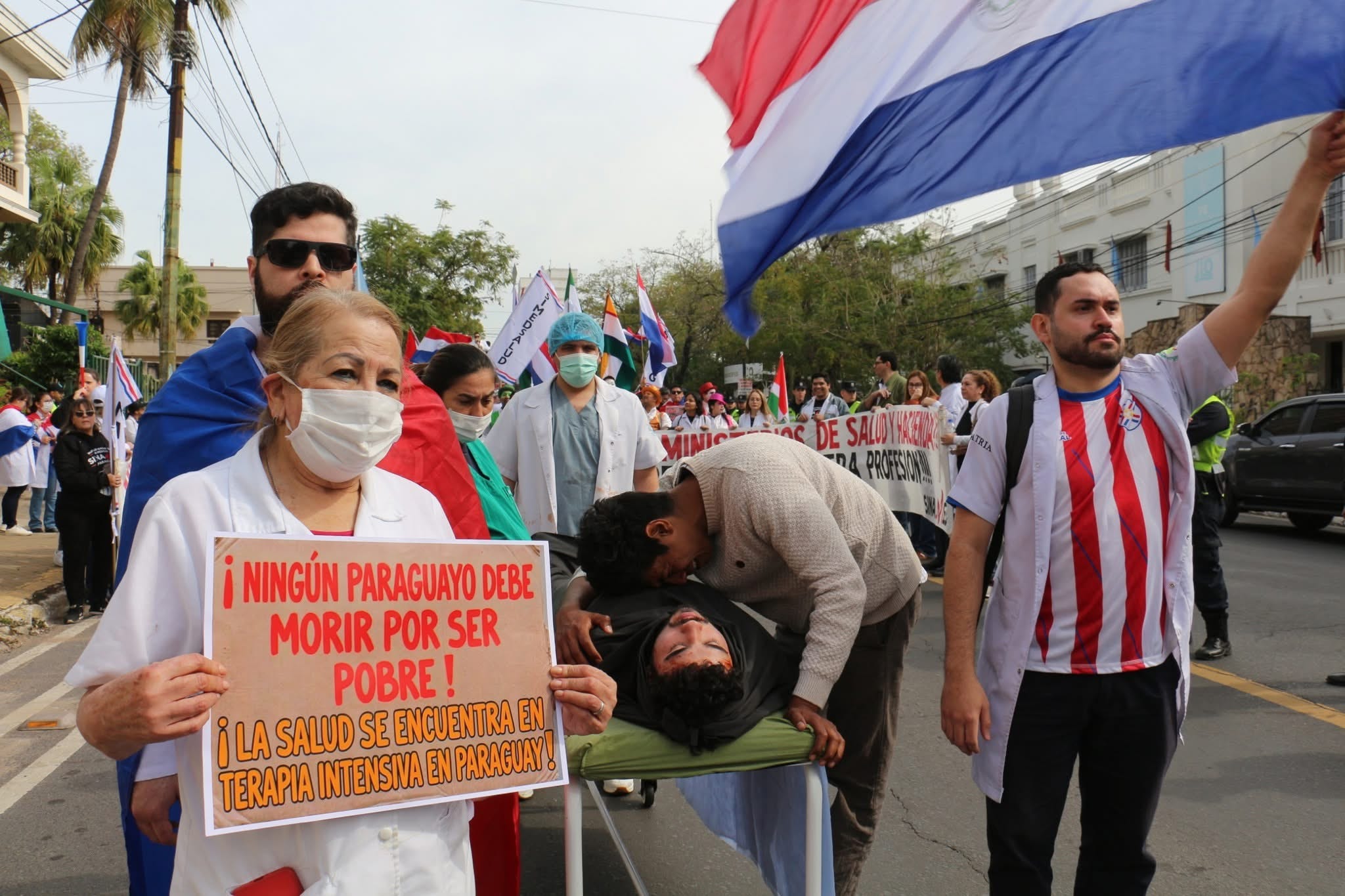
After negotiations with health ministry officials broke down last week, hundreds of staff walked out of public hospitals and marched through Asunción and other cities.
Police blocked marching medics from occupying the centre of Encarnación, which was hosting tens of thousands of fans for the World Rally Championship (WRC) over the weekend.
In Ciudad del Este, riot police clashed with white-coated demonstrators and fired rubber bullets in the air.
”All we’re asking is to be paid the same as in 2012,” Rosanna González, the secretary general of doctors’ union Sinamed, told reporters.
Sinamed says minimum salaries for physicians have remained frozen at roughly five million guaraníes ($830) per month for the past fifteen years.
It says real wages have been slashed by more than 75% during that period due to the rising cost of living, and wants the government to hike salaries by the same amount.
Doctors also want the Health Ministry to hire more staff, saying that 9,000 of Paraguay’s 11,000 medical professionals are on precarious short-term contracts.
But anger mounted as Paraguay’s president, Santiago Peña, refused to acknowledge doctors’ demands — instead dancing with his wife at the WRC’s closing party, and taking grinning selfies behind the wheel with driver Oliver Solberg.
On Friday, 141 doctors at the Acosta Ñu Children’s Hospital — equivalent to 86% of its staff, and including all of its 18 surgeons — were reportedly preparing to tender their resignation.
At the Trauma Hospital in Asunción, union leader Sara Burgos said 37 of her fellow anesthesiologists had quit, and that 19 of the hospital’s 23 neurosurgeons were ready to follow.
“We don’t have basic supplies,” she told reporters, mentioning the drugs atropine and etilefrine — essential to complex surgeries — as well as the tracheal tubes used to deliver oxygen and anesthesia. “The patients had to buy them. In an emergency, we had to buy them.”
Sinamed bosses said hundreds more resignations were on the way — and the Peña administration would be to blame for any patient deaths that resulted.
“We’re just asking the president to have a little empathy,” said Norma Ruiz, the head of paediatric intensive therapy at the Itauguá National Hospital.
Ruiz told press she is often forced to buy syringes out of her own pocket to treat children in critical condition — and that much of her salary is spent on drugs to treat a medical condition of her own.
”We’re putting our bodies on the line,” she added, through tears. “I don’t want to go and work in a private hospital, I’ve worked here for 13 years and this is like my home.”
Senior figures in the ruling Colorado Party meanwhile insisted the government couldn’t afford to meet Sinamed’s demand for a raise of three million guaraníes per contract.
Senate president Bachi Núnez — who practiced as a surgeon over twenty years ago — criticised the resignations, suggesting medicine was a “calling” that went with long low pay and responsibility to patients.
On Monday, cabinet chief Javier Giménez said health was a priority for Peña and offered to reopen talks with doctors — but ruled out any immediate pay rise, saying it was incompatible with balancing the budget.
In a short press conference with health minister María Teresa Barán and economy minister Óscar Lovera, Giménez said any increase in salaries would have to be folded into a restructuring of the profession to create a carrera sanitaria, or health-career track.
“If we’re going to give a raise,” said Giménez, “Let it be according to speciality, merit, and length of experience.”
THE POST TAKE
Anyone who has set foot in a public hospital in Paraguay knows how much doctors do with so little.
Seriously ill patients languish on makeshift ICU beds in hallways. Toilets are disaster zones, often lacking running water.
Queues form for hours before dawn for vaccines and diagnostics. No luck? Come back tomorrow and get in line again.
Even middle-class families are forced to hold raffles or barbecues — or sell possessions, or simply get into debt — to pay for life-saving medicines.
The constant drip of medical misery anecdotes reflect the data. Paraguay spends just 4% of GDP on health: well below the 6% that the Pan American Health Organization sets as the minimum for universal coverage.
In February 2024, President Peña and First Lady Leticia Ocampos recorded a sombre video where they said they had been shocked by conditions at the National Hospital — and promised to turn things around.
“We are committed to changing this reality,” Peña added. “If we can’t change this, we won’t be able to change anything in Paraguay.”
Some relief for Paraguay’s creaking public health system may finally be on the way.
Released on Tuesday, the government budget for 2027 suggests Paraguay will spend $2.8bn on public health next year: up a striking 77% from this year.
Accounting for nearly 11% of government spending, this will be the highest single budget item, well above education ($1.65bn) and infrastructure ($1.4bn).
The amount destined for medicines and supplies in particular is due to rise by $220m to $760m in 2027 — which just so happens to be the year when presidential primaries are held ahead of national polls in 2028.
In social media posts on Wednesday morning, Peña said he would put nearly 2,400 doctors on permanent contracts, spend half a billion dollars on improved infrastructure, and build seven new major health centres.
“We will keep working without pause for solutions so each Paraguayan, wherever they are, receives a complete, dignified and more human health service,” he wrote.
But experience with previous budgets suggests there’s a big difference between promising to spend money on something and actually spending it.
And after the Peña administration admitted last month that — having fessed up to some questionable accounting techniques — the deficit will rise to 3.9% of GDP next year, some are asking where the money will come from.
Predictably, some have called for slashing government waste and clawing back cash from corruption.
Or, trimming entitlements for penpushers: like the $101m the government forecasts spending this year on private health insurance for civil servants, mostly in the Supreme Court and Ministry of Justice.
The reality is that even if Paraguay were to reach Scandinavian levels of probity, it wouldn’t recoup enough money to reanimate the country’s moribund public services.
That kind of cash can only come from borrowing — an unpopular option, given public debt has nearly doubled to 41.2% of GDP since 2019 — or touching an even greater taboo: taxes.
Opposition senator Rafael Filizzola argues that levying a 2,000-guaraní ($0.30) duty on every pack of cigarettes sold in Paraguay would recoup $700m every year: more than covering the $500m the treasury spends on treating smoking-related illnesses.
Given that the fortunes of Peña’s patron, former president and tobacco baron Horacio Cartes (2013-18), rest on producing cheap smokes — most of which are later smuggled outside the country — this particular proposal seems unlikely to fly.
Yet even some members of the ruling Colorado Party are breaking ranks and questioning Paraguay’s allergy to taxation.
“There’s no two ways about it,” senator Silvio “Beto” Ovelar told a meeting with doctors last week. “We have to raise taxes: if not today, tomorrow.”
“Even if all us senators and civil servants went without a single guaraní, we still couldn’t … reach 6% [of GDP] on health,” he added.
The senior Colorado politician said Paraguay’s famous “triple 10” formula — the percentage levied on corporate, personal income, and value-added taxes since 2012 — had been “very beneficial” but has now run its course.
He argued for increasing the personal income tax to 14%, VAT to 12%, or corporate taxes to 15% — while acknowledging that such proposals would likely be shot down by the Peña administration, which has repeatedly resisted calls to raise taxes.
“Those of us who earn more should pay more,” Ovelar added. “That’s my own, very personal opinion.”
You’re reading The Weekly Post, your essential briefing on Paraguay.
Also in this issue:
Prieto in court in a bulletproof vest · Colorado takeover of watchdog · No traffic cops, no clamps? · Meet Andy Rivas, Paraguay’s Cerimedo · Evangelical Day declared · More Ueno questions · EV Boom · Much, much more
Want to keep reading? Claim your trial to unlock everything we publish, and access exclusive subscriber benefits.
Last chance: Two months for free!