


TOP STORY
U.S. to send Paraguay up to 25 deportees every month
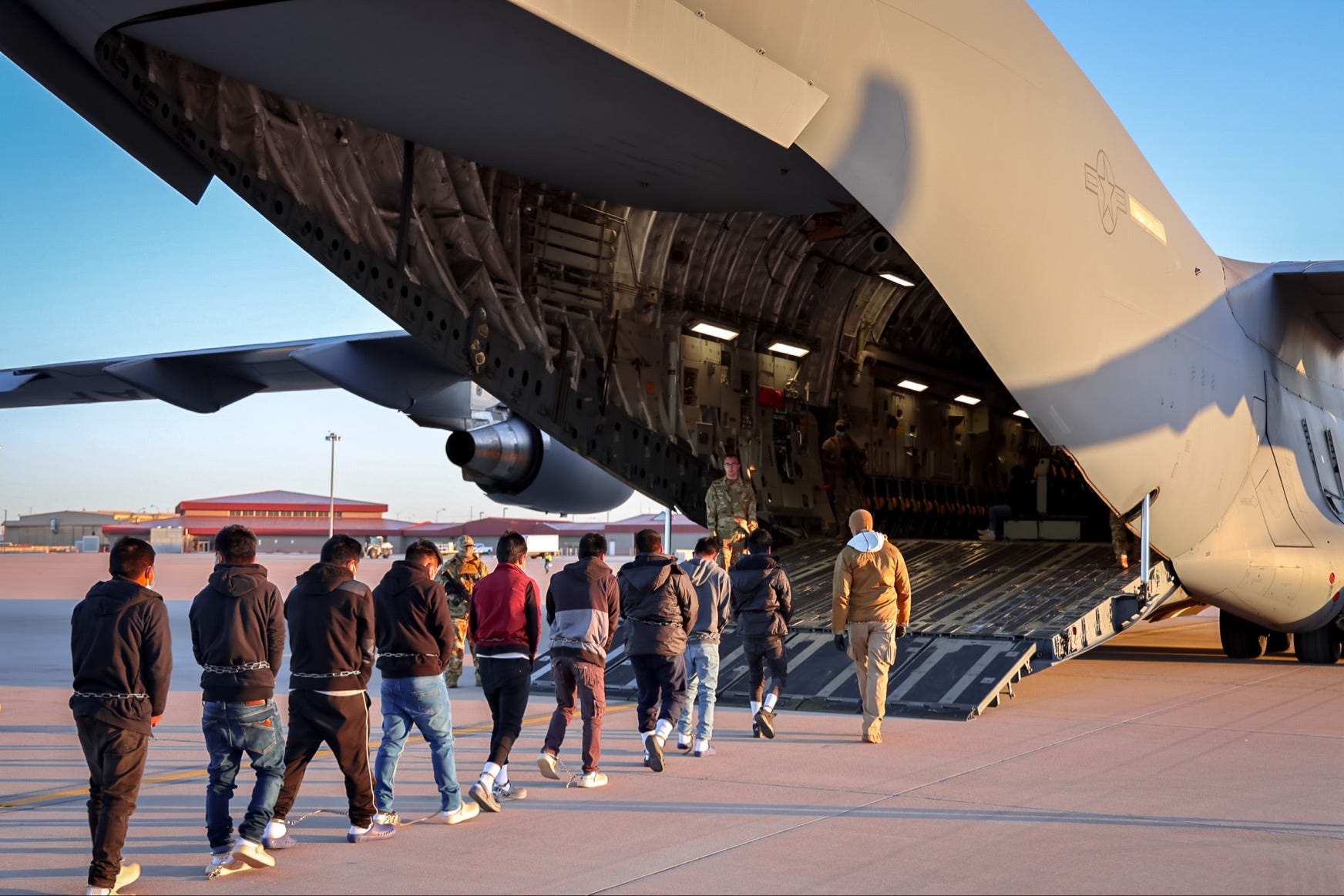
Paraguayan officials said on Thursday that 16 migrants from other countries deported from the United States had arrived on Paraguayan soil via charter flight.
In a statement, the national migration authority (DNM) said the individuals were all adults with no criminal record, and would be given assistance to return to their home countries.
Local press said the group was made up of economic migrants from Bolivia, Colombia, Ecuador, Spain, the Dominican Republic and El Salvador who had been apprehended illegally entering the United States.
The deportation flight is the first to arrive following a Safe Third Country Agreement signed in August between Donald Trump’s White House and Paraguay’s president Santiago Peña. That deal focused on people seeking asylum in the U.S., allowing them to be transferred to Paraguay while their claims are processed.
A subsequent agreement signed in February — the text of which has not been published, and does not apply to asylum-seekers — envisions a regular flow of would-be migrants to the U.S. being deported to Paraguay on a rolling basis.
The latest deal allows the United States to send Paraguay up to 25 deportees from Spanish-speaking countries per month. Paraguay will be given a flight manifest 72 hours in advance with information about migrants, including their criminal record.
On Wednesday, foreign minister Rubén Ramírez Lezcano said Paraguay had declined to receive nine people originally due to be on Thursday’s flight, citing issues with their documents.
Once in Paraguay, the International Organization for Migration (IOM), a UN body, will be responsible for providing accommodation, food, emergency medical attention, and supporting their onward journey. Paraguay does not expect to shoulder any of the cost.
The deportees will be lodged in a hotel in central Asunción, the capital, and helped to return home within 30 to 60 days. They can also apply to stay in Paraguay. ABC Color reported that nearly all of the first group of arrivals did not plan to stay.
“Many of them have suffered a lot,” Paraguay’s national migration director, Jorge Kronawetter, told ABC Cardinal 730 AM. “We want to help them return to their home countries.”
The migrants will be able to circulate freely. Most, if not all, come from countries that do not require a visa to enter Paraguay.
Speaking to reporters earlier in the week, U.S. Chargé d’Affaires in Asunción Robert Alter hailed the recent deportation agreement as “another element in the strategic alliance between the United States and Paraguay”.
He stipulated that the monthly deportation flights would not carry asylum seekers, but rather migrants that the U.S. wants to return to their home countries “in a safe and orderly way.”
“We are extremely grateful for the collaboration of the Paraguayan government,” he added.
THE POST TAKE:
“Welcome, foreign brother / my people are full of friendliness / my countrymen will take your hand.”
So goes a popular Paraguayan folk song, praising the country’s fabled openness to people from far-off lands.
According to Latinobarómetro, a region-wide opinion poll, Paraguay is one of Latin America’s most welcoming countries towards immigrants.
Just a third of Paraguayans think migration is harmful to the country or increases crime, while 73% think it boosts economic development, compared to a regional average of 57%.
This could reflect a long history of immigration — and emigration. Thousands were forced into exile overseas by the 1954-89 Stroesser regime. In recent decades, almost a million Paraguayans, some 15 percent of the population, are estimated to have gone abroad in search of greater opportunities.
And amid a rush to enjoy tax benefits and the quiet life in Paraguay, a record 40,000 foreigners — mainly Brazilians, along with Argentines and Europeans — were granted residency last year. Paraguay is also reportedly home to roughly 6,000 refugees, mostly from Cuba and Venezuela.
But the news that victims of Donald Trump’s mass deportation drive will be arriving on guaraní soil every month for the foreseeable future has provoked criticism and concern.
Some Internet users complained that the deportees will bring crime. One TV news anchor grumbled that while most Paraguayans have to fly coach with at least one stopover to reach the United States, deportees get an express service.
Paraguay’s press, opposition, and even some members of Peña’s party have criticised the secrecy around the two deportation deals — neither of which have been debated by the country’s congress — and questioned what Paraguay gets in return.
“The Parliament was not consulted,” Oscar Salomón, a senator with the ruling Colorado Party, told UPI. “We do not know who they are or why they were deported,” he said of the migrants.
Left-wing senator Esperanza Martínez defended Paraguay’s tradition of hospitality, but accused Peña of “kneeling before the Trump administration, which not only harasses and persecutes migrants, but also seeks to turn our country into a storehouse for whoever it expels.”
“What does Paraguay gain from this?” asked her colleague Rafael Filizzola. “It seems to be payback for individual favours … this is yet another display of Peña’s submission to the agendas of other countries.”
Critics have often claimed that a series of pro-U.S. policies are a quid pro quo for the Trump administration having removed corruption sanctions on Horacio Cartes, the former powerful president (2013-18), Peña’s patron, and current boss of the Colorado Party.
Yet Paraguay’s international profile has risen rapidly amid hand-in-glove cooperation with the U.S. Trump has praised Peña as “young and handsome” and “doing a great job.” Secretary of State Marco Rubio has called him a “strong American ally.”
The country’s security services in particular have benefited from deeper ties. In March, a military cooperation deal between Paraguay and the United States — which gives U.S. personnel local immunity from crimes committed on Paraguayan soil, and paves the way for more frequent joint operations and training — came into force.
Washington has recently given eight new patrol craft to Paraguay’s river-based navy along with weapons, parts and ongoing training — a donation it says will be worth $12m — sold Paraguay an advanced radar system, and strengthened its cybersecurity. Multi-billion-dollar investments by U.S. firms to build AI data centres in Paraguay have also been announced.
It’s even possible to detect preferential treatment, if you can call it that, in the small print of Paraguay’s deportee deal. The Trump administration has signed similar pacts with at least 27 other allies and client states, but often involving higher numbers, a range of different nationalities, and fewer clawbacks.
Costa Rica will get 25 deportees per week. Panama has agreed to take migrants originally from countries such as Afghanistan, China, Iran, Pakistan, and Uzbekistan. Paraguay, by comparison, should find it relatively easy to cope with barely two-dozen Spanish speakers from culturally similar countries each month that it doesn’t even have to pay for and should soon be moving on.
Yet Peña has said little publicly about the migration agreements, instead leaving it to ministers — and foreign officials — to give the public an explanation.
Welcome back to The Weekly Post, your essential briefing on all things Paraguay.
Also in this issue:
Nepobaby out · 2028 race heats up · Chaco deforestation in the spotlight · A charming community-run hotel · Paraguay to lead regional growth in 2026 · Brazilians flock to Paraguay
Want to keep reading? Claim your free trial — and unlock exclusive Insider Insight.
LAST CHANCE to lock in our $5/month rate: prices go up next week!