



TOP STORY
Lula’s haphazard history lecture
By Laurence Blair
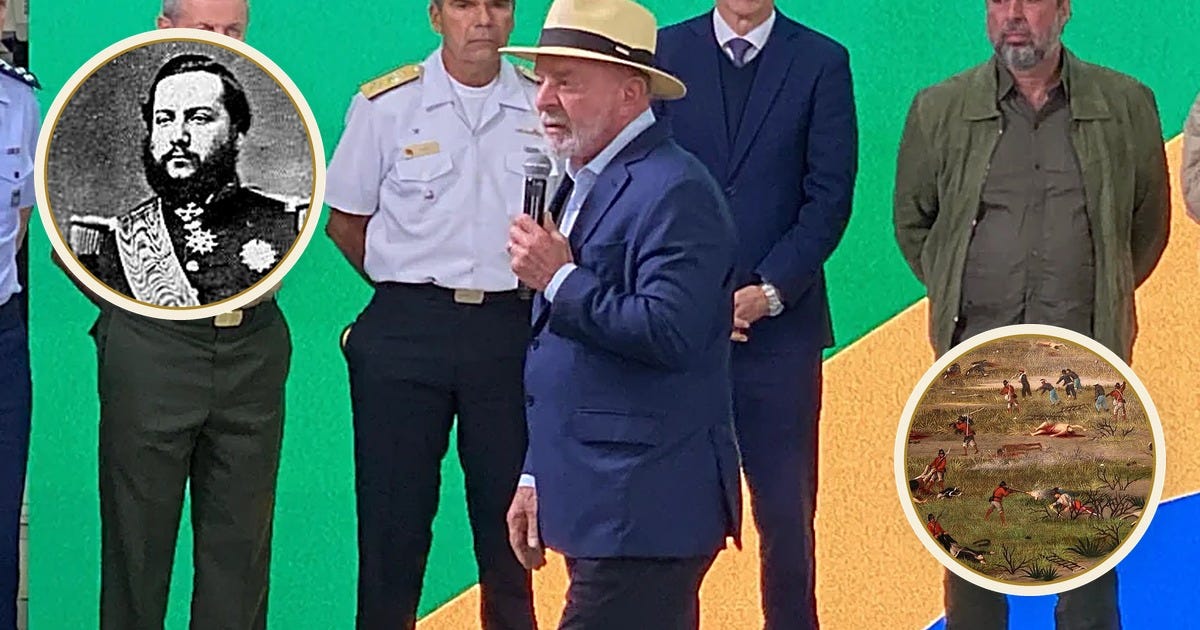
Brazilian President Luis Ignacio Lula de Silva has sparked outrage in Paraguay after blaming it for a nineteenth-century war thought to have wiped out half the smaller country’s population.
Speaking on Friday at the recently revived Avibras missile factory in Jacareí, São Paulo, the leftist leader described how his nation had long prioritised diplomacy to resolve disputes.
But he argued Brazil now has to invest more in defence, noting that geopolitical threats could emerge from nowhere — and reaching for a controversial historical example.
“We like peace,” Lula told the assembled ministers and military chiefs, “but we can’t forget that, one fine day, Paraguay decided to invade Brazil. It invaded Corumbá and at the same time invaded Uruguay and at the same time Argentina.”
“And that war,” he added, “which looked like it wouldn’t amount to much, lasted five years.”
Lula’s remarks have reopened painful historical wounds in Paraguay, which suffered a traumatising defeat in the 1864-70 War of the Triple Alliance.
Raúl Latorre, the president of Paraguay’s Chamber of Deputies, accused Lula of “speaking far too lightly about the greatest tragedy of our history, the greatest genocide of our continent.”
Opposition congressman Rubén Rubin said the veteran Brazilian leader was “distorting history” and called on Paraguay’s government to demand the return of war-era trophies from Brazil.
Popular historian Fabián Chamorro meanwhile said Lula, 80, was “scattered” and “confused,” and that his version of events “has half-truths at best.”
Paraguay’s strongman ruler, Marshal Francisco Solano López, seized a Brazilian vessel bound for Mato Grosso, imprisoned its governor, and launched attacks on Brazilian forts late in 1864.
But Paraguayan historians have emphasised that López’s actions were preceded by a Brazilian invasion of Uruguay that October. Troops loyal to Pedro II then installed a puppet government the following year.
López had warned that any intervention in Uruguay would be an unacceptable challenge to the regional balance of power — and that he would take measures in response. Brazil, an increasingly expansionist power, ignored him.
After López raided Brazil in response — and marched his troops across northern Argentina to come to the aid of his Uruguayan allies — the governments of Buenos Aires, Rio de Janeiro, and occupied Uruguay signed a treaty declaring war on Paraguay and vowing to overthrow López on May 1, 1865.
Paraguay mounted a desperate defence, but was ultimately vanquished.
It lost huge swathes of territory and most of its adult men — including López, who was shot dead fleeing the battlefield after being wounded at Cerro Corá in 1870. Brazilian troops occupied the capital, Asunción, for six years: looting the city, enslaving children, and stabling their horses in López’s palace.
The victors in what many Paraguayans call simply the guerra guazú (The Great War) have long been accused of war crimes: including the slaughter of women, children, and the wounded.
In 2022, a subcomission of regional parliament Parlasur declared the Allies were responsible for “genocide in modern terms”. Brazilian delegates boycotted the inquiry.
Lula’s simplistic explanation of the war’s causes — and the implication that Paraguay could one day attack again — have yet to meet with a public response from Paraguay’s president, Santiago Peña, or his diplomatic service.
Vice-president Pedro Alliana, a 2028 presidential hopeful, said the war had “massacred our children, burned hospitals, and looted Asunción.”
In a social media post, he said he was “focused on the future”, but that the return of war-era trophies by Brazil “could be a gesture of brotherhood that helps to make amends for the past.”
THE POST TAKE
The Paraguayan War — the bloodiest inter-state conflict in Latin American history — is still being fought over.
The dominant view abroad, which Lula seems to share, is that López’s Paraguay was to blame for the bloodshed.
His delusions of grandeur arguably made López fatally overestimate the strength of his forces — and needlessly prolong the carnage.
For decades, many Paraguayans agreed. Post-war governments made it illegal to praise the marshal and his supposed megalomania.
Yet a popular counternarrative gradually emerged: that Brazil, Argentina, and Uruguay — backed by London banks and even the British crown — had plotted from the outset to dismember the emerging Paraguayan superpower.
Only López’s strategic genius and heroic sacrifice, this meandering theory runs, saved Paraguay from being wiped off the map.
This point of view was championed by the Alfredo Stroessner regime (1954-89) — and more subtly by the Peña administration, which describes Paraguay as a reawakening “giant.” Today, López is claimed by every political tendency.
A splinter cell from the EPP — the leftist guerrilla group which allegedly perpetrated a deadly attack on a police station last week (see below the paywall) — called itself the Army of Marshal López (EML). Paraguay’s footballers were given a replica of López’s sabre before heading to the World Cup.
More recent scholarship has emphasised how hazy post-colonial borders and disputes over river navigation — as well as nationalistic miscalculations on all sides — set the region on the road to war.
In my book Patria — chapter eight contains a whistle-stop journey through Paraguayan history — I describe the conflict as “a clash over the control of Montevideo city hall that had spiralled out of control, becoming a civilisational struggle with ugly racial overtones.”
Perceptions about the morality of the war also vary among the victors.
Uruguay was quick to repent, returning looted war trophies to its as early as 1885. Argentina followed suit, with Juan Domingo Perón bringing back seized weapons and flags when he attended Stroessner’s inauguration in 1954.
In the 1980s, Brazil returned thousands of documents seized during the war from Paraguay’s national archives. But popular legend in Paraguay has it that important or incriminating records have been held back.
The Christian Cannon — a massive artillery piece forged by López from church bells — still sits in the courtyard of the National Historical Museum in Rio.
(Paraguay, to be fair, still has a couple of Brazilian warships sitting on its riverbeds and at an open-air museum called Vapor Cué.)
And while the experience of mobilisation and victory paved its way to South American superpower status, few in Brazil today give much thought to the conflict.
Lula’s unexpected saunter down memory lane puts Peña in a tricky position. He has talked up Paraguay’s pre-war greatness and claims the country is once more taking its place as a regional player.
But Paraguay depends on Brazil as the buyer of 35% of its exports — especially soybean, maquila manufactured goods, and hydroelectric energy — as well as the source of a third of Paraguay’s foreign investment in 2025.
Over 20,000 Brazilians applied for residency in Paraguay last year — over half the total. Brazilian aerospace firm Embraer also sold Paraguay six Super Tucano attack aircraft.
The two countries have only recently gotten past an espionage scandal where Brazilian spies hacked Paraguayan officials renegotiating the future terms of the shared Itaipú dam.
And Brazilian buy-in is crucial if infrastructure projects like the Bioceanic Highway — and the related cross-border bridge at Carmelo Peralta, due to be completed in September — are to bear fruit.
Despite claiming to be the heirs of López, the ruling Colorado Party isn’t exactly known for standing up to Brasília or wealthy brasiguayo settlers.
Former president Horacio Cartes (2013-18) — the power behind Peña’s throne — famously told a drinks party of Brazilian investors gathered in the Palacio de López to “use and abuse Paraguay.”
There’s a broader question about how much mileage Paraguay — arguably Donald Trump’s closest ally in the Southern Cone — can get from playing the victim 150 years later.
The Peña administration has signed a controversial military cooperation deal with the White House and declared Brazilian criminal organisations the PCC and CV to be terrorists, sparking a rift with Brazil.
The prospect of a ramped-up US military presence in the next-door nation — and the abduction of Venezuelan dictator Nicolás Maduro by US special forces in January — may be playing on Lula’s mind as he faces elections this October.
And with Lula now on course to defeat the scandal-ridden Bolsonarista right and remain in power for four more years, Peña’s best option may be to apply the refrain from a popular British sitcom: don’t mention the war.
You’re reading The Weekly Post, your essential briefing on Paraguay.
In this issue:
Police killings revive EPP spectre · Prieto sketches 2028 platform · Residency applications surge · Paraguay apologises for journalist’s murder · Paraguayan science spotlighted · Beijing cultivates business ties
Want to keep reading? Claim your free trial to unlock everything we publish, and access exclusive subscriber benefits: