



Photo: Matei Noticias
TOP STORY
Another AI data center throws its hat in the ring
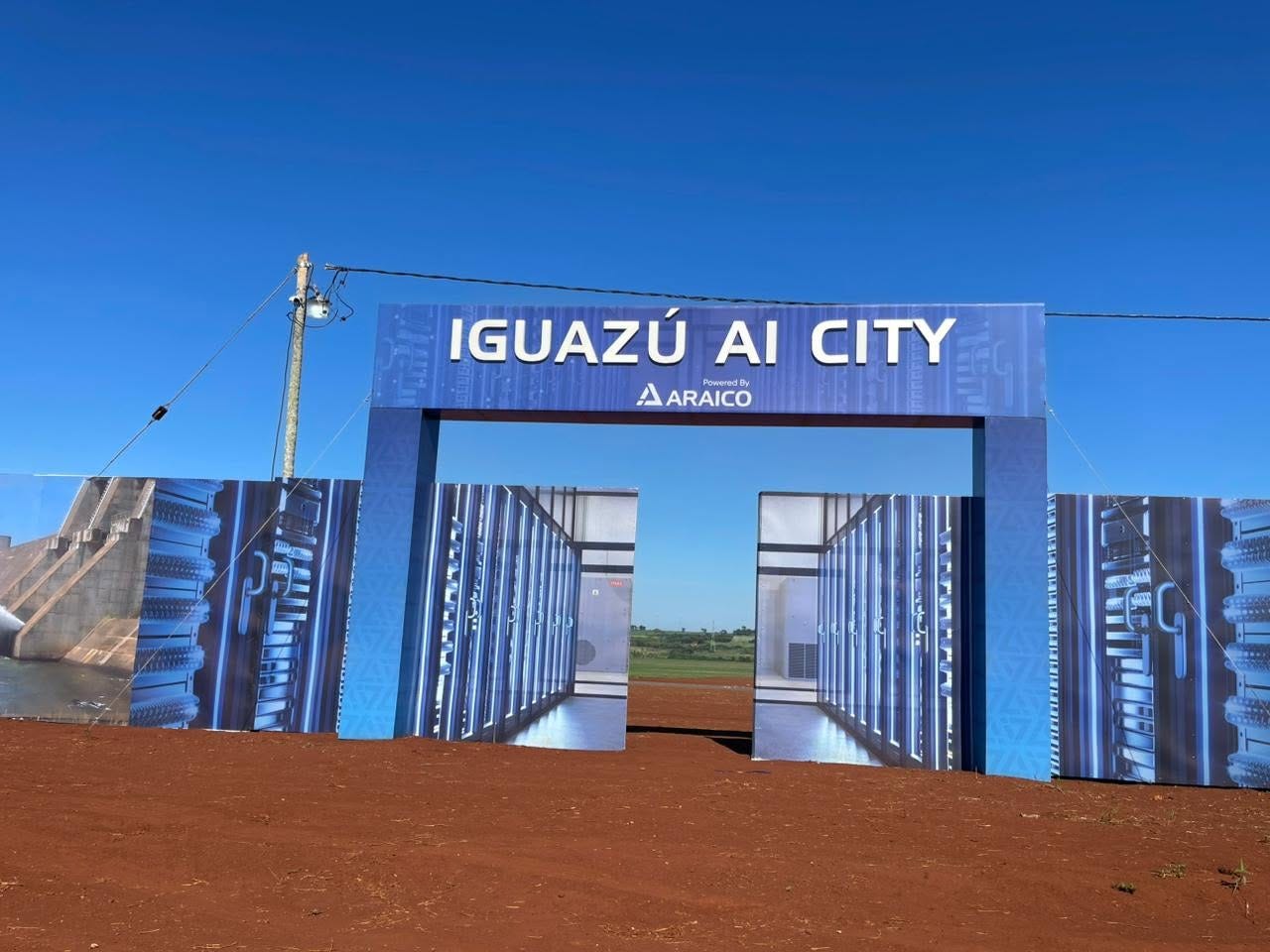
Paraguay’s next great export, according to the businessmen behind Iguazú AI City, will be computing power.
Their proposed campus in Yguazú, Alto Paraná, would use the country’s cheap, renewable electricity from the Itaipú dam to process artificial intelligence workloads for customers abroad.
Alejandro Zuccolillo, a real-estate and transport magnate and co-founder of project developer ARAICO, wants Paraguay to become “one of the world’s leaders in computing exports.”
The company, which he cofounded with Nicolás Arrellaga, says it will invest up to $12bn in Paraguay. That would make Iguazú AI City by far the biggest private project in Paraguayan history.
Its announced stages so far total $11.3bn: $300m initially, followed by two $5.5 bn expansions. The opening phase would draw 6 MWs of power, with infrastructure due in December and computing exports in March 2027.
Later stages would take the proposed supply from ANDE, Paraguay’s state electricity firm, to roughly 280 MW.
The ultimate 1.3 GW ARAICO says it will need — equivalent to two of Itaipú’s 20 turbines —would require private energy producers, few of which currently exist in Paraguay, to pick up the slack.
Washington had already spotted the resource. In May 2025, Secretary of State Marco Rubio highlighted Paraguay’s surplus hydropower as an opportunity for AI investment. A year later, Peter Thiel, the Palantir co-founder and Founders Fund partner, visited President Santiago Peña. Zuccolillo now names Founders Fund as ARAICO’s anchor investor.
ARAICO’s strongest argument is its proposed electricity tariff. It says it will pay ANDE $45 per megawatt-hour, rising annually by at least 2.5%, or in line with US inflation if higher.
That’s a much better deal then Paraguay gets from selling its spare power at cents on the dollar to Brazil. It would generate millions in revenue for ANDE that could help patch up Paraguay’s creaking and powercut-prone grid: attracting other investors and benefiting regular people.
Zuccolillo argues that proximity to Itaipú’s infrastructure keeps delivery costs down. Using the energy at home, he says, would allow Paraguay to “industrialize and create a new technological value chain.”
That’s the “for” case. Stacked against the project are a welter of questions about water use, noise pollution — and concerns that Paraguay could sign away its hugely valuable power to a project that is still largely pie in the sky.
Tech analyst Joaquín Morínigo notes there are no publicly verifiable customer contracts and financing for the larger, later phases; the initial 6 MW represents less than 0.5% of the promoted 1.3 GW. On October 1, Zuccollilo himself said the project’s contract with ANDE was still under review.
Morínigo also questions claims that the AI City will boost Paraguay’s digital sovereignty, given that the country relies on high-speed Internet connections that are routed through Brazil.
Expensive hardware depreciates quickly, he adds, while an AI investment bubble could see ARAICO’s massive facility left idling with little paying demand.
How much water the project will use is also unclear. Consenso uncovered plans for the company to dig 20 wells and consume an estimated 350,000 litres daily in order to cool its computers.
ARAICO engineer Verónica Peralta said those figures were outdated and that the first phase would use less than 1,000 litres a day: less than the soybean crops the data centre would replace.
The Paraguay Post was also the first to report last year on how a data center in Villarrica — in that case, used for bitcoin mining — was keeping residents up all night and driving them crazy with incessant noise. Locals are now suing the local representative of company in question, Bitfarms.
Yguazú AI City — which will be huge by comparison — could have similar impacts on residents of the town of Yguazú, which lies barely a kilometre away.
THE POST TAKE
This is the pivot we described in May, when telecoms chief Gustavo Villate proposed to “unplug crypto and plug in AI.” With bitcoin mining contracts due to expire at the start of 2027, Peña’s government is courting investors with deeper pockets and greater political leverage.
The promised upgrade also serves a geopolitical purpose: presenting Paraguay’s alignment with Washington and Taiwan as a route into the tech industry, versus the commodity dependence offered by China.
In fact, ARAICO’s fully private campus contrasts with a different model in the same location: Peña’s proposed venture with Taiwan, Yguazú Digital. MITIC says this will be a 50/50 partnership, with Paraguay contributing energy and land and Taiwan supplying equipment.
Its proposed 10 MW computing pilot is estimated at $300–500m; the eventual ambition is 1 GW of computing capacity, requiring around 1.5 GW of electricity. Peña invited Taiwanese electronics producer Foxconn to join on October 1.
The private pipeline of existing projects offers further comparisons. Los Angeles-based X8 Cloud announced a 50 MW starting phase and a 500 MW ambition for 2027. Pardat Holding presented a proposed $1bn, 100 MW facility in Yguazú in March. Penguin says it is adapting existing bitcoin mining infrastructure for AI, advertising 100 MW live and a 500 MW pipeline.
All of these projects are at different stages; none of their promises are guaranteed.
US firm HIVE offers a more concrete test. It reported a live GPU cluster in Asunción in March, serving Columbia University researchers. The engagement is noncommercial, and HIVE’s much larger Paraguayan power footprint remains primarily Bitcoin infrastructure, but it demonstrates that foreign researchers can run small AI workloads in Paraguay.
Still, there are many reasons to doubt the sweeping promises of the US big tech lobby, as Jazmín Acuña of El Surti details. Imported equipment accounts for a big chunk of the investment, and the transfer of knowledge to the few local workers employed will probably be limited.
But rejecting AI data centres would not magically produce a traditional, jobs-heavy factory ready to buy the same power at the same prices.
ATOME illustrates why a traditional industrial project may not be a better bargain. The British fertilizer developer sought $30/MWh fixed for 15 years, while ANDE said it needed $44.30 just to break even. Peña’s government issued decrees offering cheap rates anyway, then withdrew them after pressure from ANDE’s union. ATOME has since issued notice of an investment dispute, threatening to sue Paraguay if no settlement is reached.
ARAICO’s higher, adjustable offer is therefore worth examining on its own merits. But Paraguay must subtract supply and infrastructure costs and foregone compensation from Brazil, then assess taxes, wages, and the impact on the local economy and environment.
The main risk is committing the country’s future energy capacity — which is scheduled to run out around 2030 — before the project’s customers and financing materialize. Each expansion should require a published assessment of available power, credible demand and guarantees against leaving ANDE with stranded infrastructure or costs passed to regular users.
Our story in May asked whether the AI pivot would create a real technology ecosystem or just another insiders’ industry like bitcoin mining. So far, despite all the fanfare, Iguazú AI City is yet to answer that question.
The AI industry needs cheap, reliable power. Paraguay has that, for now. That gives the country a chance to negotiate beneficial terms that transform its spare energy into lasting development.
Success would mean a stronger grid that works better for residents and attracts other industrial projects — and a local economy capable of doing more than supplying cheap power to the next global tech trend.
Also in this issue:
Whistleblowers sound alarm on Ueno · Peña calls for calm · World Bank upgrades growth prospects · Fitch plays hard to get · China targets top Paraguayan official · Prieto lays out 2028 plans · Flooding displaces hundreds
Want to keep reading? Claim your trial to unlock everything we publish, and access exclusive subscriber benefits.