


A few years back, a Colombian author wrote to me in search of writers. She had managed to track down published works of literature from every country in Latin America and the Caribbean, with one exception: Paraguay.
I realised that, here in the lesser-known -guay, we live in uncharted literary territory. How to navigate the pages of a place that shifts from utopia or dystopia according to who you ask?
This terra incognita is harder still to traverse for non-Spanish speakers: let alone the question of the Guaraní and other Indigenous languages — and their poetry, culture, and mythology — which deserve a separate review entirely.
Paraguay is a nation of paradoxes: its economy, its politics. That sense of contradiction reigns even in the world of letters. Although Paraguayan books rarely break out of containment to reach readers abroad — and despite Paraguayans reading far less than their regional peers — more titles are being printed in Paraguay than ever before.
So here’s my beginner’s guide to the blooming field of writing from and on Paraguay in English and Spanish. It’s not a definitive ranking, nor an exhaustive digest. Take it as an invitation to flick through a variety of genres and voices — a perfect pastime for the sleepy summer months.
Son of Man (Augusto Roa Bastos)
Roa Bastos is the classic introduction to Paraguayan fiction. A pioneer of Latin America’s mid-century literary “boom” alongside figures like Gabriel García Márquez, Roa is the Paraguayan writer’s writer: adored, detested, unmatched. He is also perhaps the only local writer familiar to foreign readers, having won Spain’s Premio Cervantes in 1990.
Son of Man (1960), Roa’s first published novel, mixes Christian mysticism with a deft pen-portrait of oppression in the early 1900s. It captures the essence of Paraguay: a nation imprinted with authoritarianism, “beloved of misfortune.” For a challenge, try I, the Supreme. Written from exile in 1974, the book inhabits the mind of revolutionary leader Dr. Francia (1766-1840) to explore how dictators, by controlling language, seek to bend society and reality to their will.
Poesías completas
(Josefina Plá)
Though born in the Canary Islands, Josefina Plá (1903-99) marked a before and after in Paraguayan culture. Relocating to South America with her husband, Paraguayan sculptor Andrés Campos Cervera, in 1926, she quickly established herself as a journalist, art critic, playwright, ceramicist and historian. Encountering her work, which has been translated into multiple languages, is like finding the key to deciphering the country’s cultural richness. And her vanguardista poetry, intimate and nostalgic, is illustrative of an entire era.
La Babosa (Gabriel Casaccia)
To me, Paraguay’s best novel (sorry, Roa fans), this book — set in the sleepy lakeside town of Areguá — has all the ingredients for a Netflix adaptation alongside Pedro Páramo and One Hundred Years of Solitude. Capturing the idiosyncrasies of smalltown Paraguayan life, it blends humour, romance, guilt, desire, and the favourite pastime of every Paraguayan: gossip. Though sadly yet to be published in English, La Babosa — the nickname of the rumour-spreading Doña Angela — is available in French as la limace.
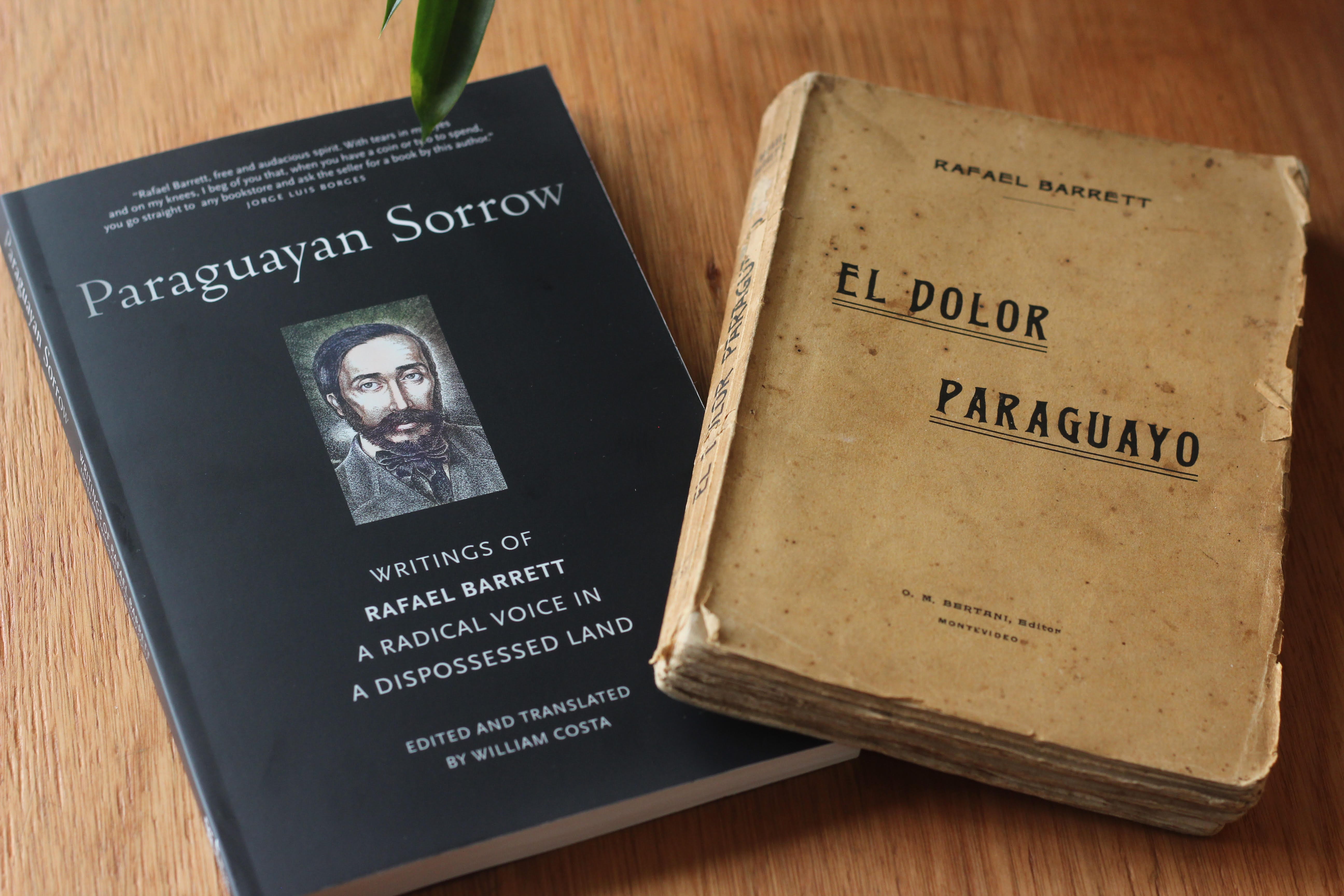
Paraguayan Sorrow (Rafael Barrett)
The rebellious Spanish anarchist Rafael Barrett shook up the intellectual life of Argentina, Uruguay and Paraguay at the beginning of the twentieth century. In Paraguay, the country he loved and to which he dedicated most of his output — especially workers toiling in the country’s rapacious yerba mate industry — he founded a tradition of critical journalism dedicated to the dispossessed. Barrett’s sharp pen and sharper conscience was a profound influence on generations of writers, artists, and activists, including Roa Bastos. William Costa’s magnificent translation, published in 2024 by Monthly Review Press, contains an essential introduction to Barrett’s life and reception after his death aged just 34 in 1910.
Trails from a World Beyond (Benno Glauser)
Part-memoir, part-anthropology, this book contains three decades of the author’s experiences in the Paraguayan Chaco, one of the fastest-vanishing forests on the planet. He confronts us with the existence of nomadic Ayoreo groups that have decided not to make contact with outside society — a right which should be respected.

Beautifully written, with great sensitivity, simplicity and depth, Glauser leads us through the surviving natural wonder of the Chaco and reminds us of the many worlds that exist alongside our own. Available for purchase at El Granel, this book is a must-read at a time when the Chaco faces dire threats from agribusiness, narcotrafficking, and the climate crisis.
En los sótanos de los generales (Alfredo Boccia Paz, Miguel H. López, Antonio V. Pecci, Gloria Giménez Guanes)
This book, available only in Spanish, compiles key documents from Operation Condor — the mass murder of dissidents by the regime of Alfredo Stroessner and neighbouring autocrats, supported by the United States — including the archivos del terror discovered in an Asunción police station in 1992. To get a handle on this dark period of recent history, I also recommend Under the Flags, the Sun, a recent documentary charting the rise and fall of Stroessner through rarely seen footage, stitched together by director Juanjo Pereira.
Subtropical essays (Ysanne Gayet)
This is a beguiling memoir by Ysanne Gayet, the British co-founder of the Museo del Barro and the Centro Cultural del Lago in Areguá, two of Paraguay’s finest art museums. The volume immerses the reader in a documentary-like journey through village festivals, popular art, and Indigenous celebrations. Gayet’s decades-long commitment to championing Paraguayan culture in all its exuberant expressions shines through in every page.


1811 (Robin Wood and Roberto Goiriz)
Graphic novels, without doubt, deserve a mention in any round-up of literature in Paraguay: the birthplace of acclaimed comic-book writer Robin Wood. Published to mark the bicentenary of independence, 1811 is a dramatic retelling of Paraguay’s struggle for freedom from Spain. The life-and-death stakes and vivid characters are ably brought to life by the brushstrokes of veteran graphic novel artist Roberto Goiriz.
La masacre de Curuguaty (Julio Benegas Vidallet)
Paraguay’s best writer of journalistic chronicles turns his pen to the Curuguaty Massacre: a clash over land rights in rural Paraguay that resulted in the deaths of 11 campesinos and six police officers. The tragic episode in June 2012 led to a congressional coup that unseated the only progressive government in modern Paraguayan history. ¿Qué pasó en Curuguaty? read the graffiti in the streets at the time. More than a decade later, questions about what took place at Curuguaty still remain: as does the struggle for land by Indigenous and peasant communities in Paraguay, one of the world’s most unequal countries for land ownership.
Contar el Arte (Fundación Texo)
Fredi Casco, artistic director of the leading contemporary art institution Fundación Texo, has published a fascinating series of annotated interviews with leading cultural figures in Paraguay. While published only in Spanish, the three volumes of Contar el Arte to date represent a major effort to bring Paraguayan musicians, artists, filmmakers, architects, and performers to the world, with footnotes offering key context to international readers seeking to better understand Paraguay’s cultural offering.
Also interested in Paraguayan cinema? The Paraguay Post has it covered:
INDIE PRESS BONUS:
Perros del Pantano (Cave Ogdon)
Mixes humour and social critique straight out of Sajonia, a traditional working-class neighbourhood of Asunción.Mujer Ave (Estela Asilvera)
For fans of Isabel Allende, three generations of women discuss their dreams and the injustices of the Stroessner dictatorship.La mujer del cuadro (Ana Miranda)
A fresh and unique science-fiction story told from women’s lived experience.Hambro (Gustavo Baéz Rolón)
Inspired by the aesthetic of 1980s action films, this innovative comic series keenly satirises contemporary Paraguayan society.
What else should be on the list? What’s your cult Paraguayan classic you can’t stop re-reading? And is Roa Bastos overrated, or rightly famous? Let us know what you think:
What are your choices for history books??? I would highly recommend Michael Kenneth Huner’s new book. It’s beautiful.
I am glad that Colombian author gave you that call because you got to tell us the names of Paraguayan authors. Since there is a debate regarding Roa Bastos I would love to read I the Supreme from a linguistic perspective.