


TOP STORY
Horacio meets Marco, and Landau
Former president Horacio Cartes (2013-18) briefly met US Secretary of State Marco Rubio while attending the World Cup final, in an encounter celebrated by his allies as proof of political rehabilitation.
The warm exchange of words captured on camera at the MetLife stadium in New Jersey carried obvious symbolic weight. Cartes had been designated “significantly corrupt” by the US State Department and placed under Treasury sanctions in 2023 over alleged corruption, accusations he has repeatedly denied.
Yet those financial sanctions were lifted in October 2025 — officials said they were no longer serving U.S. foreign-policy interests — clearing the way for the tobacco magnate to set foot on North American soil once more.
Rubio’s presence in the VIP box made the moment particularly striking. During a visit to Guatemala in February 2025, the newly appointed secretary of state said changes to sanctions against officials accused of corruption and anti-democratic conduct had not been discussed by the Trump administration. His comments wrong-footed cartistas, who had expected the ouster of the Biden administration to bring Cartes immediate relief.
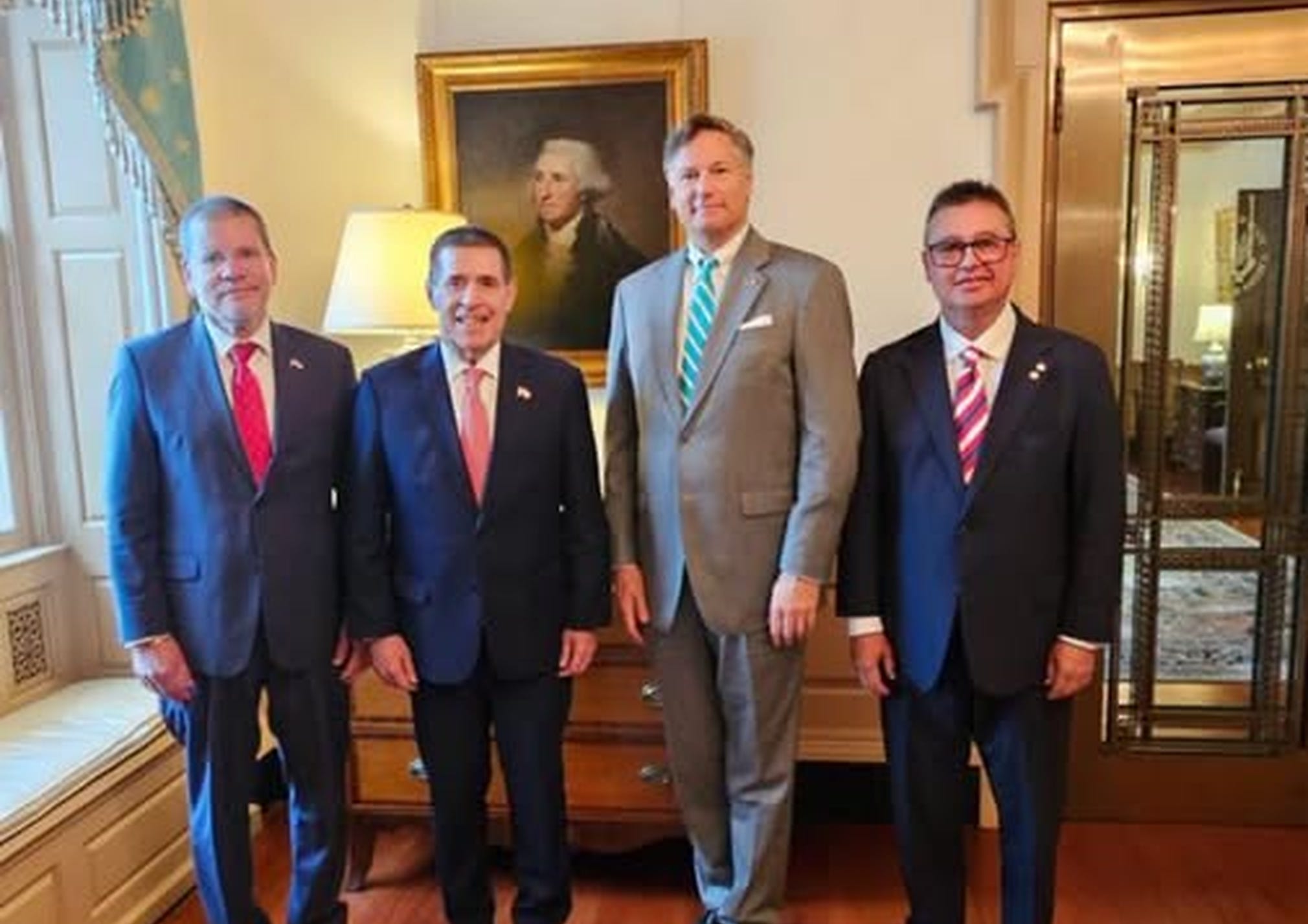
Yet after rubbing shoulders with Rubio and other top dignitaries over the weekend, Cartes was also formally received by Deputy Secretary of State Christopher Landau, whose father served as US ambassador to Paraguay during the 1970s.
For Honor Colorado, the dominant faction of the ruling Colorado Party, the message was clear: its leader was no longer being treated as a diplomatic liability, but as someone welcome in Washington’s political orbit.
Cartes holds no official government position beyond the presidency of the Colorado Party. Yet the encounter underlined the parallel influence he exercises over Paraguay’s government, particularly given that President Santiago Peña was not present at the Argentina–Spain final.
The timing was also striking. Days later, Peña’s government confirmed that Gustavo Leite would leave Paraguay’s embassy in Washington and return to his Senate seat on July 22, less than a year after taking up the diplomatic post.
Leite’s short tenure coincided with an unusually close phase in US-Paraguay relations. Paraguay signed a controversial Status of Forces Agreement facilitating the presence of US military personnel and contractors, while also expanding an arrangement allowing migrants rejected by the United States to be transferred through Paraguayan territory.
Yet Leite’s performance as ambassador was repeatedly questioned at home. Cartista senator Natalicio Chase described him as a “luxury ambassador,” but struggled to point to concrete achievements. Opposition senator Rafael Filizzola was harsher, characterizing the posting as a year of “diplomatic tourism” focused on Honor Colorado and one wing of the GOP rather than Paraguay’s national interest.
Leite also created friction inside Peña’s government. In April, he criticised departing Economy Minister Carlos Fernández Valdovinos and said that under Cartes there had been “not even the smell of a bribe” — something, he implied, that stood in sharp contrast to the Peña administration. Foreign Minister Rubén Ramírez Lezcano formally reprimanded him.
His early departure will not be cheap. ABC Color estimates that terminating the posting requires the state to pay Leite more than $30k in additional salary, on top of the cost of housing, representation, relocation and his months in Washington. His return also forces substitute senator Carlos Liseras to surrender the seat.
Leite’s recall forms part of a wider diplomatic reshuffle. The moves cover eight embassies and mix routine rotations with more politically awkward removals — including a career diplomat in Lebanon accused of swiping on Tinder during working hours. But Leite’s successful matchmaking mission between the Trump White House and HC is the one making headlines for all the wrong reasons.
THE POST TAKE
Leite’s Washington mission now looks less like an ordinary diplomatic appointment than a political assignment with a defined objective.
His return to the Senate was announced almost immediately after Cartes secured the photographs Honor Colorado had been seeking — first beside Rubio at the World Cup final, then in a formal meeting with Landau. The sequence has the feel of a mission-accomplished statement.
Measured by that standard, Leite’s brief posting may have been successful. His public defense of Cartes, his attacks on Peña’s own officials, and the lack of clearly identifiable national-policy achievements all reinforce the impression that the embassy served as an extension of factional politics.
Peña may formally direct Paraguay’s foreign policy. But the World Cup photograph suggests that, when it comes to the relationship with Washington, his political patron is once again the figure Honor Colorado most wants in the frame.
You’re reading The Weekly Post, your essential briefing on Paraguay.
In this issue:
Investment grade (and fiscal strain) confirmed ⋅ Property buyers beware⋅ Spanish casino giant arrives ⋅ The asphalt mafia strikes ⋅ A new mega-dam? ⋅ Paraguay adds three restaurants to 50 Best ⋅ Did the Guaraní invent football?
Want to keep reading? Claim your free trial to unlock everything we publish, and access exclusive subscriber benefits: