



TOP STORY
Paraguay plans its answer to Disney World
– By Laurence Blair
Some 1.5 billion people worldwide took trips abroad in 2025, contributing to an international tourism industry worth 11.6 trillion dollars.
But only 3.5 million made it to Paraguay: barely 0.2% of the global total. A little under half were day-trippers, mainly from Argentina and Brazil.
And where a record 1.5m people visited Cristo Redentor last year, and 1.6m flocked to Machu Picchu, Paraguay’s stand-out sights — its 18th-century Jesuit missions and the Itaipú hydroelectric dam — typically get a handful of visitors per day.
This might be about to change. Late last month, the new head of Senatur, the national tourism secretariat, unveiled an ambitious objective for Paraguay to host 10 million visitors a year by 2037.
Jacinto Santa María told local press that the president, Santiago Peña, has instructed him to “transform Paraguay into a world-class tourist destination.”
“We need to take an exponential leap in our efforts to encourage the benefits that tourism can generate,” Santa María added, mentioning the industry’s positive impact on economic growth and job creation.
And the Peña administration has recently announced an Investor Pass that offers fast-tracked residency for foreigners investing $150,000 in the local tourist industry.
There are signs that the world is starting to wake up to Paraguay’s potential as a travel and leisure location.
Last year saw a record number of both tourist arrivals and residency applications. Some 90,000 foreigners are forecast to formally relocate here in 2026.


The country is betting big on event tourism, hosting an eclectic mix of festivals and sporting competitions: including a leg of the World Rally Championship in August and the World Skate Games in October.
The South American Bird Fair, due to be held at the Centro Cultural del Puerto in Asunción in September, will also shine a spotlight on sub-tropical Paraguay’s 700 avian species: from the flamboyant bell bird to the expertly camouflaged urutaú.
Paraguay’s simple-yet-succulent cuisine — heavy on river fish, corn-based soufflés, and barbecued beef — has so far failed to draw international acclaim like Central in Lima or D.O.M. in São Paulo.
But The Paraguay Post can reveal that a senior representative of The World’s 50 Best Restaurants is visiting top Asunción spots like Óga and Cocina Clandestina this week — and is impressed by what she’s found.
The crowds cramming into downtown Asunción last week for the country’s Independence celebrations — 120,000 people reportedly attended — demonstrates how locals are also hungry for civic events, concerts, and shared cultural experiences.
Taken all together, Paraguay’s travel and tourism industry contributed an estimated 6.5% of GDP and 264,000 jobs in 2025.
Still, the authorities may struggle to convince millions more people to come and spend their hard-earned tourist dollars in faraway Paraguay: currently the only South American nation with no direct flights to the United States.
Recent talks to resurrect the Asunción-Miami route have so far failed to produce results: even as the Peña administration has reportedly offered American Airlines and Brazilian carrier GOL bungs of more than $3m per year.
Citizens of India and China — the world’s most populous nations, and increasingly big spenders overseas — have to apply for visas and secure a local letter of recommendation to even set foot in Paraguay.
The gringo backpacker trail usually misses the country altogether, running down the Andes from Colombia and Peru to Chile — sometimes detouring to Bolivia — before hopping over to Buenos Aires or Rio.
And even industry officials are downbeat about Paraguay’s prospects of entering the Bucket List big leagues in the short run.
“Paraguay still isn’t a touristic icon that demands your attention,” Santa María admitted. “We don’t have any striking landmarks like Machu Picchu or a world-class beach. So we’ll have to create one.”
THE POST TAKE
Paraguay has a public image problem.
Not many people know about it. Those that do often associate it with corruption and crime. This, despite Paraguay being one of Latin America’s safest countries.
The perception gap isn’t always helped by us journalists, for whom the occasional shootout or attempted coup are easier to pitch to editors than “things are pretty chill here.”
Over the years, I’ve tried to do my bit to counteract the stereotypes: penning a profile of Paraguay as one of the Lonely Planet’s Top 10 Countries to visit last year, and writing several guides to Asunción.
I’ve also reviewed the city’s best restaurants in these pages, and scored the capital a spot in the “36 Hours In…” segment for The New York Times — as well as a front-page Times feature on one of Paraguay’s most beloved gastronomic brands.
But sadly, it’s not always clear that officials understand what makes Paraguay so special.
Santa María, the Senatur boss, cited Orlando as a destination to emulate. He said Paraguay should attract investors willing to create huge theme parks to lure in Brazilian tourists who might otherwise go to Florida.
“When a park the size of a Disney or something similar starts being built, there is no turning back,” he elaborated to EFE last week.
Whether Paraguay can or should try to go up against the Magic Kingdom (Guaraní World or López Land, anyone?) is debatable.
And if Paraguay wants to attract more wealthy eco-tourists and birders like Colombia or Costa Rica, opening up the Chaco’s biodiverse national parks to mining and drilling — as members of the ruling Colorado Party have repeatedly proposed — probably isn’t a step in the right direction.
More promising are plans to work with Argentina and Brazil to set up a trinational tourist circuit in the Triple Border area.
Visitors to Iguazú Falls currently have to handle traffic-clogged border crossings, multiple buses and taxis, and separate entry fees for the Argentine and Brazilian sides. Few of those that hop over into Paraguay make it beyond Ciudad del Este’s duty-free shopping malls.
A trinational tourist pass — perhaps incorporating the existing passenger ferry between Presidente Franco and Puerto Yguazú — could make it easier to take in the falls, lesser cascades in Paraguay that get a fraction of the visitors, and the Jesuit ruins on both sides of the Paraná River.
Establishing routes like this will need improvements to Paraguay’s inter-city buses, which often move at a glacial pace, picking up passengers on every corner. One positive example is Peru Hop, a long-distance coach service that shuttles from Lima to Cusco with stops at key attractions along the way.
It will also require some serious investment in visitor facilities.
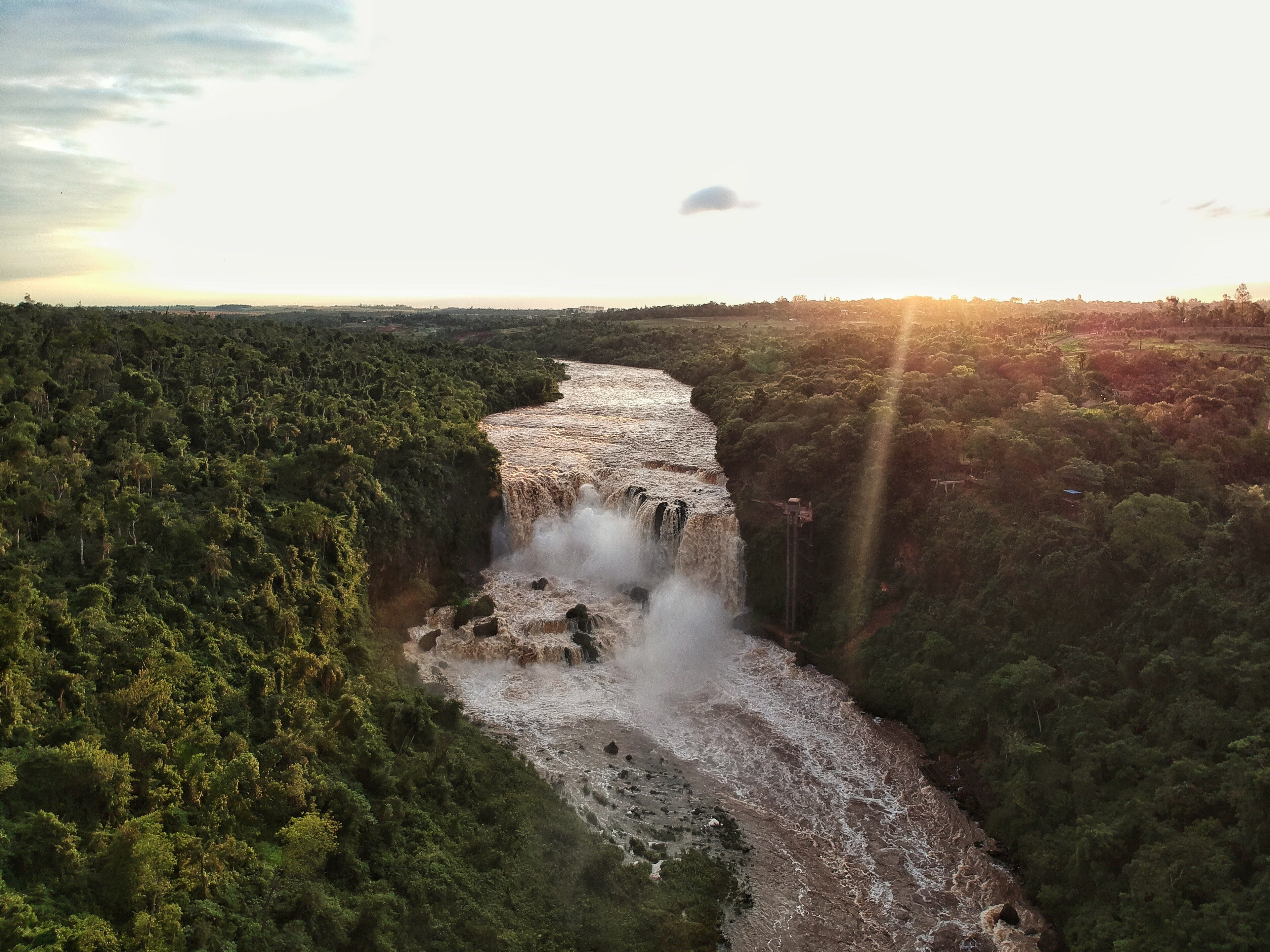
At Saltos del Monday — a stunning, 45-metre torrent just south of Ciudad del Este — tourists are currently treated to the smell of burgers sizzling on a grill just meters from the roaring drop.
Then, they descend through a cloud of water vapour to the base of the falls in a rusty elevator whose exposed wiring occasionally sparks.
Perhaps the most exciting project underway is a plan to create a national cycling and walking trail along Paraguay’s disused steam railway.
Pushed forward by non-profits and private philanthropy, the 420km route between Asunción and Encarnación takes in picturesque pueblos with grand old train stations. Volunteers have cleared vegetation off the tracks with machetes and rebuilt collapsed bridges over creeks.
While currently limited to a pilot stage, the Sendas project holds huge potential to spread the benefits of tourism among local communities. A network of homestay bed-and-breakfasts, like Cuba’s casas particulares, could be a good complement.
The pedal-based plan plays to Paraguay’s strengths: its rolling green landscapes, its charmingly time-worn towns, and its people, who surely rank among the friendliest and most hospitable in the world.
You’re reading The Weekly Post, your essential briefing on Paraguay.
Also in this issue: Bolivia crisis deepens · A DEA murder plot? · Q1 growth bounce · Re-election via the back door? · Maquila manufacturing boom · Peter Thiel in Paraguay · Stroessner’s fall in comic form · Narco chic · Ducks ‘n’ drivers
Want to keep reading? Claim your free trial — and a host of benefits: