


The dust is settling. Paraguay is now coming up for air, and starting to come to terms with the downfall of Ueno Bank and Santiago Peña.
Both Ueno executives and Paraguay’s former president stand accused of perpetrating one of the largest scams involving public money (roughly a billion dollars of it) in South American history.
I have reported on and travelled all over Paraguay for nearly 12 years. I live here, and some of my loved ones have been affected.
I know the facts, and I stick to them in my reporting, but I’m not “neutral”. So take today’s analysis with that in mind.
Anatomy of a crisis
A quick recap, for those who haven’t been paying attention.
Ueno was declared insolvent by regulators and taken over on November 3. Its three million clients, half the population, were frozen out of their accounts, sowing panic and protests.
The president, Ueno executives, and the entire Central Bank board were arrested.
Peña is being held on a military base, accused of directing nearly a billion dollars of public funds towards Ueno, which his family held extensive financial ties with while in office. He also built a mansion with a loan from the bank worth roughly $500,000.
Ueno meanwhile made reckless insider loans to tiny companies owned by its own bosses, as well as suckering in poor Paraguayans with unsustainable cash-back and credit deals.
That $1bn in government money, including pensions, was stranded when Ueno inevitably went bust this month. The CFO of a major Hungarian bank that invested in Ueno calls the affair “a huge fraud event.”
Peña was impeached within days. Nobody died in the protests. Small savers are guaranteed their money back up to $38,000, courtesy of a government deposit insurance fund. They have already received emergency repayments totalling nearly $750m.
The new president, Pedro Alliana, says Paraguay is “standing tall.”
Some — including those whose knowledge of Paraguay is limited to the few blocks around the Paseo Galería mall — have concluded the crisis is over and “the institutions worked”.
This is false on both counts.
A slow-burning fallout
About $2bn belonging to major investors and public entities who held deposits with Ueno are not guaranteed by the insurance fund. About a quarter of the total consists of pensions.
There have been credible reports of heart attacks and suicides among those seeing their life’s savings and retirement vanish before their eyes.
After social security (IPS) bosses revised their estimated amount of public pensions deposited with Ueno from $355m to $516m on Nov 10, the total of stranded public assets is now $970m.
Assets seized from Ueno and those responsible for this debacle could cover some of that.
But even if regulators crack open Ueno’s ATMs to get the cash out, auction off its branches, turn Peña’s mansion into a AirBnb, and flog the biometric data harvested by Ueno’s sister company ITTI to the highest bidder, there will still be millions missing.
That probably means higher taxes: or more debt, just as Paraguay’s credit with international lenders takes a hit, and the debt-to-GDP ratio nears 40%.
Though still strong for the region, the country’s risk rating has jumped by about 15 basis points to 137. Fitch says it may downgrade Paraguay’s BB+ sovereign rating, highlighting “institutional weaknesses” and “fiscal risks.”
The Guaraní is down nearly 10 percent against the dollar, making servicing debt in foreign currency more expensive.
Meanwhile, the broader economy is taking a major hit.
At least three thousand local employees with Grupo Vázquez, the conglomerate that owns Ueno, now face losing their jobs, along with 1,000 in Argentina. Their families will suffer. But if the state props these firms up, everyone will have to pay.
Other banks are liquid; we probably won’t see a 90s-style crisis. Wealthy people are still out spending in bars and restaurants.
Foreign investors will continue to see dollar signs when they look at Paraguay’s 10% tax rates (with generous exemptions), cheap land and non-unionised workforce.

But importers’ association Asimcopar says sales plunged by 70% for shops and department stores in the days after Ueno went under, before stabilising to a shortfall of around 30%.
Seven in ten payments are now with cash, up from a fifth a few weeks ago.
The blow to the micro-economy is even greater: working people relied hugely on Ueno accounts, which were easier to open than others.
Mercado 4 stallholders tell me sales are down 50% and fear the holiday season will be a washout. “Only God can help us,” one yuyera, a traditional seller of herbs for mate & tereré, told me Friday.
“People are scared”, says another vendor. “You can feel it.”
A deep institutional crisis
Adding to the storm clouds are grave questions about who knew what, when, and why they failed to act.
Far from functioning, the institutions failed at every stage.
Peña & his officials repeatedly rewrote the law for Ueno’s benefit. He picked Ueno’s chairman, Carlos Carvallo, to lead the Central Bank.
Ueno was then allowed to take over another bank while dodging its toxic loans for 20 years. It hoovered up unprecedented amounts of public pension funds.

The banking association Asoban, journalists including Josué Congo of El Surtidor, and opposition lawmakers like Rafael Filizzola warned for years about revolving doors, blatant corruption, and the coming crash.
Even Peña’s housekeeper told ABC Color how envelopes stashed with $200,000 in cash circulated at Peña’s residence, where Ueno’s CEO Miguel Vázquez regularly made undeclared visits.
Such voices were silenced. Peña called critics of his pet bank “financial terrorists”, yelled at reporters and threatened them.
Ueno and Peña only fell because reports from mid-level regulators were leaked to Horacio Cartes, who used them to torpedo his protege-turned-enemy via a senate inquiry.
Peña has been replaced by vice-president Pedro Alliana, who also borrowed a massive loan from Ueno. The Colorado Party remains in charge and dozens of officials who placed huge sums of public money with Ueno are still in place.
Attorney General Emiliano Rolón downplayed criminal complaints against Peña while in office. Even after his arrest, Rolón took days to carry out raids on Ueno offices and the ex-president’s homes, giving both time they reportedly used to destroy evidence and move assets abroad.
Peña even kept his phone for days after being detained. Protesters and opposition lawmakers are now calling for Rolón’s removal.
That people are getting any money back is not to the credit of this administration. The person to thank is mainly Dionisio Borda, a progressive former finance minister who was jailed under the Stroessner regime, and set up the deposit insurance fund in 2003 after the 90s banking crash.
Roughly half of that fund, approximately $750m, is now being used to rescue small savers who were rug-pulled by Ueno. It will partly be topped up by seized Ueno assets but will take years to recapitalise, Borda tells me: “That money’s gone.”
The end of the myth
Peña’s international sales pitch was that Paraguay was the new Dubai, a “reawakening giant” that would soon be as rich as Chile, Uruguay, or — to quote jailed Ueno CEO Miguel Vázquez — “Switzerland, but better.”
Nobody should mourn it. That was always hype, amplified by local hacks like “Forbes Paraguay” who took bribes (sorry, “consultancy fees”), residency snake oil salesmen (boosted by pro-government bots and trolls), and US officials seeking to extract resources through flattery.
Foreign analysts, newspapers, think-tanks, multilateral banks & even European royalty also played a major role in puffing up Peña’s delusions, charmed by his charismatic overseas persona as a liberal reformer. They should have seen through him.
Yet the scandal is a painful blow to all those who have worked so hard to grow Paraguay’s economy, strengthen its institutions, and boost its reputation overseas. There have been genuine achievements — the poverty rate has halved since 2003 — but Ueno-gate, fairly or not, takes the shine off them.
In particular, the credibility of the Central Bank has been shredded.
Beyond the alleged collusion of its directors with Ueno, many have long questioned the rosy picture the BCP paints on inflation when prices for meat, fuel and fruit are through the roof — and its hands-off stance as the guaraní hurtled towards the 5,000/dollar mark, making everything more expensive.
Uenogate is also a tragedy because Paraguay deserves to be known and celebrated for so much more.
For its rich culture and heritage, its stunning (and threatened) biodiversity, its punchy scholarly, sporting and artistic scene — and its warm and resilient people, whose strong sense of justice and solidarity has once more come to the fore.

After such high expectations were set and soon dashed, people feel defrauded. Scan social media beyond the expat shills, and one guaraní word regularly crops up: vy’a’ỹ, or sadness.
The middle-class brain drain and working-class exodus to Argentina, Spain, and Brazil may deepen. Roughly a million Paraguayans already live abroad, roughly 15% of the population.
If there is a silver lining, it’s that Paraguay now has an opportunity to come back down to earth, embrace its strengths, be realistic about its weaknesses, and reconsider its friends.
Looking to the future
Paraguay is not destined to be the 51st US state, an Israeli outpost, or the new Singapore.
It’s a middle-income Latin American nation blessed with a strategic geographic position, a young and hard-working population, and huge renewable-energy potential — even beyond the Itaipú Dam, whose surplus will soon run out.

In the nineteenth century, Paraguay had strong, patriotic governments who harnessed the country’s resources, modernised the nation with new technologies, and jealously guarded its sovereignty.
The country was no democratic paradise, but it prospered — until a horrific war brought it low.
Paraguay can thrive again by protecting and restoring its natural ecosystems, making its democracy competitive (including by introducing a run-off in presidential elections), investing in hospitals and schools, and building a nation where “neither oppressors nor slaves” exist.
Nearly ten years ago, in an interview with Latitud 25, Peña complained the foreign press didn’t give Paraguay the credit it deserved.
“It would take only one sad event for Paraguay to be in the international headlines,” the then-finance minister and young promise added.
That sad event has happened, and it happened on his watch. Now comes the time for justice, and to rebuild.
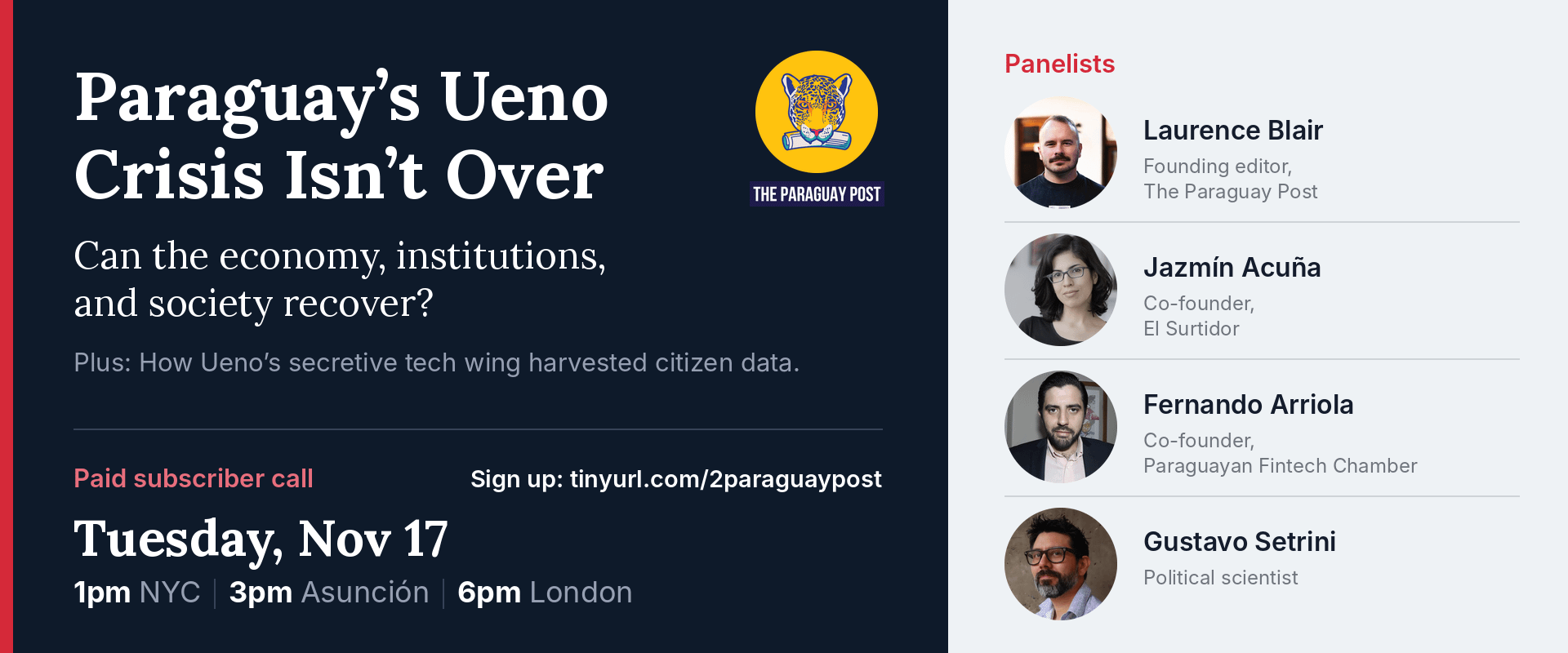
Disagree with my take? Register for our paid subscriber call tomorrow and tell me what you think.