


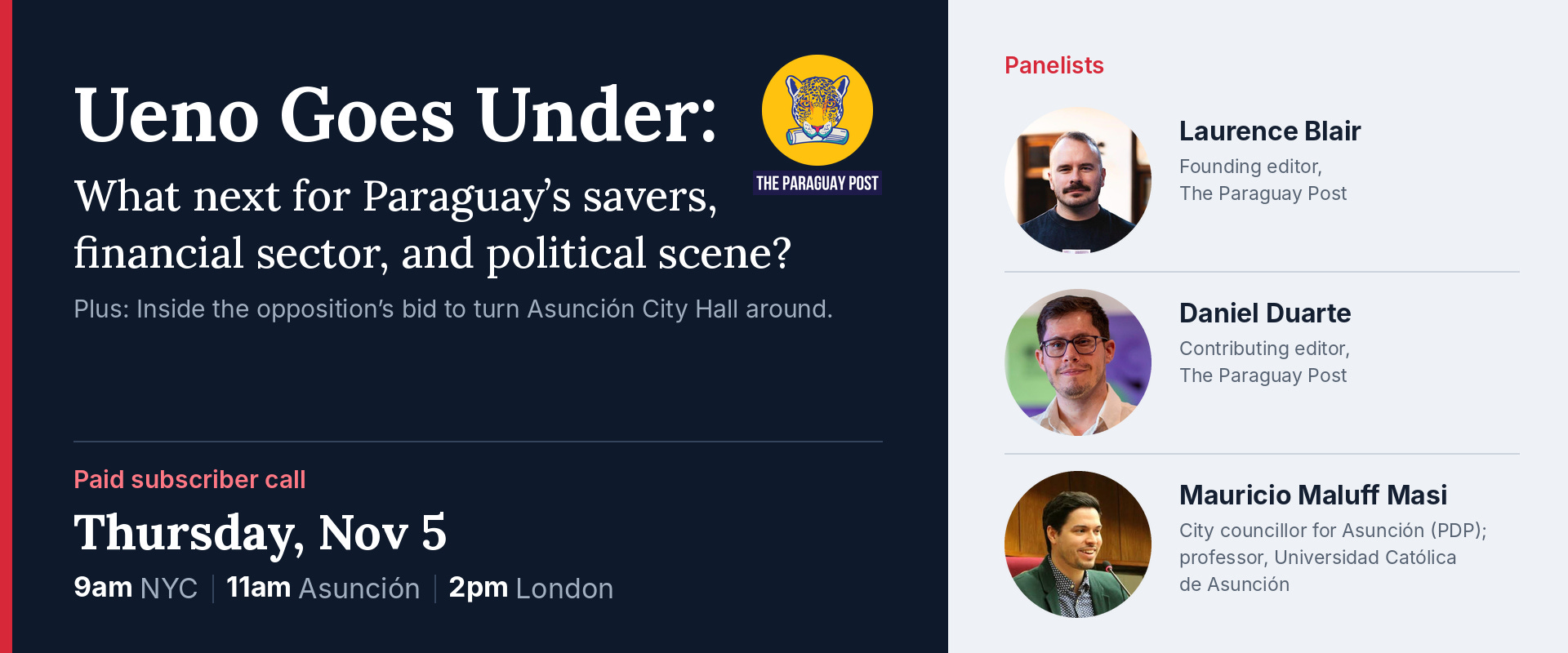
DIAL IN: Tomorrow, 5 November at 11am Paraguay time, we’ll be holding our first quarterly call for paid subscribers.
We’ll discuss the collapse of Ueno bank, what it means for the banking system, whether Santiago Peña could be impeached, and the future of Asunción under its new mayor.
Scroll down for sign-up details.
There’s a saying in South America: Brazil is not for beginners.
The continent-sized country is so complex, the twists and turns of its news cycle so unexpected, that the wise warn against hot takes and simplistic judgements.
We have our own version: Paraguay is only for professionals.
This is Latin America’s fastest-growing non-oil economy, where poverty has halved since the millennium, but education and corruption indicators are among the world’s worst.
A haven for expatriates, with a record 50,000 residency requests in the first ten months of this year, but where scams and frauds are commonplace.

A tiny nation by population — just over six million, if you trust the latest census — but with hydroelectricity, foodstuffs and critical minerals to spare, and whose relationship with the US, Israel and Taiwan give it leverage far beyond its size.
And an investors’ darling, with record $1.1bn in FDI in 2025 — but where just yesterday the country’s fastest-growing bank was seized by regulators, its bosses hooded and handcuffed by police, and bundled to a high-security jail, and 2.9 million people frozen out of their accounts until who knows when.

Following our English-language exclusive that broke the news of Ueno’s implosion yesterday, we’ll be discussing the fallout and taking questions on a call tomorrow, exclusively for our paid subscribers.
Joining me are The Paraguay Post’s contributing editor Daniel Duarte, as well as Mauricio Maluff Masi, a professor at the Universidad Católica who took office as a city councillor yesterday, and is one of the opposition’s new leading lights.
Scroll down below the paywall to sign up.
But I also want to take this moment to explain to readers old and new who we are, what we do, and how we help you navigate this complicated moment for Paraguay.
Who we are
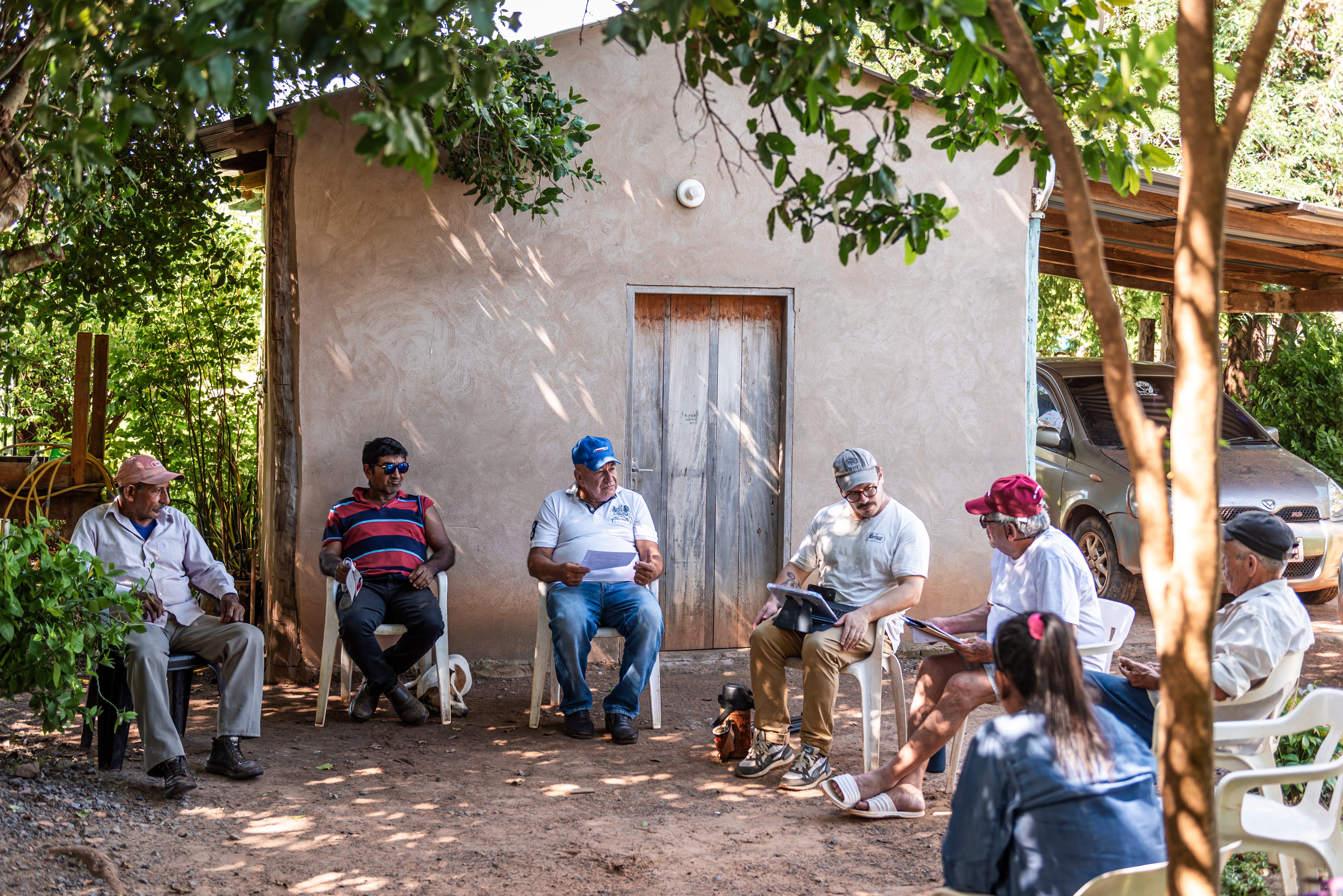
I’m Laurence Blair, a British foreign correspondent who has covered Paraguay and Latin America for nearly 12 years for outlets like The New York Times, the BBC, CNN and The Economist.
Based in Asunción, I live and breathe Paraguay.
But I’m often frustrated by how little reliable information there is out there about the place I call home.
My colleagues who sometimes write about Paraguay from Buenos Aires, Madrid or São Paulo do a fine job, but are stretched too thin covering their own patches. They can only rarely capture the nuances of what happens here.
Social media is dominated by blowhards selling residency packages and real estate. Paraguay’s press, with a few honourable exceptions, is controlled by corporations. There are few spaces for quality, insightful reporting to flourish.
That’s why, two years ago, I formed a crack team of local writers, photographers, and editors, and founded The Paraguay Post.
What we do
We bring you the broader picture the local corporate press doesn’t publish, the eyewitness perspectives AI can’t scrape, and the sleeper stories off the radar of international media.
We read the newspapers, press releases, official documents, and academic journals. We scan WhatsApp groups, Facebook forums, Instagram footage, and even LinkedIn posts.
We call sources, check details, and draw on our years of experience investigating and explaining Paraguay.
Above all, we go out and speak to people: government officials, law enforcement, business owners, Indigenous communities, landless activists, artists, architects, and many more.
We then synthesise and summarise, drawing out what really matters: for politics and policy, geopolitics, the economy, business, expat living, culture, climate and nature, and more.
And we deliver that directly to your email inbox in a jargon-free briefing called The Weekly Post.
All that, from just US$5 a month.
Why we’re writing to you now
If you subscribed for free at the start of the year, you’ve received 50,000 words of The Weekly Post with zero charge.
More importantly: you’ve missed another 50,000 words of insight and analysis behind the paywall.
If you’ve subscribed since day one — kudos to the real ones — you can double those figures.
By now, we think our work speaks for itself. But so does our list of paid subscribers: G7 embassies and foreign offices, banks and credit ratings agencies, investors and CEOs, top academics and analysts. Here’s what they say:
”Provides an indispensable tool for anyone seeking to navigate the complex Paraguayan political context. Highly recommend” — Diplomat, G7 Embassy in Paraguay
“Has access to an excellent range of sources across key sectors in Paraguay, and delivers nuanced insights into key risks and areas of interest in a timely and discreet manner. These insights help drive informed decisions by investors” — Latin America Lead, due diligence firm
“Unique, on-the-ground perspectives on Paraguayan politics and economics … fills in a crucial market gap on one of South America’s fastest-growing economies” — Economist, World Bank
People here in Paraguay have also recognised our work.
Last year, we won a National Environmental Journalism Prize for our investigation into narcotrafficking, poverty and conservation in the Mbaracayú Forest Reserve.

Just last week, The Paraguay Post picked up another journalism award for our story on criadazgo, a traditional practice that sees thousands of kids, mainly girls, work without pay in other people’s homes.

We’ve also gone inside a controversial colony of European anti-vaxxers called El Paraíso Verde, followed the route of Paraguay’s former (and future?) railway, accompanied the search for those disappeared by the Stroessner dictatorship, delved into Asunción’s nightlife and restaurants, and much more besides.
In the process, we have nurtured and published dozens of local journalists. That kind of public-interest reporting will keep being free to read, even as we strongly encourage you to support it.
Upgrade now to lock in great value
But from next week, all of The Weekly Post will sit behind the paywall.
We think that’s fair: our analysis provides huge value. And it’s a reflection of what makes us a trusted source: we don’t take advertising, rely on institutional grants, do paid content or publish AI slop.
We’re funded by readers like you. And we need hundreds more to step up so we can become sustainable.
As the banking system trembles, criminal gangs expand, and the ruling party fragments ahead of pivotal elections in 2028, now is the time to get clued up on Paraguay.
As a paid subscriber, you’ll unlock everything we’ve published, enjoy money off your bill at top bars, restaurants and cafés in Asunción, access our new quarterly call — the first is tomorrow — and get perks at our occasional live events.
SPECIAL OFFER: Lock in today’s low price for as long as you subscribe, and get your first month free. Hurry: offer lasts one week only!
You can also purchase multiple subscriptions for friends and family at a discount.
Corporate and institutional subscribers are warmly invited to take out a Professional subscription. We’ll give you subscriptions for up to eight email addresses, and a quarterly one-on-one call to discuss whatever you want.
Below the paywall are the signup details for tomorrow’s group call on Ueno’s collapse, what it means for the banking system, whether Santiago Peña could be impeached, and the future of Asunción. Register to get access.
If you’re upgrading your subscription, head to this post in your web browser and scroll to the bottom to get the registration link.
The call will keep Chatham House rules: not on the record, with attendance kept private. There’s a lot to discuss, and we hope you can join us.
Questions? Reply to this email or write us theparaguaypost@gmail.com